A DVMS Replaces Continuous Assessment Costs with Cost-Effective, Intelligence-Driven Stewardship
Rick Lemieux – Co-Founder and Chief Product Officer of the DVMS Institute
From Compliance to Demonstrated Capability
For years, organizations have relied on Governance, Risk, and Compliance (GRC) programs and formal assessments such as CMMC, HITRUST, ISO 27001, cybersecurity audits, and ITIL reviews to demonstrate that they are “in control.” These mechanisms were designed to provide structure, comparability, and evidence that policies and controls are in place. They have served an important purpose. However, in fast-moving digital environments, the central question leaders must answer has evolved. It is no longer sufficient to prove that controls are documented and mapped into frameworks. The real question is whether the organization can create value, protect it, deliver it reliably, and adapt under stress.
A Digital Value Management System (DVMS) shifts assurance from periodic validation of paperwork to continuous demonstration of operational capability. When assurance is embedded into the operating model itself, follow-on assessments become redundant rather than essential. Compliance becomes a byproduct of discipline management, not a separate project.
DVMS as an Operating Overlay, Not Another Framework
A DVMS is not another control catalog layered on top of existing standards. It is not a replacement for ISO 27001, ITIL, CMMC, or other frameworks. Instead, it functions as an operating overlay that aligns governance, resilience, assurance, and accountability with how digital work is done.
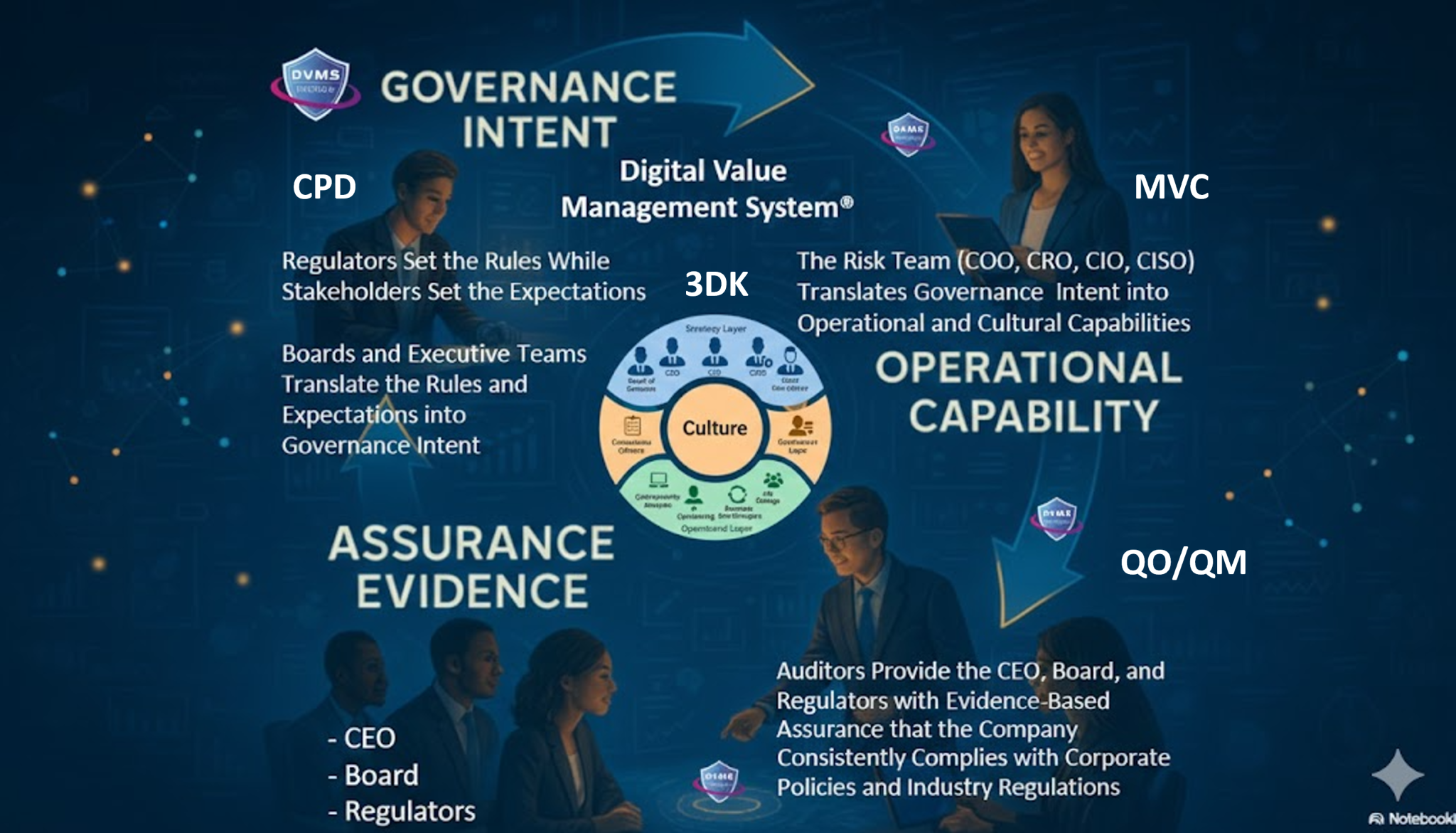
Traditional frameworks describe what “should” exist: policies, procedures, controls, and documentation. DVMS focuses on what is happening at critical operational boundaries—where value is created, where risk concentrates, and where delivery meets real-world conditions. It connects intent, capability, evidence, and learning in a continuous loop. Rather than asking whether a control exists, DVMS asks whether the capability the control was meant to enable performs under pressure.
When that shift occurs, the frameworks do not disappear. They become reference points that can be mapped to demonstrated behaviors. As a result, the need for separate, recurring assessments diminishes. The system itself generates evidence continuously.
Eliminating the Paper System Versus Living System Divide
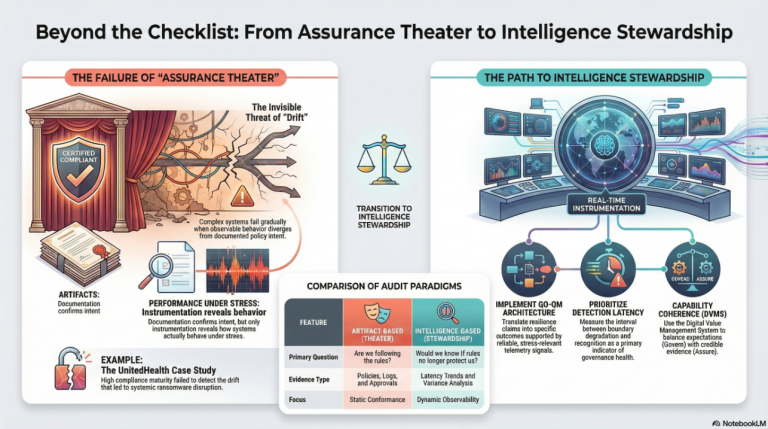
One of the fundamental weaknesses of traditional compliance regimes is the divergence between the “paper system” and the “living system.” The paper system consists of policies, standards, risk registers, and dashboards. The living system comprises real decisions made under time pressure, operational trade-offs, incident responses, and informal workarounds.
Assessments typically evaluate the paper system. They confirm that required artifacts exist and that controls are mapped to recognized frameworks. Yet many organizational failures occur not because documentation was missing, but because behavior under stress did not align with stated intent.
A DVMS closes this gap by anchoring governance in operational reality. It requires leaders to define outcomes at specific value stream boundaries and to attach meaningful measures to those outcomes. Evidence is gathered not to satisfy auditors, but to confirm that the system can detect stress early, contain failure, recover within defined limits, and learn from disruption.
When the operating system and the documented system are continuously reconciled, audits stop being discovery mechanisms. They become confirmations of what is already visible internally.
Boundary-Centered Governance Replaces Periodic Audits
At the core of DVMS is a simple but powerful discipline: focus governance at the boundaries where value is created, protected, and delivered. Every digital enterprise has such boundaries, customer authentication, payment processing, supplier onboarding, system deployment, and data exchange. These are the points where speed, risk, and reliability intersect.
Traditional assessments examine these domains in aggregate, often annually or biannually. DVMS examines them continuously. Leaders define clear outcomes for each boundary and establish measures that indicate whether the boundary is operating within acceptable limits. The emphasis shifts from checklist compliance to performance within a defined envelope of trust.
When governance operates in this way, organizations no longer need to wait for an ISO surveillance audit or a cybersecurity review to reveal weaknesses. Evidence loops are already in place. Issues are detected and addressed as part of normal operations. The system produces assurance in real time.
Minimum Viable Capabilities Replace Control Proliferation
Many organizations accumulate thousands of controls across multiple frameworks. GRC platforms are growing increasingly complex. Yet control proliferation does not guarantee operational resilience. Controls describe intended actions; capabilities reveal what the organization can do when conditions deteriorate.
A DVMS defines a set of minimum viable capabilities that must exist at every critical boundary. These capabilities span governance, assurance, planning, design, change, execution, and innovation. They represent the full lifecycle of digital work. Each capability must be expressed not merely as documentation, but as observable, testable behavior.
When these capabilities are operating effectively, they inherently satisfy the objectives embedded in ISO 27001 clauses, CMMC practices, HITRUST requirements, cybersecurity standards, and ITIL processes. Frameworks are simply different expressions of the same underlying capabilities. If the capabilities are alive and measurable, compliance follows naturally. Separate follow-on assessments add little value beyond formal recognition.
Continuous Evidence Loops Make External Validation Secondary
Traditional compliance operates on cycles: prepare, assess, remediate, certify. DVMS operates as a continuous loop: set intent, build capability, gather evidence, learn, refresh intent. Evidence is not collected for a moment in time; it is embedded in daily work. Leaders can see how boundaries perform, how incidents are handled, how exceptions accumulate or are resolved, and whether learning translates into improved behavior.
In such a system, the organization does not depend on external assessors to validate its condition. Internal visibility is stronger, timelier, and more relevant than any annual audit report. External certifications may still be pursued for contractual or regulatory reasons, but they no longer drive improvement. They simply attest to capabilities that have already been demonstrated and are observable.
This fundamentally changes the relationship between the enterprise and compliance. Compliance becomes confirmation, not discovery.
Integrating Culture into Governance
Another reason follow-on assessments become less necessary under DVMS is that culture is treated as a measurable governance dimension rather than an abstract concept. Behavior under pressure reveals whether incentives align with stated intent. Are issues escalating early? Are exceptions tracked and resolved? Do incident reviews produce durable learning? These are operational questions, not cultural slogans.
When culture is integrated into capability measurement, organizations gain insight into systemic drift before it results in failure. Traditional audits rarely capture this dimension effectively because they focus on artifacts. DVMS, by contrast, treats culture as part of the enterprise’s control surface. The living system becomes visible.
Compliance as a Byproduct, not a Goal
A mature DVMS does not eliminate regulatory obligations. Organizations operating in regulated industries must still demonstrate alignment with required standards. However, the emphasis shifts. Instead of building compliance programs and then attempting to improve operations around them, DVMS improves operations in a way that inherently satisfies compliance objectives.
When governance, resilience, assurance, and accountability are embedded in value streams, the organization continuously produces defensible evidence of capability. Mapping that evidence to ISO 27001, CMMC, HITRUST, cybersecurity, or ITIL requirements becomes a translation exercise, not a remediation effort.
This is why DVMS eliminates the need for follow-on assessments as improvement drivers. The system itself becomes an assurance engine.
Conclusion: Governing by Capability, Not Certification
Follow-on GRC, CMMC, HITRUST, cybersecurity, ISO 27001, and ITIL assessments emerged in response to a legitimate need for structure and comparability. But in modern digital enterprises, assurance must move beyond paperwork and periodic validation. A Digital Value Management System embeds governance at operational boundaries, defines minimum viable capabilities, and runs continuous evidence loops that demonstrate performance under stress.
When assurance is built into the operating model, compliance frameworks no longer serve as the primary mechanism of trust. They become reflections of an already-functioning system. Certification may still be useful, but it is no longer the source of confidence. Confidence comes from demonstrated capability—visible, measurable, and continuously improving.
In that environment, follow-on assessments are no longer the engine of governance. They are simply acknowledgments of a system that already governs itself.
About the Author

Rick Lemieux
Co-Founder and Chief Product Officer of the DVMS Institute
Rick has 40+ years of passion and experience creating solutions to give organizations a competitive edge in their service markets. In 2015, Rick was identified as one of the top five IT Entrepreneurs in the State of Rhode Island by the TECH 10 awards for developing innovative training and mentoring solutions for boards, senior executives, and operational stakeholders.
Digital Value Management System® is a registered trademark of the DVMS Institute LLC.
® DVMS Institute 2026 All Rights Reserved