The Role of the DVMS as a Continuous Learning System
Rick Lemieux – Co-Founder and Chief Product Officer of the DVMS Institute
Introduction
Artificial intelligence is fundamentally transforming the modern digital enterprise.
Organizations are increasingly operating within highly interconnected ecosystems driven by automation, real-time analytics, autonomous systems, cloud infrastructures, intelligent applications, and continuously evolving cyber-physical environments. In this new operational reality, enterprises are no longer challenged solely by technological complexity, but by the accelerating pace of change itself.
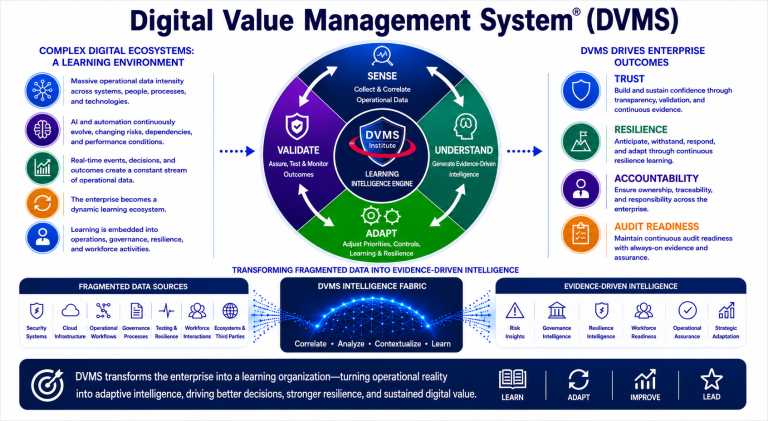
Traditional governance, management, training, and operational models were designed for environments where change occurred incrementally and systems remained relatively predictable. AI-driven digital ecosystems operate differently. They evolve continuously, adapt dynamically, and generate operational conditions that can shift in real time. As a result, the enterprise of the future must become a learning enterprise capable of continuously sensing, understanding, adapting, validating, and improving its operations.
Static governance frameworks, periodic assessments, annual training cycles, and isolated operational oversight are no longer sufficient for sustaining trust, resilience, accountability, and operational readiness. Organizations must instead develop continuous learning capabilities that integrate governance, assurance, operational telemetry, workforce readiness, resilience validation, and strategic adaptation into a unified operational intelligence system.
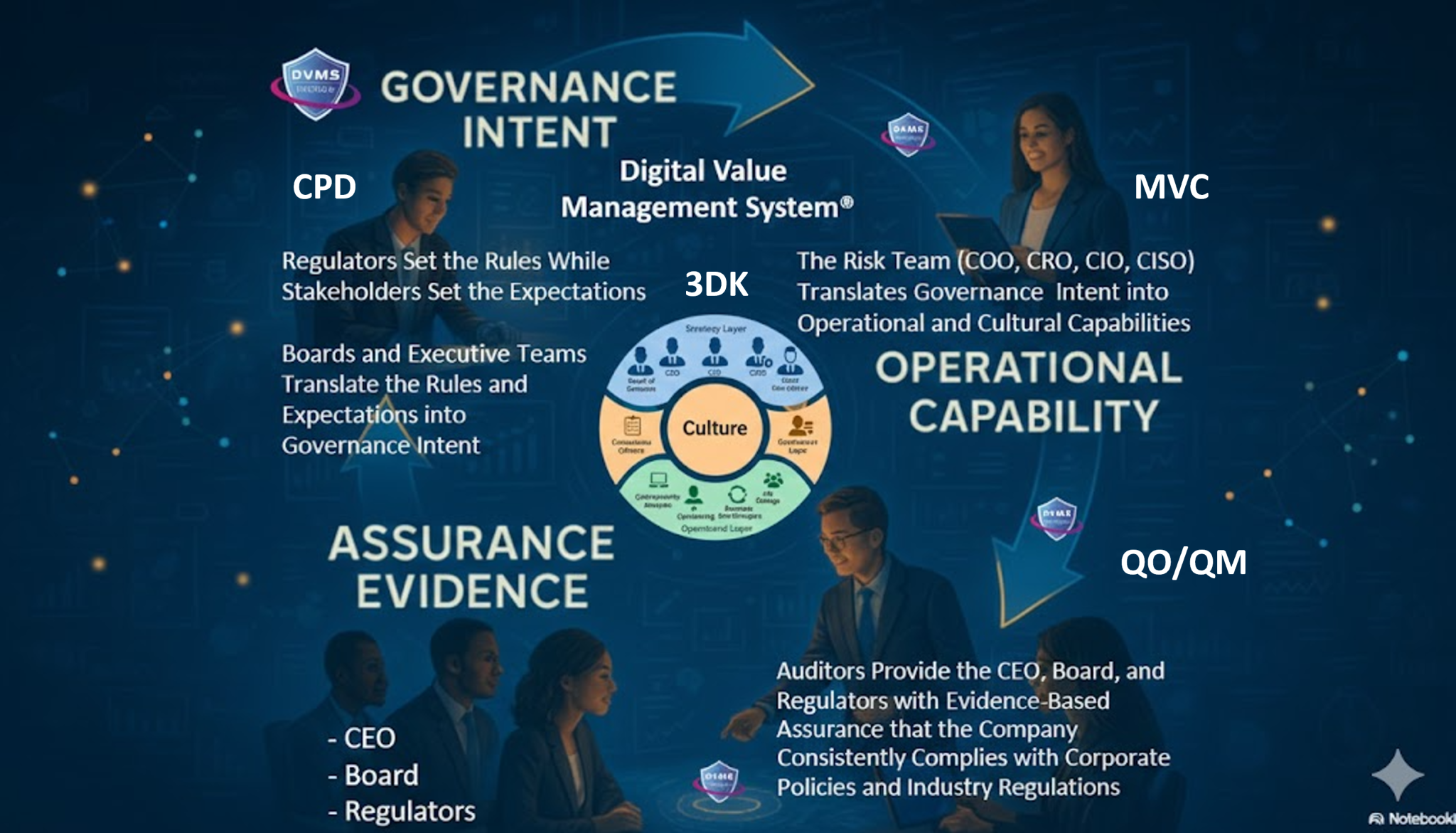
The Digital Value Management System® (DVMS) represents the emergence of this new enterprise learning architecture. As a unified governance and assurance system, the DVMS transforms fragmented operational telemetry into evidence-driven intelligence that drives trust, resilience, accountability, and continuous audit readiness across complex digital ecosystems.
More importantly, DVMS functions as a continuous enterprise learning system that enables organizations to operationalize adaptive intelligence, organizational learning, resilience evolution, and continuous operational improvement in increasingly AI-driven environments.
The AI-Driven Enterprise as a Continuous Learning Environment
The AI-driven enterprise generates enormous volumes of operational telemetry across digital systems, cloud infrastructures, security platforms, workforce interactions, business processes, autonomous applications, and external ecosystem dependencies. Every operational event, policy decision, resilience exercise, threat response, and governance action creates data that reflects the real condition of the enterprise. Historically, much of this information remained fragmented across disconnected systems, limiting organizational visibility and reducing the ability to learn from operational outcomes in real time.
Artificial intelligence amplifies this challenge because AI systems themselves continuously evolve through machine learning, adaptive automation, and autonomous decision-making. This creates operational environments where risks, dependencies, behaviors, and performance conditions are constantly changing. Organizations must therefore learn continuously to govern effectively. Learning can no longer be confined to classroom education, periodic training, or retrospective analysis. Instead, learning must become embedded directly into operational systems, governance structures, resilience processes, and workforce activities.
In this environment, the enterprise itself becomes a dynamic learning ecosystem. Operational telemetry has become a source of organizational knowledge. Governance becomes adaptive. Assurance becomes continuous. Workforce development becomes contextual and real time. Decision-making becomes evidence-driven rather than assumption-based. This is precisely the role DVMS fulfills.
DVMS as an Enterprise Learning Architecture
The Digital Value Management System functions as an enterprise learning architecture by continuously transforming operational conditions into actionable intelligence that informs governance, assurance, resilience, workforce readiness, and strategic adaptation. Unlike traditional governance systems that rely heavily on static policies, periodic assessments, and manual reporting, DVMS operates as a continuous intelligence overlay across the enterprise ecosystem.
DVMS continuously correlates operational telemetry from security systems, resilience platforms, cloud infrastructures, operational workflows, governance processes, testing environments, and workforce interactions. Through this process, the system creates evidence-driven insight into how the enterprise is performing under real-world conditions. This enables organizations not only to observe operational outcomes, but also to learn from them continuously.
The learning capability of DVMS extends beyond technical analytics. It enables enterprises to identify emerging operational risks, governance gaps, workforce deficiencies, resilience weaknesses, and systemic vulnerabilities before they escalate into disruptive events. The system continuously adapts governance priorities, operational assurance activities, resilience exercises, and training interventions based on live operational evidence. As a result, the enterprise evolves dynamically alongside changing operational conditions rather than relying on static assumptions or outdated governance models.
In this sense, DVMS transforms organizational learning from a reactive administrative process into a continuously operating intelligence capability embedded directly within the enterprise ecosystem.
Continuous Adaptive Workforce Learning
One of the most important roles DVMS plays within the AI-driven enterprise is enabling continuous adaptive workforce learning. Traditional workforce training models are largely compliance-driven and periodic in nature. Employees often complete standardized annual training programs disconnected from real operational conditions and emerging organizational risks. These approaches are increasingly ineffective in AI-driven environments where threats, technologies, and operational dependencies evolve continuously.
DVMS changes this model by enabling telemetry-driven workforce readiness and adaptive learning. Operational telemetry, governance indicators, resilience conditions, assessment results, testing outcomes, and workforce performance metrics continuously inform training priorities and learning interventions. Learning becomes contextualized to real enterprise conditions rather than generic educational requirements.
For example, if operational telemetry reveals repeated cloud security misconfigurations, DVMS can trigger targeted role-specific training aligned directly to the identified operational risk. If resilience exercises reveal coordination weaknesses during simulated disruptions, the system can dynamically recommend adaptive learning modules, operational guidance, and resilience exercises tailored to affected teams. Governance violations, policy failures, operational anomalies, or AI decision inconsistencies can similarly trigger contextual learning activities tied directly to enterprise conditions.
This creates a continuous operational learning loop where the organization learns directly from its own operational behavior, resilience conditions, and governance outcomes. Workforce development therefore becomes operationally integrated, evidence-driven, and continuously adaptive.
DVMS and Organizational Resilience Learning
Resilience in AI-driven enterprises cannot remain static. Modern digital ecosystems are too interconnected, dynamic, and adaptive for organizations to rely solely on predefined continuity plans or periodic resilience exercises. Enterprises must continuously learn from disruptions, simulations, operational stress conditions, governance failures, and ecosystem dependencies to improve resilience over time.
DVMS enables this capability by continuously integrating resilience telemetry, operational testing results, incident data, governance indicators, and performance outcomes into a unified intelligence environment. This allows organizations to identify resilience trends, emerging vulnerabilities, operational dependencies, and adaptive response patterns across the enterprise ecosystem.
Importantly, DVMS enables organizations not only to recover from disruptions, but also to evolve because of them. Every operational event becomes a learning opportunity that strengthens governance maturity, operational awareness, workforce readiness, and resilience capability. This transforms resilience from a reactive recovery function into a continuously advancing enterprise learning discipline.
In AI-driven environments where operational conditions evolve rapidly, this continuous resilience learning capability becomes essential for sustaining trust and operational continuity.
Governance as a Continuous Learning Function
Traditional governance models are often based on periodic reviews, static controls, annual audits, and retrospective reporting. These approaches assume operational stability and predictable change cycles. AI-driven enterprises do not operate under these conditions. Governance must therefore evolve into a continuous adaptive intelligence function capable of learning from operational reality in real time.
DVMS operationalizes this transformation by converting fragmented operational telemetry into evidence-driven governance intelligence. Governance decisions become continuously informed by live operational conditions, resilience indicators, workforce readiness metrics, testing outcomes, and ecosystem-wide telemetry correlations. This enables organizations to govern based on continuously validated operational evidence rather than isolated reports or delayed assessments.
As AI systems become more autonomous, governance learning becomes even more critical. Enterprises must continuously validate AI behaviors, monitor algorithmic outcomes, assess governance effectiveness, and adapt oversight mechanisms as operational conditions evolve. DVMS provides the intelligence framework necessary to support this adaptive governance model.
In this sense, governance itself becomes a learning system continuously informed by operational evidence and ecosystem feedback.
Conclusion
The AI-driven digital enterprise requires far more than traditional governance systems, periodic workforce training, or isolated operational oversight. It requires continuous enterprise learning architecture capable of adapting alongside evolving technologies, operational conditions, cyber threats, resilience challenges, and organizational dependencies. In increasingly autonomous and interconnected digital ecosystems, organizations must continuously learn to sustain trust, resilience, accountability, and operational readiness.
The Digital Value Management System® (DVMS) represents the emergence of this new enterprise learning paradigm. By transforming fragmented operational telemetry into evidence-driven intelligence, DVMS enables organizations to continuously govern, assure, learn, adapt, and improve across complex digital ecosystems. Its unified overlay architecture integrates governance, assurance, resilience validation, operational intelligence, workforce readiness, and adaptive learning into a continuously operating intelligence environment.
As artificial intelligence continues to accelerate digital transformation, the enterprises that succeed will not simply be the most automated or technologically advanced. They will be the organizations most capable of learning continuously from operational reality and adapting intelligently to changing conditions. DVMS provides the foundational governance and assurance learning system necessary to enable this future.
About the Author

Rick Lemieux
Co-Founder and Chief Product Officer of the DVMS Institute
Rick has 40+ years of passion and experience creating solutions to give organizations a competitive edge in their service markets. In 2015, Rick was identified as one of the top five IT Entrepreneurs in the State of Rhode Island by the TECH 10 awards for developing innovative training and mentoring solutions for boards, senior executives, and operational stakeholders.
Digital Value Management System® is a registered trademark of the DVMS Institute LLC.
® DVMS Institute 2026 All Rights Reserved