The Illusion of Control in Modern Enterprises
Rick Lemieux – Co-Founder and Chief Product Officer of the DVMS Institute
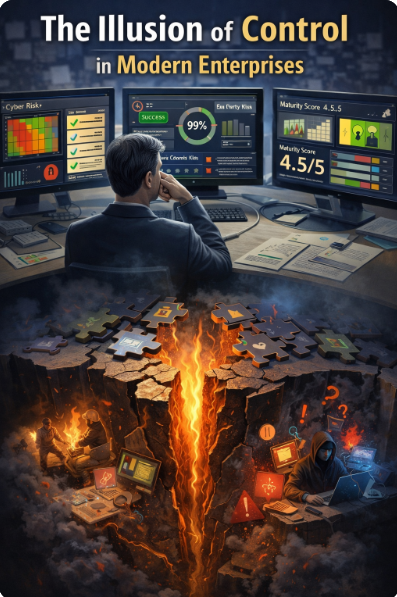
Most GRC, ITSM, and cybersecurity platform companies promise visibility, control, and confidence amid growing digital complexity. Their marketing emphasizes dashboards, heatmaps, workflows, and maturity scores that suggest organizations can be managed through structured data and standardized processes. Yet many executives and practitioners experience a persistent gap between what these platforms report and how their organizations behave under pressure. Incidents recur, risks emerge unexpectedly, and cultural or coordination failures undermine otherwise well-designed controls. The core problem is that most platforms are built to manage artifacts and abstractions, not the living system of people, processes, and technologies that produce real outcomes.
Platforms Optimized for Frameworks, Not Systems
A fundamental limitation of most GRC, ITSM, and cybersecurity platforms is that they are optimized around frameworks rather than systems. They encode standards such as NIST, ISO, COBIT, ITIL, or regulatory requirements into catalogs of controls, processes, and assessments. This approach helps organizations demonstrate alignment and compliance, but it assumes that faithfully implementing the framework’s elements leads to the desired behavior. Frameworks are static representations of good practice, while organizations are dynamic systems shaped by competing priorities, local adaptations, and human judgment. Platforms that mirror frameworks tend to reinforce a checklist mentality, where success is measured by completion and coverage rather than by how the system responds to stress, change, and uncertainty.
Fragmentation by Design
Most platforms reflect the same functional silos that exist within organizations. GRC tools focus on risks, controls, audits, and issues. ITSM platforms concentrate on incidents, changes, and service levels. Cybersecurity platforms emphasize threats, vulnerabilities, and detections. Each domain is internally coherent, but the boundaries between them are rigid. As a result, leadership intent, structural design, and operational behavior are captured in different systems, using different vocabularies, metrics, and cadences. The organization’s reality, however, unfolds across these boundaries, especially within end-to-end value streams. When platforms cannot natively connect these perspectives, leaders are left to mentally integrate fragmented views, relying on experience and intuition rather than shared, system-level insight.
Static Models in a Dynamic World
Another core issue is that most platforms rely on static or slowly changing models of the organization. Risk registers, control libraries, service catalogs, and asset inventories are periodically updated snapshots. They struggle to represent how workflows, how decisions are made in real time, or how priorities shift under pressure. Complex systems, by contrast, are defined by interactions and feedback loops that evolve continuously. Behavior changes in response to incentives, leadership signals, workload, and external events. Platforms that treat the organization as a stable structure miss these dynamics, leading to a false sense of predictability and control. When reality diverges from the model, the divergence often only becomes apparent after failure.
Overemphasis on Process Compliance
GRC, ITSM, and cybersecurity platforms typically assume that process compliance is the primary driver of good outcomes. Workflows are designed to ensure approvals are obtained, steps are followed, and evidence is captured. While process discipline is important, it is not sufficient in complex environments where judgment, trade-offs, and improvisation are unavoidable. People routinely encounter situations that fall between defined processes, or following the process exactly would create worse outcomes. Platforms rarely capture these moments or treat them as valuable signals about system health. Instead, deviations are logged as exceptions or noncompliance, reinforcing a gap between formal processes and lived reality.
Neglect of Leadership Signals and Incentives
One of the most significant blind spots in most platforms is leadership behavior. What leaders emphasize, reward, tolerate, or ignore has a profound impact on how systems operate. Yet leadership signals are largely invisible in GRC, ITSM, and cybersecurity tools. Strategies, narratives, and implicit priorities are treated as context rather than as active forces shaping risk and performance. As a result, platforms may report strong control environments while teams are simultaneously responding to conflicting messages that drive risky shortcuts or silence escalation. Without a way to surface and examine how leadership intent interacts with structures and behaviors, organizations cannot diagnose why well-designed controls are underused or bypassed.
Behavior Treated as an Output, Not an Input
Most platforms treat behavior as an outcome to be measured after the fact, rather than as a control surface. Incidents, breaches, outages, and audit findings are recorded and analyzed retrospectively. Culture surveys may be appended as separate artifacts. What is missing is a continuous view of how people make decisions, communicate concerns, and coordinate across boundaries in real time. Behavior is where risk materializes, and resilience is tested, yet platforms struggle to represent it beyond lagging indicators. This reinforces a reactive posture, where learning happens after harm rather than as part of ongoing system awareness.
Misaligned Metrics and Local Optimization
Platform-driven metrics often encourage local optimization at the expense of system performance. Risk scores, SLA compliance, mean time to resolve, vulnerability counts, and audit closure rates each make sense within their own domain. However, when teams are incentivized to optimize these metrics independently, the overall system can become more brittle. For example, pressure to meet delivery timelines may discourage risk escalation, while aggressive incident-closure targets may reduce learning. Platforms rarely make these trade-offs visible because they lack a shared model of value streams and cross-functional dependencies. The result is a system that appears efficient and controlled in parts, but fragile.
Tool-Centered Rather Than Work-Centered Design
Many platforms are designed around what is easy to configure and sell rather than around how work happens. They assume linear processes, clear ownership, and stable boundaries. In practice, modern organizations rely on informal coordination, temporary teams, suppliers, and digital ecosystems that defy neat categorization. When tools force work to conform to their models, people create workarounds, parallel systems, or shadow processes. These adaptations are rational responses to tool limitations, but they further reduce visibility and trust in the reported data. Platforms end up documenting an idealized version of work rather than supporting the messy reality that produces value.
The Absence of System-Level Sensemaking
At their core, most GRC, ITSM, and cybersecurity platforms are record-keeping and workflow engines, not sensemaking tools. They collect and organize information but provide limited support for understanding how patterns emerge across leadership, structure, and behavior. Dashboards summarize indicators, but they rarely help users ask better questions about why the system behaves as it does. Complex systems require shared language, contextual interpretation, and ongoing dialogue. Without these capabilities, platforms reinforce reporting upward rather than learning across the system.
Toward Capabilities That Match Complexity
The reason most platform companies fall short is not a lack of sophistication or effort, but a mismatch between their underlying assumptions and the nature of complex socio-technical systems. Managing people, processes, and technologies requires capabilities that integrate intent, structure, and behavior around real value streams, over time. It requires tools that support learning, adaptation, and judgment, not just compliance and automation. Until platforms shift from managing artifacts to enabling system-level understanding and action, organizations will continue to invest heavily in tools that provide confidence on paper while leaving the real system only partially seen and poorly governed.
The DVMS as a System-Level Response
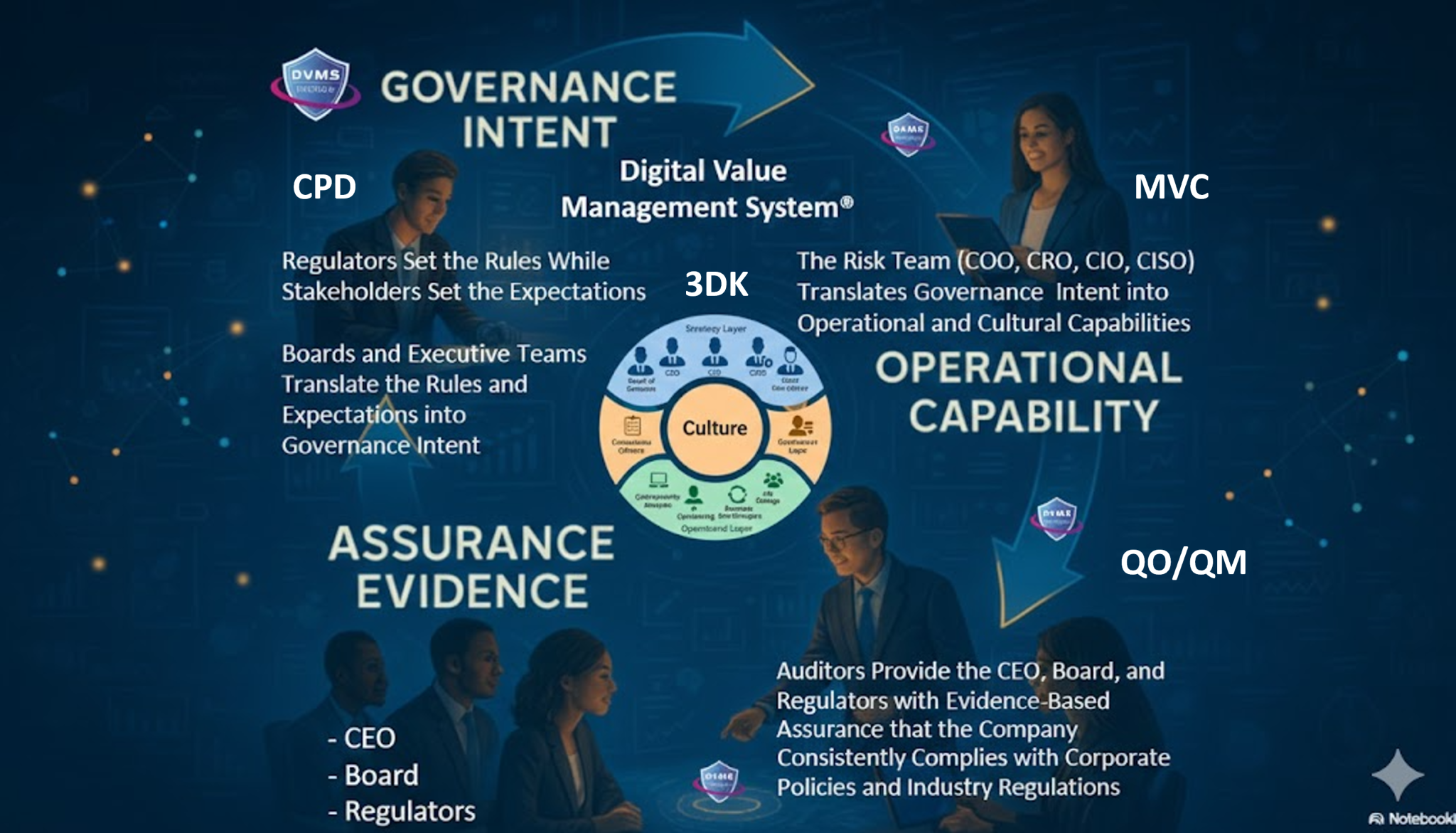
The Digital Value Management System (DVMS) addresses these shortcomings by starting from a fundamentally different premise: organizations must be understood and governed as living systems, not as collections of controls, tickets, or risk statements. Rather than centering on frameworks or tools, the DVMS focuses on shared, minimum viable capabilities that anchor leadership intent, structural design, and real behavior around actual value streams. It provides a common language that allows executives, GRC, IT, security, and operations to see how decisions, constraints, and human responses interact in practice, especially under stress and change. By integrating governance, resilience, assurance, and accountability into a single system view, the DVMS enables sensemaking rather than just reporting, helping organizations intervene where misalignment truly exists—whether in leadership signals, structural design, or behavioral norms—and thereby turning GRC from a retrospective compliance exercise into an active capability for steering complex digital systems.
About the Author

Rick Lemieux
Co-Founder and Chief Product Officer of the DVMS Institute
Rick has 40+ years of passion and experience creating solutions to give organizations a competitive edge in their service markets. In 2015, Rick was identified as one of the top five IT Entrepreneurs in the State of Rhode Island by the TECH 10 awards for developing innovative training and mentoring solutions for boards, senior executives, and operational stakeholders.
Digital Value Management System® is a registered trademark of the DVMS Institute LLC.
® DVMS Institute 2026 All Rights Reserved