ITIL®, DevOps®, NIST CSF 2.0, and DVMS®: Powering a Cohesive Operating Model for Modern Digital Enterprises
Rick Lemieux – Co-Founder and Chief Product Officer of the DVMS Institute
The Evolution of Digital Enterprise Governance
Modern organizations operate in an environment where digital systems have become the primary means of creating, protecting, and delivering value. Customers expect seamless experiences, regulators demand greater accountability, cyber threats continue to evolve, and competitive pressures require organizations to innovate at unprecedented speed. In this environment, success depends on an organization’s ability to balance agility, operational stability, cybersecurity, and governance.
Historically, organizations addressed these challenges through separate disciplines. ITIL provided structured service management practices to ensure operational reliability. DevOps emerged to accelerate software delivery and foster collaboration between development and operations teams. The NIST Cybersecurity Framework (CSF) established a common language for managing cybersecurity risk and improving organizational resilience. While each framework addresses a critical aspect of digital operations, organizations often struggle when these disciplines operate independently.
The Digital Value Management System® (DVMS®) addresses this challenge by providing an evidence-driven governance system that integrates and governs these complementary frameworks. Rather than treating service management, cybersecurity, delivery, and governance as separate functions, DVMS creates a unified operating model that aligns activities, accountability, and outcomes across the enterprise.
ITIL as the Foundation for Service Reliability
ITIL remains one of the most widely adopted frameworks for IT service management because it provides structured practices for delivering reliable and predictable services. Through capabilities such as incident management, problem management, change enablement, service continuity, and service level management, ITIL helps organizations maintain operational stability and improve service quality.
The strength of ITIL lies in its ability to create repeatable processes that reduce operational uncertainty and improve consistency. Organizations that effectively implement ITIL are better positioned to manage service disruptions, control operational risks, and ensure that technology services support business requirements.
However, modern digital enterprises require more than stability. While ITIL provides structure, organizations must also adapt rapidly to changing customer expectations, emerging technologies, and evolving market conditions. This need for speed and adaptability led to the emergence of DevOps.
DevOps as the Engine of Innovation and Agility
DevOps transformed software delivery by breaking down traditional barriers between development and operations teams. Through automation, collaboration, continuous integration, continuous delivery, and infrastructure-as-code, DevOps enables organizations to accelerate innovation while improving reliability and quality.
Rather than treating development, testing, security, and operations as separate activities, DevOps integrates them into a continuous delivery pipeline. This approach allows organizations to release new capabilities more frequently, identify defects earlier, and respond more quickly to changing business needs.
DevOps enables organizations to move faster, but speed alone is not enough. Rapid delivery must be balanced with security, risk management, and governance. Without appropriate oversight, organizations can inadvertently increase operational risk while pursuing agility. This challenge highlights the importance of cybersecurity governance.
NIST CSF 2.0 as the Cybersecurity Governance Framework
As cyber threats become increasingly sophisticated, organizations require a comprehensive approach to managing cybersecurity risk. The NIST Cybersecurity Framework (CSF) 2.0 provides a flexible and outcome-focused framework for establishing cybersecurity governance and resilience.
NIST CSF 2.0 organizes cybersecurity activities around six core functions: Govern, Identify, Protect, Detect, Respond, and Recover. The addition of the Govern function in version 2.0 reinforces the importance of leadership accountability, risk management, and organizational oversight in achieving cybersecurity objectives.
The framework helps organizations identify critical assets, manage cyber risks, establish protective controls, detect threats, respond effectively to incidents, and recover from disruptions. More importantly, NIST CSF provides a common language that enables executives, technology leaders, risk professionals, and regulators to communicate effectively about cybersecurity performance.
While the NIST CSF establishes cybersecurity objectives and governance expectations, organizations still need a mechanism to continuously demonstrate that these objectives are being achieved. This is where DVMS provides unique value.
DVMS as the Governance and Assurance Layer
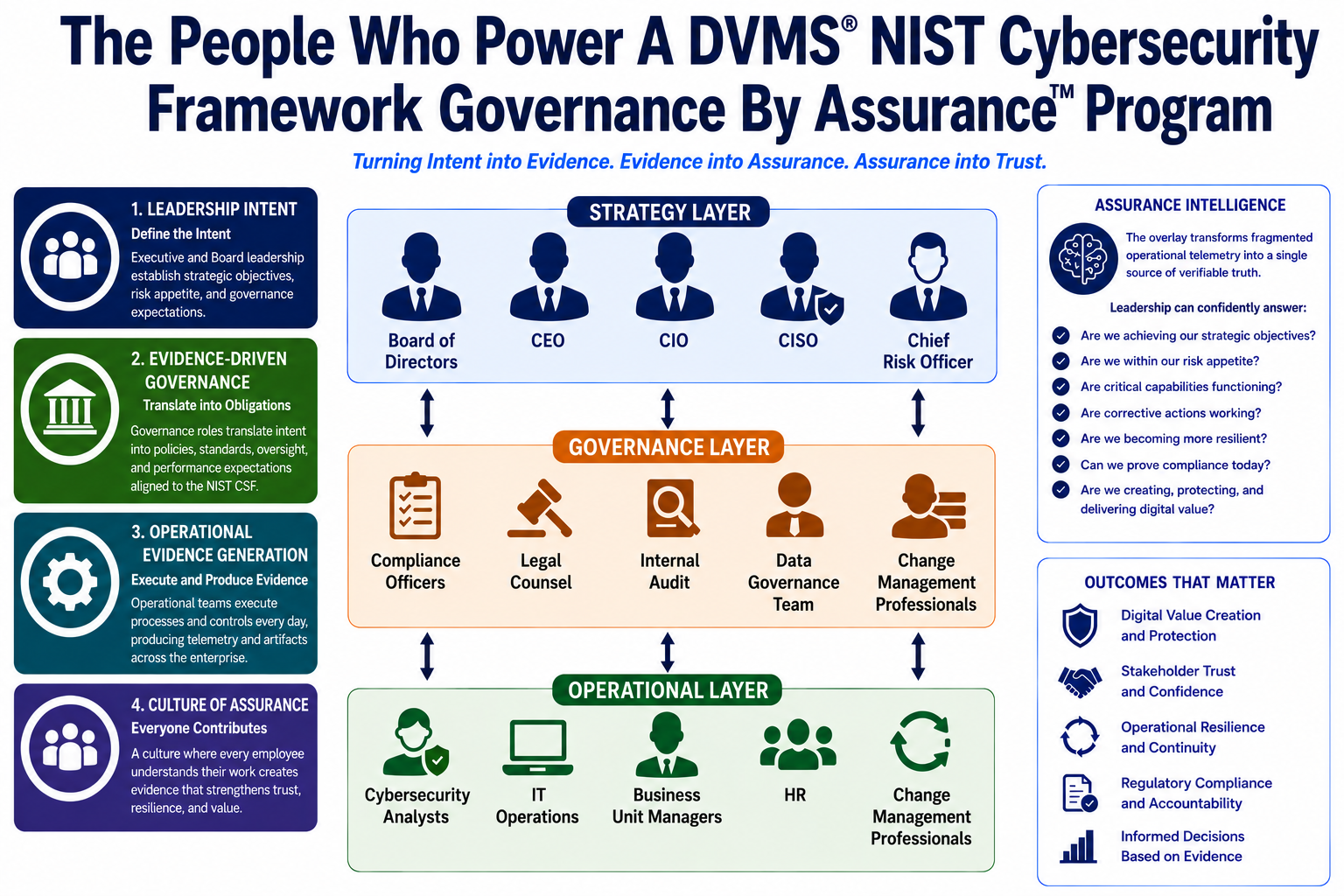
The Digital Value Management System® serves as the governance and assurance layer that integrates ITIL, DevOps, and NIST CSF into a coherent enterprise operating model.
Unlike traditional governance approaches that rely on periodic assessments, manual reporting, and retrospective audits, DVMS operates continuously. It captures evidence from operational activities, cybersecurity controls, service management processes, and delivery pipelines to provide real-time visibility into organizational performance.
DVMS enables organizations to establish clear accountability for outcomes, define measurable objectives, and continuously validate whether those objectives are being achieved. By connecting governance directly to evidence, organizations can move beyond assumptions and gain confidence in the performance of the people, processes, and technologies that create, protect, and deliver digital value.
Rather than replacing ITIL, DevOps, or NIST CSF, DVMS governs their integration. It provides the structure through which service management, delivery practices, and cybersecurity activities can be aligned to common organizational objectives and measured against desired outcomes.
Creating a Unified Digital Governance Model
When integrated through DVMS, ITIL, DevOps, and NIST CSF become complementary components of a unified digital governance model.
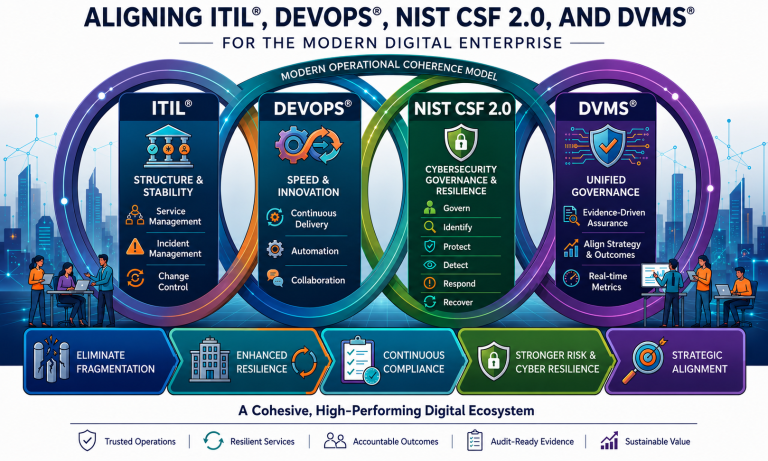
ITIL provides the operational discipline necessary to maintain service stability and continuity. DevOps provides the agility and automation required to accelerate innovation and value delivery. NIST CSF provides the cybersecurity governance framework needed to manage risk and strengthen resilience. DVMS provides the evidence-driven governance system that aligns these activities with organizational commitments and continuously assures performance.
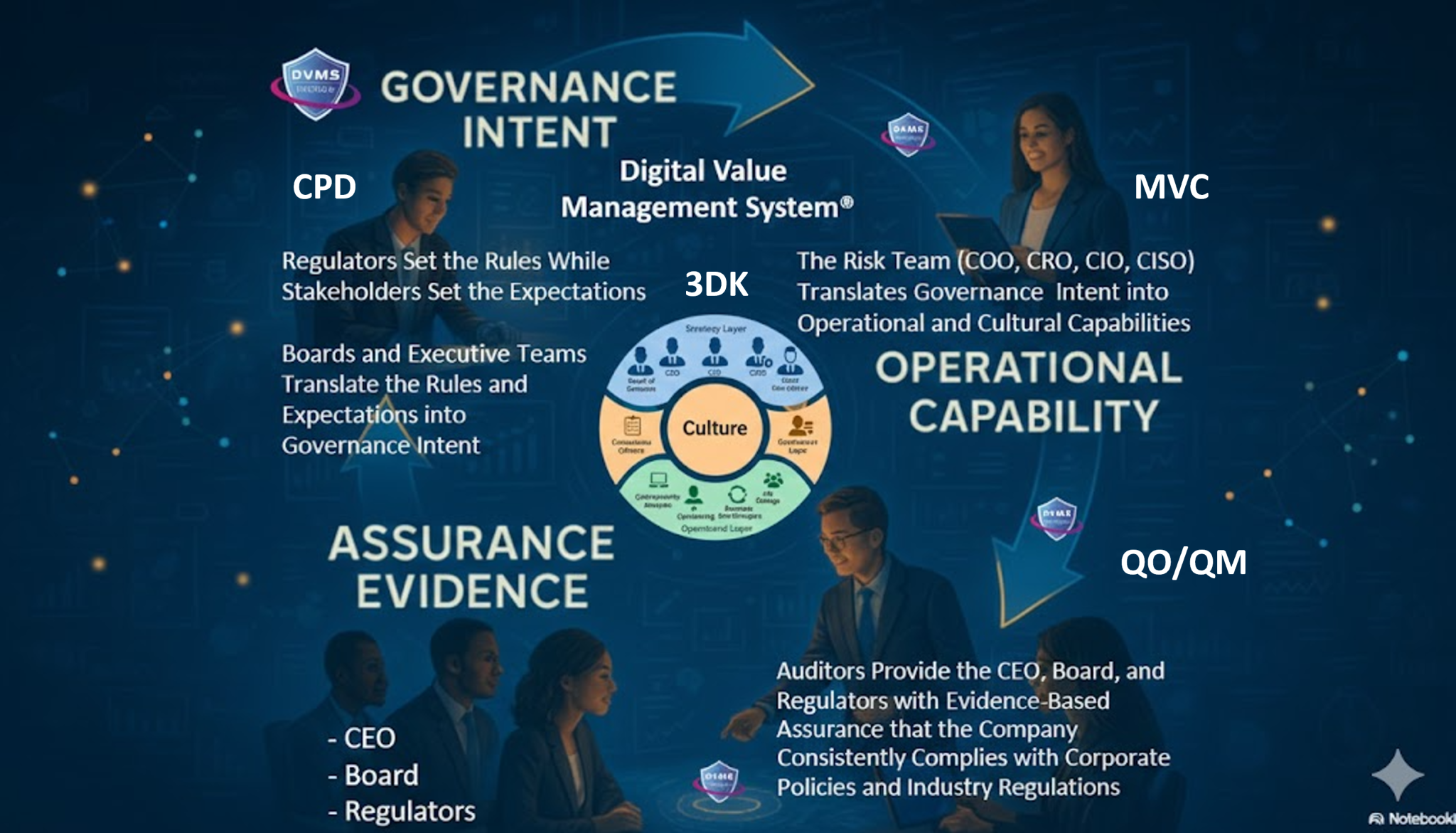
In this integrated model, ITIL processes become embedded within DevOps workflows. Security controls aligned with NIST CSF are incorporated into delivery pipelines and operational procedures. Evidence generated through these activities is continuously captured and evaluated through DVMS, creating a closed-loop governance system that supports transparency, accountability, and continuous improvement.
The result is a single source of truth for organizational performance, risk, resilience, and value delivery.
Advancing Trust, Resilience, and Accountability
One of the most significant advantages of integrating ITIL, DevOps, NIST CSF, and DVMS is the ability to continuously strengthen trust, resilience, and accountability.
Trust is established when organizations can consistently demonstrate that systems operate as intended and commitments are being fulfilled. Resilience is strengthened when organizations can anticipate, withstand, and recover from disruptions. Accountability is achieved when responsibilities are clearly defined, and performance can be objectively measured and verified.
Through continuous evidence collection and assurance, DVMS enables organizations to demonstrate that service management processes are functioning effectively, cybersecurity controls are operating as intended, and delivery practices are producing desired outcomes. This capability transforms governance from a periodic review activity into a continuous organizational competency.
The Future of Digital Governance
The future of digital enterprise management will not be defined by isolated frameworks or disconnected operational practices. Success will depend on an organization’s ability to integrate service management, cybersecurity, delivery, and governance into a unified system that sustains performance and adapts to change.
ITIL provides the operational foundation. DevOps provides speed and innovation. NIST CSF 2.0 provides cybersecurity governance and resilience. DVMS provides the evidence-driven governance and assurance system that connects them all.
Together, these disciplines enable organizations to create, protect, and deliver digital value while continuously demonstrating that they are fulfilling their commitments to trusted, resilient, and accountable digital business outcomes. In an era defined by digital dependency, this integrated approach represents a critical capability for organizations seeking to achieve sustainable performance, regulatory confidence, and long-term stakeholder trust.
About the Author

Rick Lemieux
Co-Founder and Chief Product Officer of the DVMS Institute
Rick has 40+ years of passion and experience creating solutions to give organizations a competitive edge in their service markets. In 2015, Rick was identified as one of the top five IT Entrepreneurs in the State of Rhode Island by the TECH 10 awards for developing innovative training and mentoring solutions for boards, senior executives, and operational stakeholders.
Digital Value Management System® is a registered trademark of the DVMS Institute LLC.
® DVMS Institute 2026 All Rights Reserved