Why Organizations Continue to Operate without a Unified Plan for Cyber Governance, Resilience, Assurance, and Accountability

Share This Post

Why Organizations Continue to Operate without a Unified Plan for Cyber Governance, Resilience, Assurance, and Accountability

Introduction: A Governance Gap with Enterprise Consequences

Despite unprecedented investment in cybersecurity, risk management, and compliance frameworks, organizations continue to face systemic failures in cyber resilience and operational assurance.

For boards, CEOs, and regulators, this gap reflects a deeper structural issue: most enterprises do not operate from a unified governance architecture capable of ensuring resilient performance under stress.

What’s missing is a holistic, adaptive, and culture-powered overlay system—a model that aligns leadership intent, operational capability, and evidence-based accountability into a single, coherent, and measurable governance system.

Fragmented Structures Prevent Unified Governance and Oversight

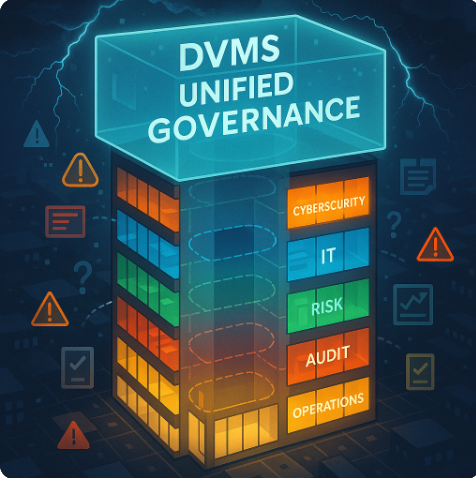
Boards and executives face an environment where cybersecurity, risk, IT operations, and business functions operate in isolation. Each domain employs its own language, metrics, and priorities, resulting in leadership lacking a unified, trustworthy view of operational resilience. These silos prevent organizations from translating governance expectations into coordinated operational outcomes. Regulators increasingly call for integrated oversight models, yet most organizations still rely on outdated structures that were never designed for modern digital dependence.

Compliance Models Create Activity, Not Resilience

A major driver of organizational vulnerability is the overreliance on compliance frameworks as a substitute for effective governance. Frameworks such as NIST, ITSM, ISO, and COBIT offer critical guidance, but they are too often implemented as checklists or audit exercises. Boards receive reports indicating compliance posture—not evidence of operational performance under real conditions. This creates a dangerous illusion of security. A holistic overlay system would shift the organization from compliance activities to capability assurance, providing leaders with the evidence needed to oversee and govern cyber resilience.

Lack of Evidence-Based Assurance Undermines Leadership Confidence

Executives and directors consistently report that cyber and operational risk data is fragmented, inconsistent, or unactionable. Without a shared definition of assurance—or a system to produce reliable evidence of performance—leadership cannot validate whether the enterprise is truly resilient. Regulators face the same challenge: compliance artifacts do not reveal whether systems and teams can perform under stress. This absence of evidence is one of the clearest indicators of why organizations have yet to adopt a modern governance overlay system.

Cultural Misalignment Blocks Accountability and Resilient Behavior

True resilience is not purely technical—it is a cultural phenomenon. Yet most organizations still operate under models of fear, blame, and siloed ownership. Such environments suppress transparency, limit reporting of weak signals, and discourage cross-functional collaboration.

A culture-powered governance overlay requires shared accountability, normalized learning, and evidence-based decision-making. Boards are increasingly recognizing culture as a risk factor, but organizations have yet to embed behavioral governance into their cyber resilience models. Without cultural alignment, resilience remains an aspiration rather than a measurable outcome.

Cyber Risk Is Treated as a Technical Problem, not a Systemic One

Executives and regulators often encounter a fundamental misconception: cyber resilience is not solely an IT problem. It is a business systems problem requiring integrated governance, operational capabilities, organizational behaviors, and evidence flow. However, most organizations still respond with technology investments rather than systems-based governance. This results in tool proliferation, inconsistent practices, and limited improvement in enterprise resilience. A holistic overlay system provides the architecture to govern cyber risk as part of enterprise risk—not as a technical silo.

Governance Intent Fails to Translate into Operational Execution

Leadership routinely sets expectations for cyber resilience, but few organizations have mechanisms to operationalize these expectations. Policies and strategies lack the connective tissue needed to shape real behavior, capability, and evidence. This “last mile” governance problem leaves boards uncertain whether directives are being delivered as intended. Regulators face similar concerns: requirements are issued, but evidence of execution is difficult to obtain. A unified overlay system would close this gap by ensuring governance intent cascades into measurable operational performance.

The Absence of a Learning System Prevents Adaptation

Modern cyber risk is dynamic, yet most organizations operate static governance processes. Incidents, near misses, disruptions, and control failures rarely feed into an adaptive learning cycle. Without a system designed to learn, organizations repeatedly fail across business units, programs, and technology estates. Leaders cannot rely on manual, episodic reviews to achieve resilience. A culture-powered overlay system embeds continuous learning and adaptation directly into governance, strengthening resilience over time.

Conclusion: The Strategic Imperative for a Modern Governance Overlay

Organizations have not yet developed holistic, adaptive governance frameworks because current structures, cultures, and evidence-based practices are insufficient to support them. Boards and CEOs are forced to govern cyber risk and operational resilience without a unified system to translate intent into capability and evidence. Regulators continue to elevate expectations for operational resilience, yet industry responses remain compliance-driven rather than capability-driven.

A holistic, adaptive, culture-powered governance overlay system is no longer optional—it is essential infrastructure for governing modern digital enterprises. Such a system enables leadership to replace assumptions with evidence, fragmentation with unity, and static compliance with resilient performance—providing the trustworthy operational foundation that boards, executives, and regulators now require.

About the Author

Rick Lemieux
Co-Founder and Chief Product Officer of the DVMS Institute

Rick has 40+ years of passion and experience creating solutions to give organizations a competitive edge in their service markets. In 2015, Rick was identified as one of the top five IT Entrepreneurs in the State of Rhode Island by the TECH 10 awards for developing innovative training and mentoring solutions for boards, senior executives, and operational stakeholders.

Digital Value Management System® (DVMS)

An Adaptive, Culture-Powered Overlay System for Unified Governance, Resilience, Assurance, and Accountability

Digital Value Management System (DVMS) is not another framework, standard, or maturity model. It is a Culture-Powered Governance Overlay System that aligns leadership, operations, and business teams around a single purpose of creating, protecting, and delivering digital value.

Where most organizations struggle with fragmented systems, competing priorities, and siloed accountability, a DVMS introduces a unifying model that connects governance, resilience, assurance, and accountability into one integrated digital value management operating system.

Rather than adding more complexity, a DVMS amplifies the value of existing investments in ITSM, GRC, Cybersecurity, and AI by turning them into a coordinated resilience and assurance engine. It enables leaders to see, in real time, whether the business is working as intended—and whether the risks that matter most are being managed proactively.

At the core of the DVMS is a simple but powerful integration of:

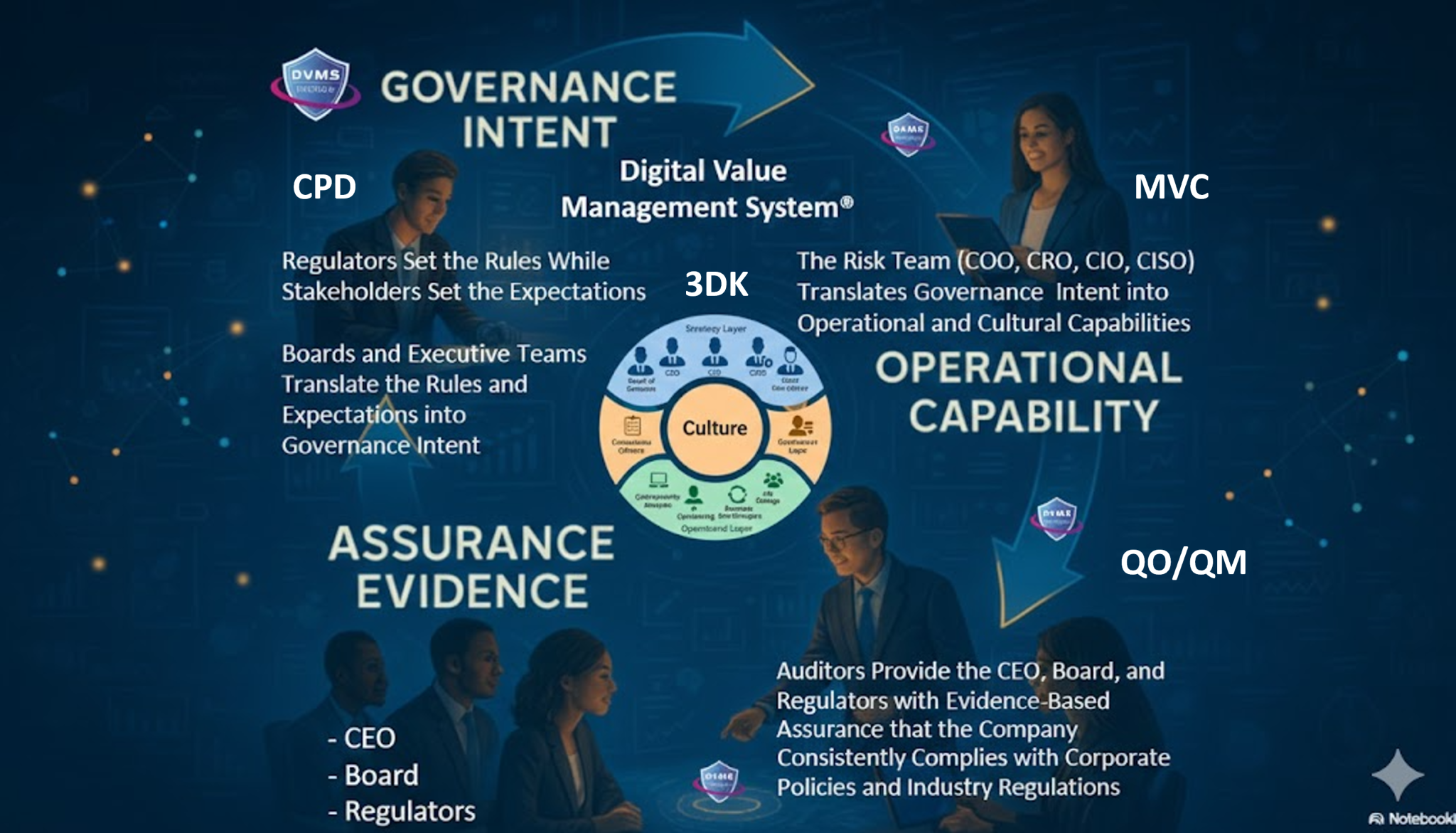
  • Governance Intent – shared expectations and accountabilities.

  • Operational Capability – how the business actually performs

  • Assurance Evidence – proof that value is being created and protected

Through its MVCCPD3D Knowledge, and FastTrack Models, a DVMS turns this integration into three distinctive capabilities:

  • A Governance Overlay that replaces fragmentation with unity. The DVMS provides organizations with a structured way to connect strategy with day-to-day execution. Leaders gain a consistent mechanism to direct, measure, and validate performance—across every system responsible for digital value.
  • A Behavorial Engine that drives high-trust, high-velocity decision-making. The DVMS embeds decision models and behavior patterns that help teams think clearly and act confidently, even under uncertainty. It is engineered to reduce friction, prevent blame-based cultures, and strengthen organizational reliability.
  • A Learning System that makes culture measurable, adaptable, and scalable. Culture becomes a managed asset—not an abstract concept. The DVMS provides a repeatable way to observe behavior, collect evidence, learn from outcomes, and evolve faster than threats, disruptions, or market shifts.

DVMS Organizational Benefits

Instead of replacing existing operational frameworks, the DVMS elevates them—connecting and contextualizing their data into actionable intelligence that validates performance and exposes the reasons behind unmet outcomes, including cultural ones.

By adopting a DVMS, organizations are positioned to:

  • Maintain Operational Stability Amidst Constant Digital Disruption
  • Deliver Digital Value and Trust Across A Digital Ecosystem
  • Satisfy Critical Regulatory and Certification Requirements
  • Leverage Cyber Resilience as a Competitive Advantage

DVMS Leadership Benefits

The Digital Value Management System (DVMS) provides leaders with a unified, evidence-based approach to governing and enhancing their digital enterprise, aligning with regulatory requirements and stakeholder expectations.

  • For the CEO, the DVMS provides a clear line of sight between digital operations, business performance, and strategic outcomes—turning governance and resilience into enablers of growth and innovation rather than cost centers.
  • For the Board of Directors, the DVMS provides ongoing assurance that the organization’s digital assets, operations, and ecosystem are governed, protected, and resilient—supported by evidence-based reporting that directly links operational integrity to enterprise value and stakeholder trust.
  • For the CIO, CRO, CISO, and Auditors: an integrated, adaptive, and culture-driven governance and assurance management system that enhances digital business performance, resilience, trust, and accountability

DVMS White Papers

The three whitepapers below present a coherent progression that shifts organizations from compliance-driven thinking to a modern system of Governance, Resilience, Assurance, and Accountability (GRAA). Collectively, the three papers define a comprehensive system for building and governing resilient digital enterprises, grounded in evidence rather than assumptions.

  • The Assurance Mandate Paper sets the stage by showing why traditional GRC artifacts provide only reassurance—not evidence—and calls boards to demand forward-looking proof that their organizations can continue to create, protect, and deliver value under stress.
  • The Assurance in Action Paper then moves from leadership intent to managerial execution, demonstrating how the DVMS operationalizes resilience by translating outcomes into Minimum Viable Capabilities, connecting frameworks through the Create–Protect–Deliver model, and generating measurable assurance evidence that managers can use to demonstrate real performance rather than activity.
  • The Governing by Assurance Paper elevates the approach to the policy and regulatory level, showing how DVMS functions as a learning overlay system that links governance intent, operational capability, and verifiable evidence into a continuous loop—enabling regulators, agencies, and enterprises to govern by outcomes rather than checklists and to prove capability with measurable, auditable performance data.

DVMS Cyber Resilience Certified Training Programs

DVMS Cyber Resilience Awareness Training

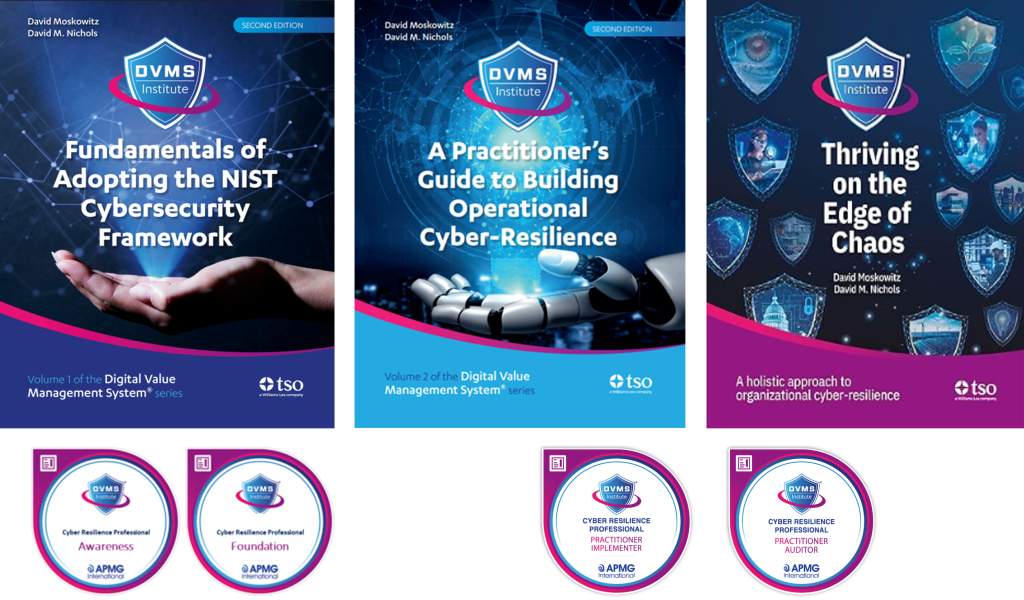
The DVMS Cyber Resilience Awareness course and its accompanying body of knowledge publication educate all employees on the fundamentals of digital business, its associated risks, the NIST Cybersecurity Framework, and their role within a shared model of governance, resilience, assurance, and accountability for creating, protecting, and delivering digital value.

This investment fosters a culture that is prepared to operate within a system capable of transforming systemic cyber risks into operational resilience.

DVMS NISTCSF Foundation Certification Training

The DVMS NISTCSF Foundation certification training course and its accompanying body of knowledge publications provide ITSM, GRC, Cybersecurity, and Business professionals with a detailed understanding of the NIST Cybersecurity Framework and its role in a shared model of governance, resilience, assurance, and accountability for creating, protecting, and delivering digital value.

This investment fosters IT, GRC, Cybersecurity, and Business professionals with the skills to operate within a system capable of transforming systemic cyber risks into operational resilience.

DVMS Cyber Resilience Practitioner Certification Training

The DVMS Practitioner certification training course and its accompanying body of knowledge publications teach ITSM, GRC, Cybersecurity, and Business practitioners how to elevate investments in ITSM, GRC, Cybersecurity, and AI business systems by integrating them into a unified governance, resilience, assurance, and accountability system designed to proactively identify and mitigate the cyber risks that could disrupt operations, erode resilience, or diminish client trust.

This investment fosters IT, GRC, Cybersecurity, and Business practitioners with the skills to assess, design, implement, operationalize, and continually innovate a Digital Value Management System® program that operationalizes a shared model of governance, resilience, assurance, and accountability for creating, protecting, and delivering digital value.

Company Brochures and Presentation
Explainer Videos

Digital Value Management System® is a registered trademark of the DVMS Institute LLC.

® DVMS Institute 2025 All Rights Reserved

More To Explore

It's Time to Protect Your digital business value & resiliency

Publications, Certification Training, Enterprise Solutions & Community