
The Institute’s Mission is to develop a DVMS® NIST Cybersecurity Framework Governance by Assurance™ Overlay System that transforms governance from a paper-based compliance exercise into an evidence-driven management discipline that continuously assures resilient and accountable digital operations.
The Institute’s Vision is to create training and tools for organizations of any size, scale, or complexity to deploy this innovative solution
DVMS Institute Timeline
In 2017, itSM Solutions LLC released its NIST Cybersecurity Framework certification training programs
In 2020, itSM Solutions LLC released revision 2 of its NIST Cybersecurity Framework training program.
In 2022, the founders of itSM Solutions launched the DVMS Institute to support the creation and release of its first two body-of-knowledge publications, as well as the revision 3 of its NIST Cybersecurity Framework training program, which included the DVMS publications in its courseware kits.
This update not only enhanced a candidate’s understanding of how to operationalize NIST Cybersecurity Framework controls but also introduced them to the concept of building a DVMS® NIST Cybersecurity Framework Governance by Assurance™ Overlay System that transforms governance from a paper-based compliance exercise into an evidence-driven management discipline that continuously assures resilient and accountable digital operations.
In 2024, the DVMS Institute announced a new standardized DVMS® Assurance-Now™ brand identity focused on building a DVMS® NIST Cybersecurity Framework Governance by Assurance™ Overlay System that transforms governance from a paper-based compliance exercise into an evidence-driven management discipline that continuously assures resilient and accountable digital operations.
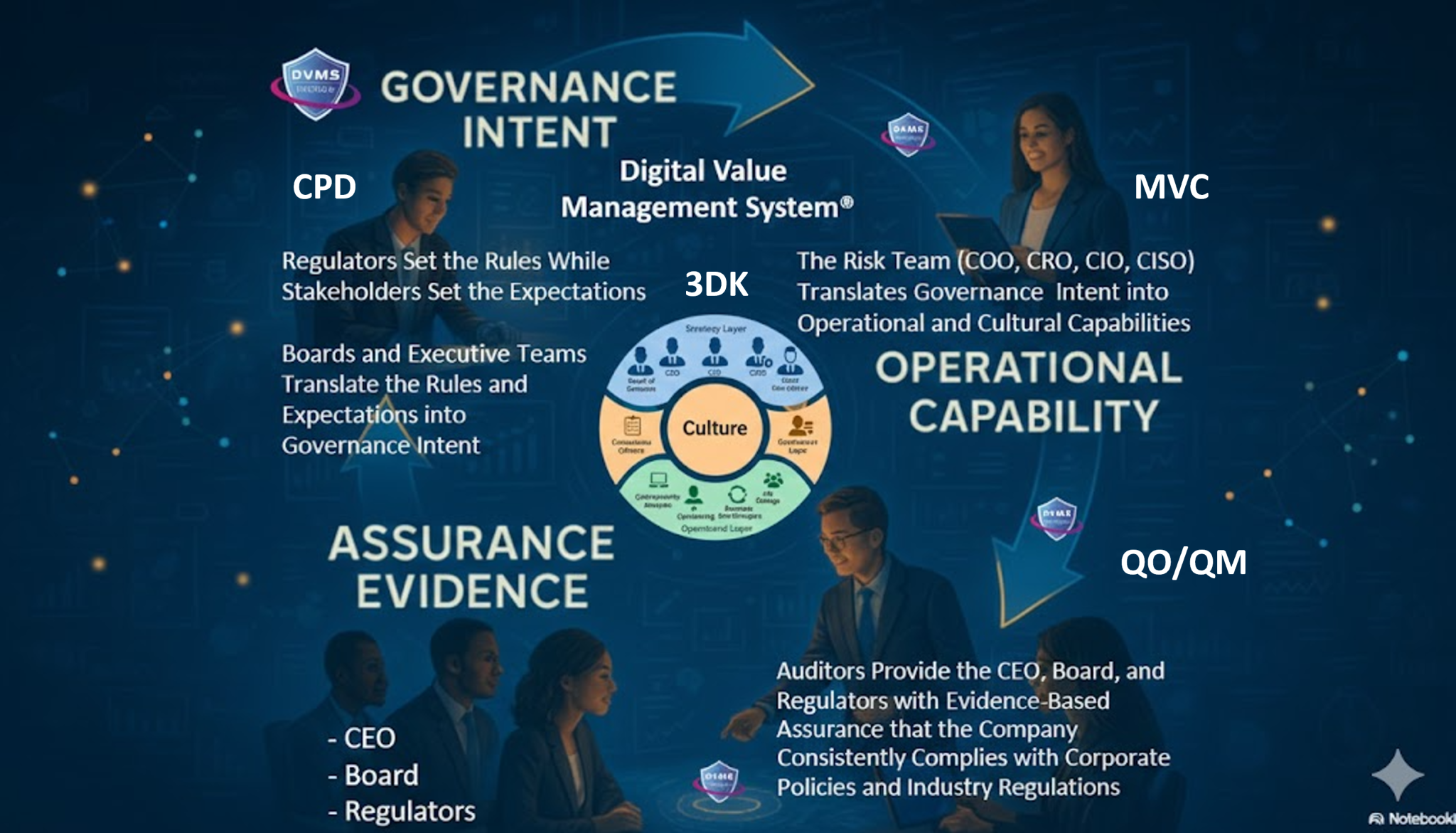
For the CEO, the DVMS provides a clear line of sight between digital operations, business performance, and strategic outcomes, turning operational risks into enablers of growth and innovation rather than cost centers.
For the Board of Directors, the DVMS provides real-time audit-ready assurance that the organization’s digital assets, operations, and ecosystem are governed, protected, and resilient, supported by evidence-based assurance that links operational integrity to value, trust, and accountability.
For the CIO, CRO, CISO, and Auditors, the DVMS establishes a common source of verifiable truth. It also enables executives, risk leaders, and assurance professionals to make better decisions, strengthen accountability, and sustain confidence in organizational performance across complex digital ecosystems.
In 2025, the Institute released its third body of knowledge publication, Thriving on the Edge of Chaos – A Holistic Approach to Organizational Cyber Resilience.
At its heart, the book highlights the critical role of organizational culture as the “glue” that binds strategy, leadership, and execution, ensuring sustainable digital resilience. Through actionable insights and real-world examples, it equips leaders with the knowledge to embrace complexity, disruption, and confidently manage a digital world that demands constant reinvention.
In 2026, the Institute released Version 4 of its DVMS training programs. V4 provided full support for operationalizing not only NIST CSF 2.0 but also its DVMS Governance by Assurance™ Overlay System.
In 2026, the Institute also released its fourth publication, titled Governing by Assurance. Drawing on the DVMS Governance, Resilience, Assurance, and Accountability model, this book provides executives, risk professionals, and operational leaders with a shared language and a practical method to turn governance from a paper artifact into a living system.
To learn more about these program updates, please visit www.dvmsinstitute.com or contact support@dvmsinstitute.com
100+ Years of Experience
| Cookie | Duration | Description |
|---|---|---|
| cookielawinfo-checkbox-analytics | 11 months | This cookie is set by GDPR Cookie Consent plugin. The cookie is used to store the user consent for the cookies in the category "Analytics". |
| cookielawinfo-checkbox-functional | 11 months | The cookie is set by GDPR cookie consent to record the user consent for the cookies in the category "Functional". |
| cookielawinfo-checkbox-necessary | 11 months | This cookie is set by GDPR Cookie Consent plugin. The cookies is used to store the user consent for the cookies in the category "Necessary". |
| cookielawinfo-checkbox-others | 11 months | This cookie is set by GDPR Cookie Consent plugin. The cookie is used to store the user consent for the cookies in the category "Other. |
| cookielawinfo-checkbox-performance | 11 months | This cookie is set by GDPR Cookie Consent plugin. The cookie is used to store the user consent for the cookies in the category "Performance". |
| viewed_cookie_policy | 11 months | The cookie is set by the GDPR Cookie Consent plugin and is used to store whether or not user has consented to the use of cookies. It does not store any personal data. |