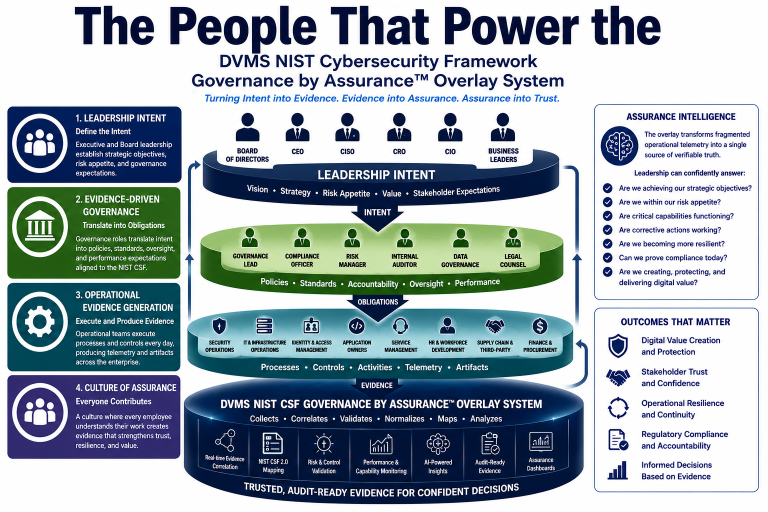
The People That Power the DVMS® NIST Cybersecurity Framework Governance by Assurance™ Overlay System
Rick Lemieux – Co-Founder and Chief Product Officer of the DVMS Institute
Introduction
Organizations have invested billions of dollars in cybersecurity technologies, governance frameworks, risk management programs, compliance initiatives, and operational monitoring platforms. They have documented policies, defined controls, implemented security tools, and adopted leading practices such as the NIST Cybersecurity Framework (CSF). Yet despite these investments, executive leaders, boards of directors, regulators, and auditors continue to ask the same fundamental question: How do we know our organization is operating as intended today?
Traditional governance provides policies, standards, reports, and periodic audits, but these mechanisms often describe what an organization intends to do rather than verify what is happening across its digital enterprise. Leadership is frequently required to make strategic decisions using fragmented operational data, delayed reporting, and assumptions that may no longer reflect operational reality.
The DVMS NIST Cybersecurity Framework Governance by Assurance™ Overlay System addresses this challenge by transforming fragmented operational telemetry into trusted, audit-ready evidence that continuously verifies whether the organizational strategic and operational objectives are being achieved. Rather than replacing existing cybersecurity, governance, or operational systems, the overlay connects them into a unified source of verifiable truth. It enables leadership to know, and prove, that digital business operations remain aligned with organizational policy, stakeholder expectations, regulatory obligations, and strategic intent.
The success of this approach depends on people. Every executive, governance professional, operational leader, and employee contributes to the evidence that powers Governance by Assurance™. Together, they create a continuously verified management system that enables organizations to create, protect, and deliver digital value with confidence.
Leadership Defines the Intent That the Enterprise Must Continuously Achieve
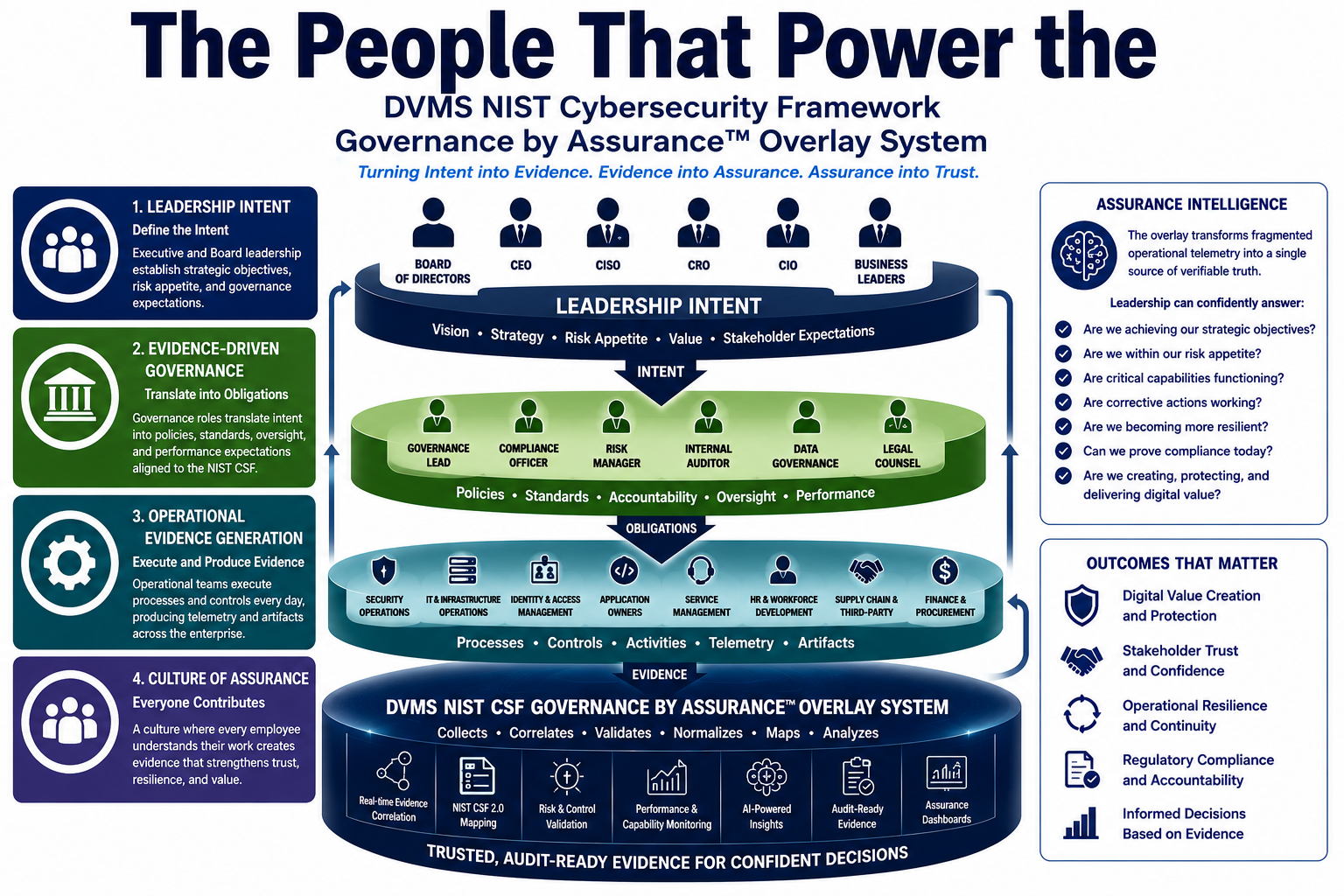
Every organization begins with intent. Boards establish governance expectations. Chief executives define strategic direction. Business leaders identify the outcomes that create value for customers and stakeholders. Risk leaders determine acceptable levels of uncertainty, while technology leaders establish the capabilities required to support the enterprise.
Within the DVMS NIST Cybersecurity Framework Governance by Assurance™ Overlay System, leadership does more than establish objectives. Leadership defines the measurable outcomes that the organization must continuously achieve and verify through trusted evidence.
- The Board of Directors establishes the organizational governance expectations, approves strategic priorities, and defines its appetite for risk.
- The Chief Executive Officer ensures cybersecurity, resilience, and digital value are integrated into the organizational overall business strategy.
- The Chief Information Officer aligns technology investments with business objectives.
- The Chief Information Security Officer defines cybersecurity capabilities aligned with the NIST Cybersecurity Framework and ensures those capabilities support enterprise objectives.
- The Chief Risk Officer integrates cyber risk into enterprise risk management so that strategic decisions reflect both opportunity and uncertainty.
These leaders establish organizational intent. The DVMS Governance by Assurance™ Overlay continuously assesses whether operational reality aligns with that intent.
Governance Becomes Continuous Verification Instead of Periodic Oversight
Traditional governance has largely depended upon policies, committee meetings, compliance assessments, and periodic audits to determine whether organizations are operating effectively. While these remain important, they provide only snapshots of organizational performance.
Governance by Assurance™ transforms governance into a continuous management discipline. Instead of asking whether policies exist, the organization continuously verifies whether those policies are producing the intended outcomes.
- Governance professionals translate executive intent into measurable obligations, performance objectives, governance policies, standards, and accountability structures.
- Compliance officers interpret regulatory requirements and map them to organizational capabilities. Internal auditors evaluate whether controls operate effectively and independently validate the evidence supporting executive decision-making.
- Data governance professionals ensure that the information flowing into the overlay remains accurate, complete, trusted, and traceable.
Rather than functioning as independent disciplines, governance, compliance, audit, and risk management become integrated contributors to a single evidence-driven governance system. Every governance activity produces trusted evidence that strengthens executive confidence while reducing uncertainty.
Operational Excellence Produces Evidence That Powers Governance
Operational teams are often viewed as implementing policies created elsewhere. Within the DVMS Governance by Assurance™ Overlay, they perform an even more important role. They continuously generate the operational evidence that enables leadership to verify organizational performance.
- Cybersecurity analysts monitor threats, investigate incidents, manage vulnerabilities, and maintain defensive capabilities.
- Infrastructure teams operate networks, cloud environments, and digital platforms. Identity specialists manage authentication and privileged access.
- Application owners maintain business services.
- Service management teams resolve incidents, execute changes, and restore operations.
- Human resources develops workforce capability and reinforces secure behaviors.
- Procurement and supplier management teams oversee third-party risk throughout the digital ecosystem.
Each operational activity creates measurable evidence.
- Security controls generate telemetry.
- Service management platforms document operational performance.
- Identity systems record authentication events.
- Risk management systems document treatment decisions.
- Business applications demonstrate service availability.
- Workforce systems verify training and competencies.
Individually, these systems provide valuable operational insight. Collectively, they become the evidence base that enables Governance by Assurance™.
Transforming Operational Telemetry into Executive Assurance
One of the defining characteristics of the DVMS NIST Cybersecurity Framework Governance by Assurance™ Overlay System is its ability to transform operational data into executive evidence.
Organizations do not suffer from a shortage of information. They suffer from an inability to correlate that information into meaningful assurance.
The overlay continuously collects evidence from existing operational systems and maps it to organizational objectives, NIST Cybersecurity Framework outcomes, governance policies, business capabilities, regulatory obligations, and executive performance expectations.
Instead of receiving disconnected reports from multiple departments, leadership gains a unified view that answers critical business questions.
- Are our cybersecurity capabilities functioning as intended?
- Are we operating within our approved risk tolerance?
- Are corrective actions reducing risk?
- Are we maintaining operational resilience?
- Can we demonstrate regulatory compliance today?
- Are we creating, protecting, and delivering digital value?
The answers are supported by trusted, traceable, audit-ready evidence rather than assumptions or isolated performance indicators.
Artificial Intelligence Strengthens Governance by Assurance™
As organizations adopt artificial intelligence across their digital enterprises, the volume and complexity of operational information continue to increase. AI offers tremendous potential to identify patterns, detect emerging risks, predict capability degradation, and recommend corrective actions. However, AI also introduces new governance challenges related to transparency, accountability, explainability, and trust.
The DVMS Governance by Assurance™ Overlay provides the evidence-driven foundation necessary for responsible AI-enabled governance. Artificial intelligence can rapidly analyze relationships across thousands of operational data sources, identify anomalies, and highlight emerging trends, while the overlay ensures that every recommendation remains supported by trusted, verifiable evidence.
Rather than replacing executive judgment, AI enhances it by accelerating evidence analysis while preserving human accountability for governance decisions.
A Culture That Produces Assurance Every Day
Technology alone cannot sustain digital resilience. The organizational culture determines whether governance becomes a living management capability or remains a compliance exercise.
Within a Governance by Assurance™ environment, every employee understands that daily work contributes to organizational assurance. Employees are not simply completing assigned tasks; they are producing evidence that demonstrates the organization is fulfilling its strategic and operational objectives.
This cultural shift transforms cybersecurity, governance, compliance, and resilience from isolated programs into shared organizational responsibilities. Transparency replaces assumption. Accountability replaces ambiguity. Continuous learning replaces periodic correction. Trusted evidence becomes part of everyday operations rather than something assembled only for audits or regulatory reviews.
As this mindset matures, Governance by Assurance™ becomes embedded in the organizational DNA.
Continuous Improvement Through Trusted Evidence
Continuous improvement has long been a goal of management systems, but it is only meaningful when grounded in reliable evidence.
The DVMS NIST Cybersecurity Framework Governance by Assurance™ Overlay System continuously measures capability performance, identifies emerging weaknesses, verifies corrective actions, and confirms that improvements produce the intended outcomes.
Every enhancement to governance, cybersecurity, operations, workforce capability, supplier management, or technology can be validated by evidence of measurable improvement. Organizations no longer depend solely on annual assessments or retrospective audits to understand performance. Improvement becomes continuous because assurance becomes continuous.
Conclusion
The future of digital governance is not defined by more policies, more reports, or more compliance activities. It is defined by the ability to continuously verify that organizational intent is being fulfilled through trusted evidence.
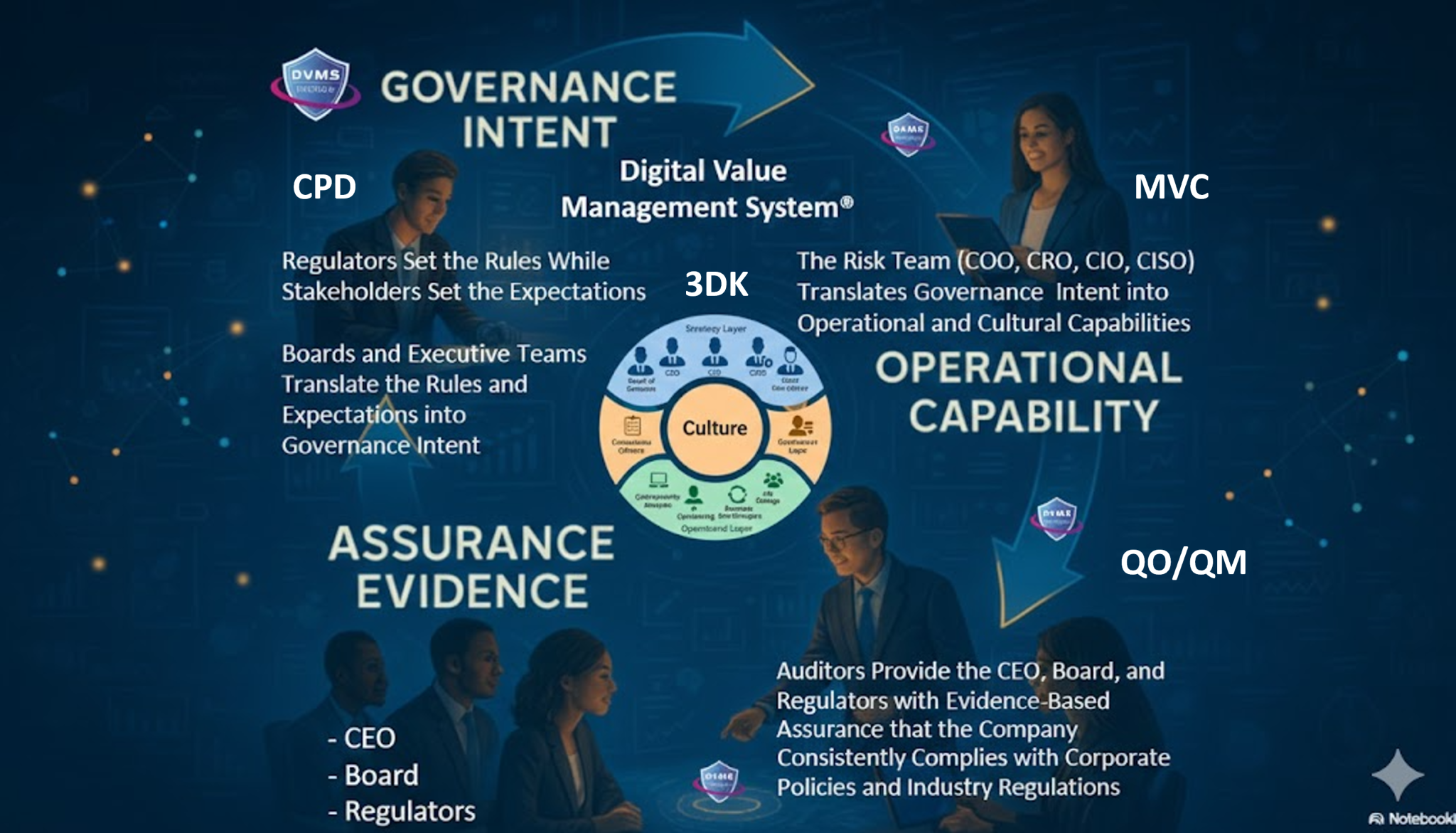
The DVMS NIST Cybersecurity Framework Governance by Assurance™ Overlay System establishes this new model by connecting leadership intent with operational reality. Executive leaders define strategic objectives. Governance professionals translate those objectives into measurable obligations. Operational teams continuously generate evidence through their daily activities. The overlay transforms that evidence into a single, verifiable truth source, enabling boards, executives, auditors, regulators, and stakeholders to make informed decisions with confidence.
In an increasingly complex digital world, organizations need more than governance frameworks that describe what should happen. They need a Governance by Assurance™ Overlay that continuously demonstrates what is happening. When leadership can know—and prove through trusted, audit-ready evidence—that digital operations are creating, protecting, and delivering value as intended, governance evolves from a periodic oversight activity into a continuous strategic capability that sustains digital value, stakeholder trust, operational resilience, and transparent accountability.
About the Author

Rick Lemieux
Co-Founder and Chief Product Officer of the DVMS Institute
Rick has 40+ years of passion and experience creating solutions to give organizations a competitive edge in their service markets. In 2015, Rick was identified as one of the top five IT Entrepreneurs in the State of Rhode Island by the TECH 10 awards for developing innovative training and mentoring solutions for boards, senior executives, and operational stakeholders.
Digital Value Management System® is a registered trademark of the DVMS Institute LLC.
® DVMS Institute 2026 All Rights Reserved