Governance by Assurance in the Age of AI
Rick Lemieux – Co-Founder and Chief Product Officer of the DVMS Institute
A New Model for Governing AI-Enabled Digital Enterprises
Artificial intelligence is transforming every aspect of the modern enterprise. It is changing how organizations create value, make decisions, develop products, interact with customers, operate digital services, secure information, and develop their workforce. Unlike previous waves of digital transformation, AI is continuously learning, adapting, and influencing operational and strategic decisions at unprecedented speed. This new operating environment demands a new approach to governance.
Traditional governance models were designed for relatively stable business environments where organizational change occurred over months or years. Governance relied heavily on policies, periodic audits, manual reviews, compliance assessments, and historical reporting to determine whether the organization remained aligned with its strategic objectives. While these methods remain important, they are no longer sufficient for governing AI-enabled digital enterprises where technologies, risks, workforce capabilities, and business conditions evolve continuously.
The Age of AI requires organizations to move beyond governance by policy toward Governance by Assurance.
From Governance by Policy to Governance by Assurance
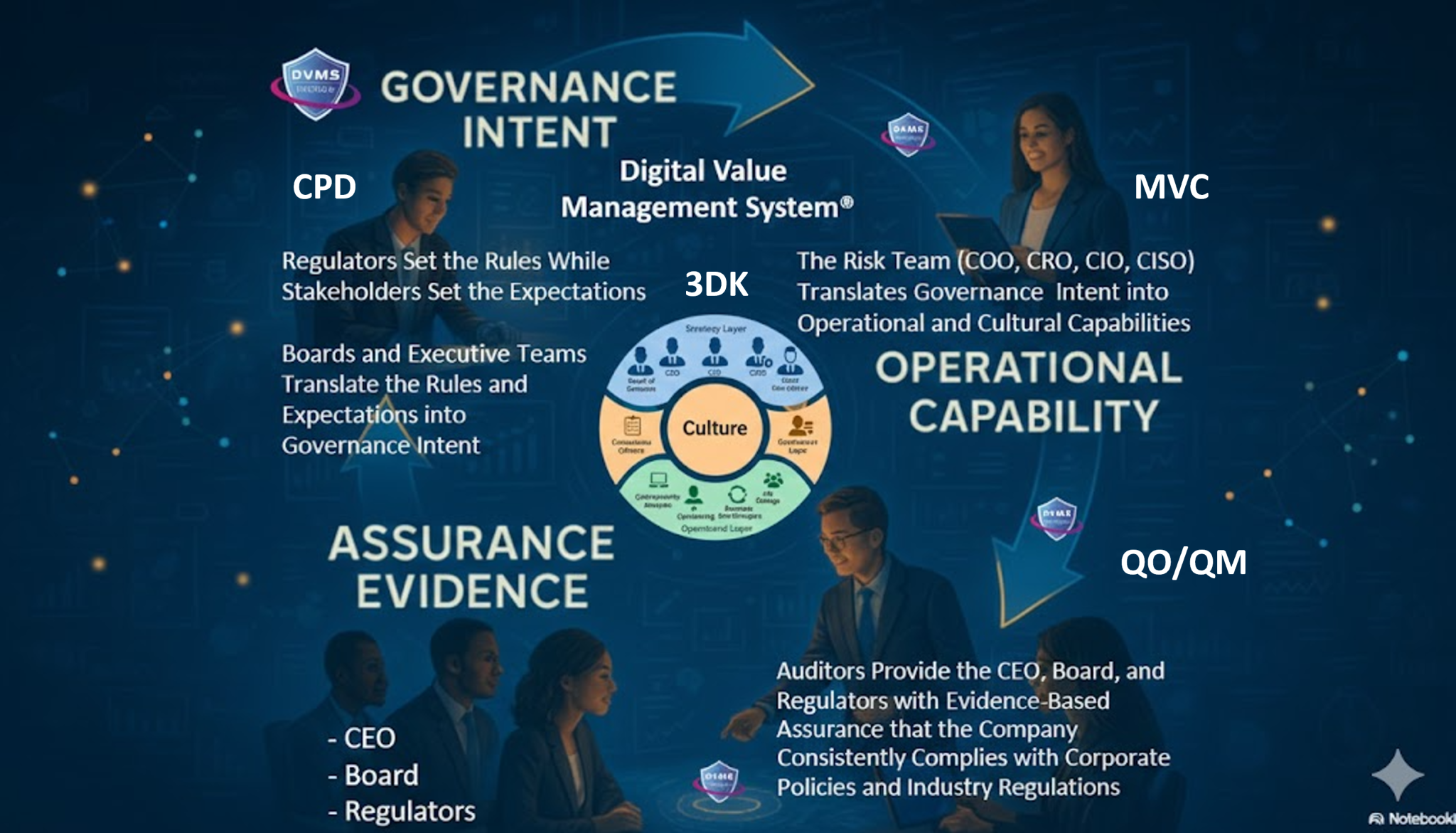
Policies establish organizational intent. Governance establishes direction and accountability. Assurance demonstrates whether the organization is actually operating in accordance with that intent.
In AI-enabled enterprises, governance cannot rely solely on non-policies or periodic compliance reviews. Leaders require continuous confidence that artificial intelligence, digital operations, and the workforce responsible for managing them remain aligned with organizational objectives, stakeholder expectations, regulatory obligations, and ethical principles.
Governance by Assurance provides that confidence through continuous, audit-ready evidence rather than assumptions, manual reporting, or periodic assessments. Instead of asking whether policies exist, Governance by Assurance continuously verifies that organizational outcomes remain aligned with leadership intent.
Governing Digital Business Outcomes
Modern organizations no longer compete solely through products or services. They compete through digital capabilities. Every customer interaction, operational process, business decision, cybersecurity control, supply chain activity, and AI-enabled workflow contributes to the organization’s ability to create, protect, and deliver digital business value.
Governance, therefore, extends beyond overseeing technology investments. It must continuously ensure that digital business operations are producing the intended business outcomes while maintaining trust, resilience, accountability, and regulatory alignment.
This represents a fundamental shift in governance thinking. Rather than governing technology, organizations govern the outcomes that technology produces.
Governing Workforce Outcomes in the Age of AI
Artificial intelligence is not replacing the workforce; it is transforming it.
As AI becomes embedded in everyday business operations, organizations must continuously develop new capabilities in AI literacy, responsible AI, cybersecurity, data governance, prompt engineering, digital ethics, human-AI collaboration, and intelligent decision-making.
Workforce development, therefore, becomes a governance responsibility rather than simply a human resources function.
Leaders must continuously ensure that the workforce possesses the competencies required to operate, supervise, govern, and improve AI-enabled digital business operations. Workforce readiness becomes measurable evidence supporting organizational resilience, operational performance, and responsible AI adoption.
Continuous Assurance as the Foundation of Governance
Governance by Assurance replaces periodic confidence with continuous confidence.
Rather than relying on annual audits or point-in-time assessments, organizations continuously collect, correlate, evaluate, and present evidence on operational, governance, cybersecurity, workforce, AI, compliance, and business performance.
This evidence provides leadership with an objective understanding of whether digital operations remain aligned with strategic objectives, whether AI systems are operating responsibly, and whether the workforce possesses the capabilities necessary to sustain business performance.
Governance becomes an ongoing operational capability rather than an occasional compliance exercise.
Governing AI with Confidence
Artificial intelligence introduces enormous opportunities, but also unprecedented governance challenges. Organizations must understand not only whether AI systems function correctly, but also whether they remain transparent, accountable, ethical, secure, compliant, and aligned with organizational values.
Governance by Assurance enables leaders to adopt AI confidently by continuously verifying that AI technologies, digital operations, governance processes, and workforce capabilities remain in sync with organizational intent.
Rather than slowing innovation, continuous assurance accelerates responsible AI adoption by providing executives, boards, regulators, and stakeholders with confidence that AI is delivering measurable business value while preserving trust, resilience, and accountability.
The Role of DVMS® Assurance-Now™ and SKILLS TX™
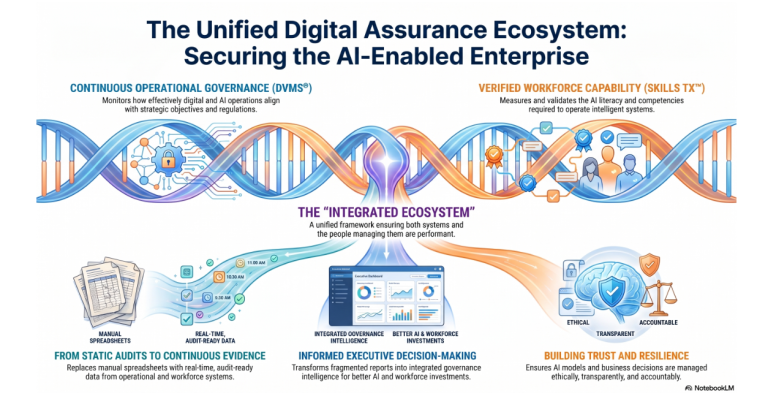
The DVMS® Assurance-Now™ Platform and the SKILLS TX™ Workforce Development Platform operationalize the principles of Governance by Assurance.
DVMS® Assurance-Now™ continuously transforms fragmented operational, governance, cybersecurity, compliance, AI, and business performance information into trusted, audit-ready evidence that demonstrates whether digital business operations remain aligned with leadership intent and organizational objectives.
SKILLS TX™ continuously measures, develops, validates, and assures workforce capability by providing evidence that employees possess the competencies required to safely, responsibly, and effectively operate AI-enabled digital enterprises.
Together, the platforms provide a continuous assurance ecosystem that connects digital business governance with workforce assurance, enabling organizations to govern both operational performance and human capability through objective evidence rather than assumptions.
The Future of Governance
The future of governance is not more reports, more dashboards, or more policies.
The future of governance is continuous assurance.
As AI becomes embedded throughout the enterprise, organizations must continuously demonstrate that digital business operations are producing intended business outcomes and that the workforce possesses the capabilities required to sustain those outcomes responsibly.
Governance by Assurance represents the next evolution of enterprise governance. It transforms governance from a periodic compliance activity into a continuous, evidence-driven management capability that enables organizations to embrace artificial intelligence with confidence while creating, protecting, and delivering sustainable digital business value.
In the Age of AI, successful organizations will not be distinguished simply by how rapidly they adopt artificial intelligence. They will be distinguished by how effectively they govern it. Governance by Assurance provides continuous evidence that enables leaders to know, not merely hope, that their digital business and workforce remain aligned with organizational objectives, stakeholder expectations, and the responsibilities that accompany an AI-enabled future.
About the Author

Rick Lemieux
Co-Founder and Chief Product Officer of the DVMS Institute
Rick has 40+ years of passion and experience creating solutions to give organizations a competitive edge in their service markets. In 2015, Rick was identified as one of the top five IT Entrepreneurs in the State of Rhode Island by the TECH 10 awards for developing innovative training and mentoring solutions for boards, senior executives, and operational stakeholders.
Digital Value Management System® is a registered trademark of the DVMS Institute LLC.
® DVMS Institute 2026 All Rights Reserved