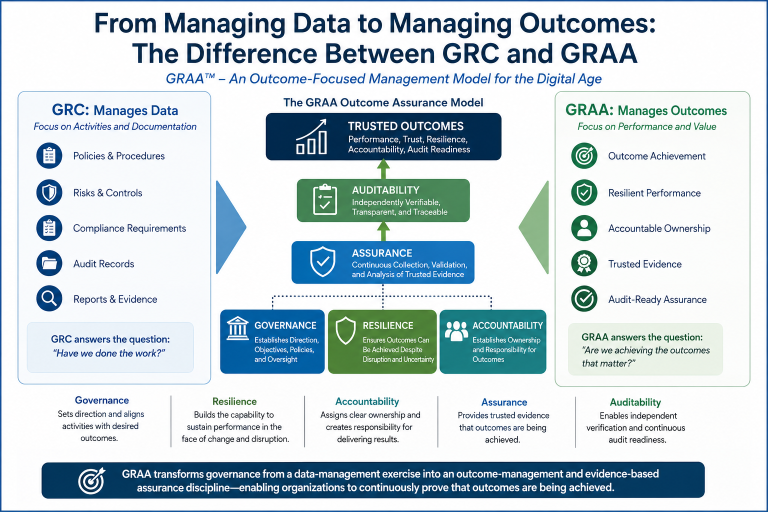
From Managing Data to Managing Outcomes – The Difference Between GRC and GRAA
Rick Lemieux – Co-Founder and Chief Product Officer of the DVMS Institute
Introduction
For more than two decades, Governance, Risk, and Compliance (GRC) has served as the dominant framework for organizations seeking to manage risk, maintain compliance, and demonstrate operational control. GRC emerged during a period when regulatory oversight, internal controls, and compliance reporting became increasingly important to business success. As a result, organizations invested heavily in systems, processes, and governance structures designed to document policies, manage controls, assess risks, and collect compliance evidence.
While GRC has proven effective in organizing and managing governance-related information, the rapid growth of digital business has exposed an important limitation. Managing governance data does not necessarily mean that an organization is achieving its intended business outcomes. An organization may maintain extensive risk registers, control libraries, audit records, and compliance reports while still struggling with operational disruptions, declining customer trust, poor service performance, or inadequate resilience.
This challenge has given rise to Governance, Resilience, Accountability, and Auditability (GRAA), an outcome-focused management model designed for the realities of digital business. Rather than concentrating primarily on governance activities and compliance records, GRAA focuses on the continuous achievement and demonstration of desired outcomes. Governance establishes direction. Resilience ensures continuity of performance. Accountability assigns responsibility for results. Assurance provides trusted evidence regarding outcome achievement. Auditability enables independent verification. Together, these capabilities enable organizations to move beyond managing data to continuously managing and demonstrating business outcomes.
The Data-Centric Nature of GRC
At its core, GRC is a data-management discipline. Organizations implementing GRC frameworks typically maintain extensive inventories of policies, procedures, controls, regulatory obligations, risk assessments, audit findings, corrective actions, and compliance evidence. The primary objective is to ensure that required governance activities are performed and properly documented.
As a result, GRC programs often become repositories of governance-related information. Risk registers track potential threats. Control frameworks document mitigation activities. Compliance databases map obligations to controls. Audit systems collect evidence and findings. Dashboards aggregate metrics associated with governance activities.
The underlying assumption is that effective management of governance information will improve organizational control and reduce exposure to adverse events. While this assumption has merit, it often leaves a critical question unanswered: Is the organization achieving its intended outcomes?
Many organizations can demonstrate that their governance processes are functioning while remaining unable to demonstrate that customers trust them, that operations remain resilient, that services perform effectively, or that strategic objectives are being achieved. Consequently, governance can become heavily focused on documenting activity rather than demonstrating value.
The Outcome-Centric Nature of GRAA
GRAA shifts the focus from managing governance information to managing business outcomes. Rather than asking whether policies exist, controls are documented, or assessments have been completed, GRAA asks whether the organization is achieving its intended objectives and whether there is trusted evidence to demonstrate those achievements.
In a GRAA environment, governance begins with clearly defined outcomes. These outcomes may include customer trust, operational resilience, cybersecurity effectiveness, service reliability, regulatory confidence, stakeholder satisfaction, and sustainable business performance. Governance activities are then aligned to those outcomes rather than existing as independent administrative functions.
This outcome orientation transforms governance from a compliance exercise into a performance discipline. Success is no longer measured solely by completed activities or documented controls. Instead, success is measured by the organizational ability to achieve and sustain desired outcomes in an increasingly dynamic and uncertain environment.
The central question becomes: Can the organization continuously demonstrate, through trusted evidence, that it is achieving the outcomes that matter most?
Resilience as the Capability to Sustain Outcomes
The second pillar of GRAA is resilience. While traditional GRC emphasizes risk identification and mitigation, GRAA focuses on the organizational ability to sustain desired outcomes amid disruptions, threats, uncertainty, and change.
Risk is important because it identifies conditions that may affect performance. However, resilience is more important because it determines whether the organization can continue to perform under those conditions. Resilience, therefore, shifts the focus from predicting adverse events to sustaining outcomes.
In a digital business environment, resilience extends beyond technology recovery and business continuity. It includes operational resilience, cybersecurity resilience, organizational resilience, supply chain resilience, governance resilience, and strategic resilience. Collectively, these capabilities determine whether the organization can maintain trust, performance, and value creation under adverse conditions.
By focusing on resilience rather than risk alone, organizations adopt a more proactive and outcome-oriented approach to management.
Accountability as the Foundation of Outcome Management
Organizations do not create value by managing controls. They create value by achieving outcomes. Consequently, every meaningful outcome must have a clearly accountable owner.
Accountability represents one of the most significant distinctions between GRAA and traditional GRC. While GRC frequently emphasizes responsibility for activities and controls, GRAA emphasizes responsibility for outcomes.
Every critical outcome should be assigned to an accountable individual, team, or governing body. Whether the objective is customer trust, cybersecurity effectiveness, service reliability, operational resilience, regulatory confidence, or strategic growth, accountability ensures that ownership is clearly established and continuously monitored.
Accountability also creates a direct connection between governance and performance. Rather than asking whether activities have been completed, leaders can determine whether accountable parties are delivering expected results. This creates a governance model that is aligned with business performance rather than administrative compliance.
Assurance as the Evidence Engine
Accountability without evidence becomes opinion. For accountability to be meaningful, organizations must possess trusted evidence demonstrating whether accountable parties are achieving intended outcomes. This is the role of assurance.
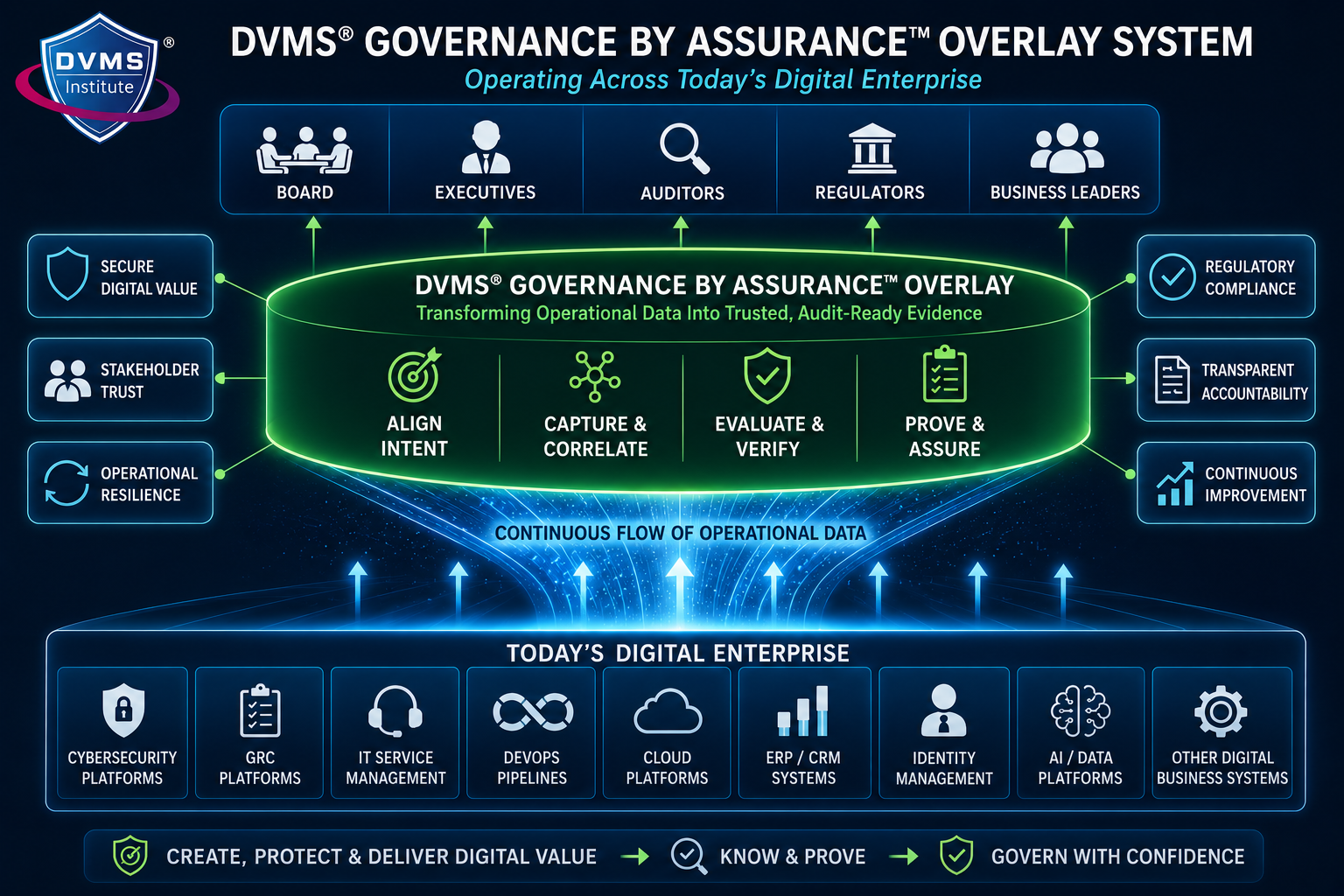
Assurance serves as GRAA’s evidence engine. It continuously collects, validates, analyzes, and maintains information regarding performance, resilience, accountability, trust, control effectiveness, and outcome achievement. Through assurance, raw operational data is transformed into trusted evidence that supports decision-making and builds stakeholder confidence.
Unlike traditional audit preparation activities, assurance operates continuously. Evidence is collected from operational processes, performance indicators, resilience metrics, customer outcomes, control monitoring activities, and business results. This evidence is validated and organized to demonstrate whether desired outcomes are being achieved.
Assurance, therefore, acts as the critical link between accountability and auditability. Without assurance, accountability cannot be substantiated. Without assurance, auditability cannot be sustained. Assurance provides the trusted evidence necessary to demonstrate both.
Auditability as Continuous Capability
Traditional governance models often treat audit readiness as a periodic event. Organizations prepare for audits by gathering documents, assembling evidence, and validating records shortly before the audit. This approach is costly, disruptive, and often reactive.
GRAA introduces the concept of continuous auditability. Auditability becomes an inherent characteristic of the management system itself rather than a temporary state achieved during audit preparation.
Because assurance continuously collects and validates evidence, organizations maintain an ongoing state of readiness. Evidence remains current, traceable, transparent, and independently verifiable. Stakeholders no longer need to rely solely on historical reports or periodic assessments. Instead, they gain continuous visibility into actual organizational performance and achievement of outcomes.
Continuous auditability strengthens trust among regulators, customers, investors, governing bodies, and other stakeholders by enabling organizational claims to be verified with trusted evidence at any time.
The Role of DVMS in Enabling GRAA
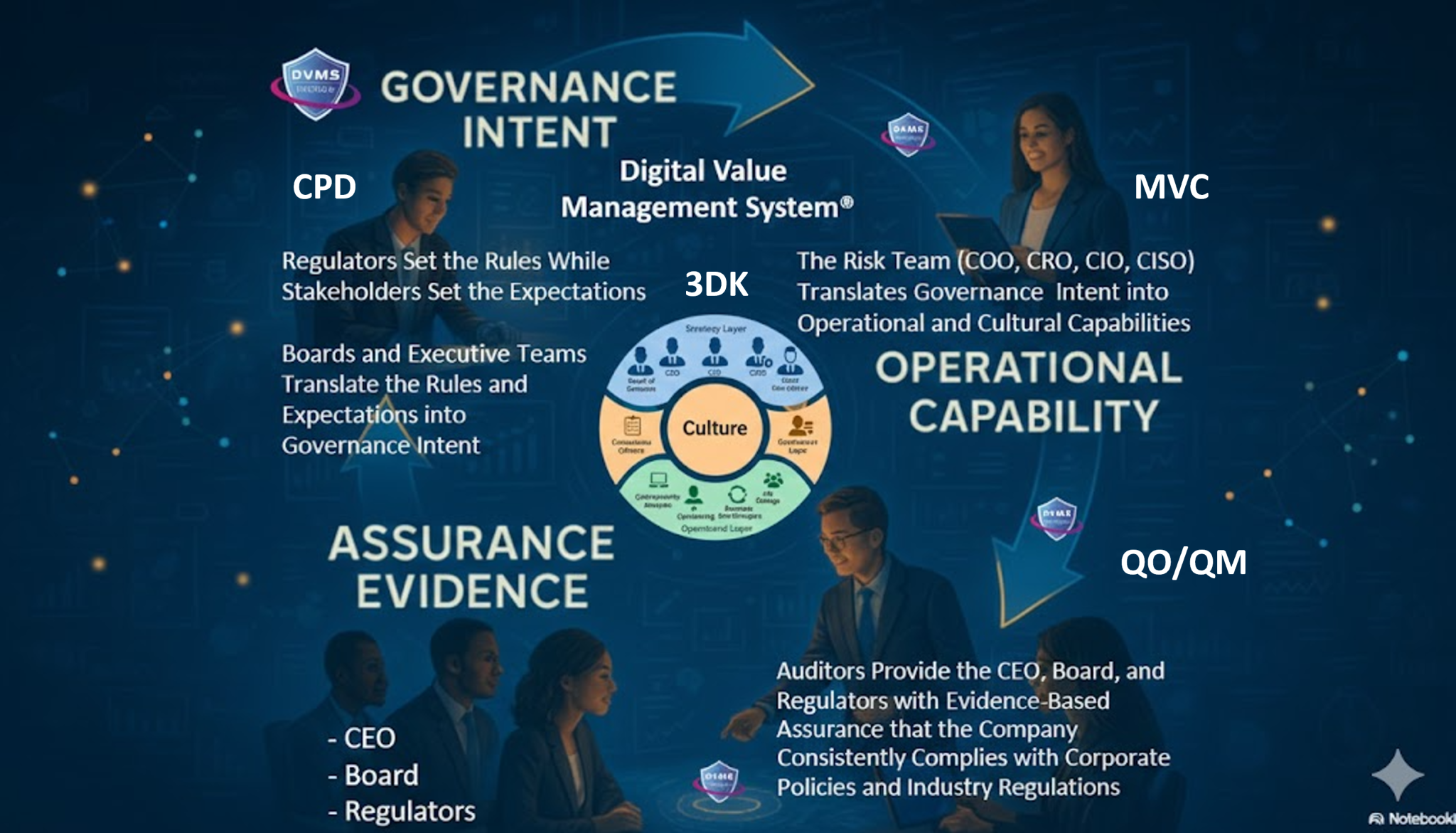
The Digital Value Management System® (DVMS®) serves as the operational system through which GRAA is implemented and sustained. While GRAA defines the management model, DVMS provides the integrated governance and assurance intelligence system that enables organizations to establish outcome-driven objectives, build resilience, assign accountability, continuously monitor performance, collect trusted evidence, and maintain auditability.
DVMS aligns governance activities with value creation and achievement. It establishes measurable objectives, identifies accountable owners, enables resilience management, and supports assurance activities that continuously collect and validate evidence regarding organizational performance and outcome attainment.
By integrating governance, resilience, accountability, assurance, and auditability into a single management system, DVMS transforms GRAA from a conceptual framework into an operational capability. Organizations gain the ability to continuously demonstrate performance, trust, resilience, accountability, and audit readiness through evidence-based management.
Conclusion
The distinction between GRC and GRAA goes beyond mere terminology. It reflects a fundamental evolution in how organizations govern digital business operations. GRC primarily manages governance-related information, including policies, controls, assessments, compliance records, and audit documentation. Its focus is on demonstrating that required activities have been performed.
GRAA, by contrast, manages outcomes. Governance establishes direction. Resilience ensures continuity of performance. Accountability establishes ownership. Assurance provides trusted evidence. Auditability enables independent verification. Together, these capabilities create a management model focused on continuous achievement and demonstration of business outcomes.
In an increasingly digital and interconnected world, organizations require more than compliance and documentation. They require continuous confidence that they are achieving their performance, trust, resilience, accountability, and audit-readiness objectives. GRAA provides this capability by transforming governance from a data-management exercise into an outcome-management and evidence-based assurance discipline. The future of governance belongs not to those who manage the most information, but to those who can continuously demonstrate the outcomes that matter most.
About the Author

Rick Lemieux
Co-Founder and Chief Product Officer of the DVMS Institute
Rick has 40+ years of passion and experience creating solutions to give organizations a competitive edge in their service markets. In 2015, Rick was identified as one of the top five IT Entrepreneurs in the State of Rhode Island by the TECH 10 awards for developing innovative training and mentoring solutions for boards, senior executives, and operational stakeholders.
Digital Value Management System® is a registered trademark of the DVMS Institute LLC.
® DVMS Institute 2026 All Rights Reserved