From Cost Center to Enterprise Value – Why Digital Business Governance Has Become a Boardroom Imperative
Rick Lemieux – Co-Founder and Chief Product Officer of the DVMS Institute
The Historical View of Technology and Digital Business
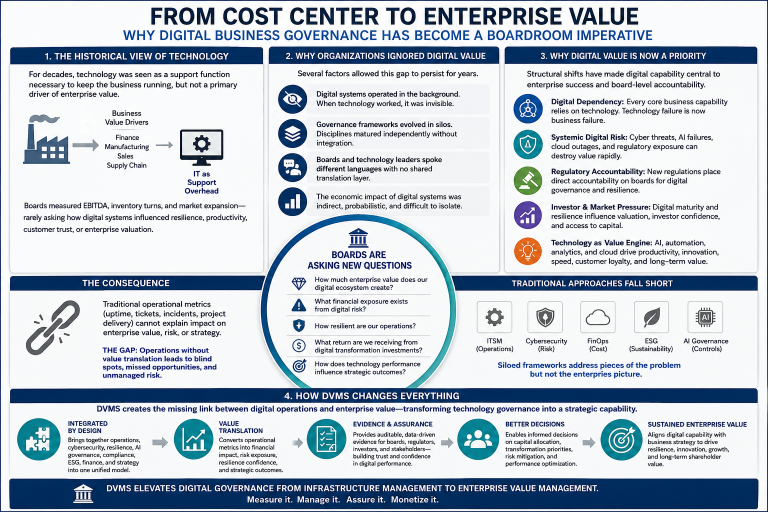
For decades, most companies treated digital technology as a support function rather than a primary creator of enterprise value. IT systems were viewed as operational infrastructure necessary for keeping the business running, but not central to how boards understood growth, competitiveness, profitability, or shareholder value. As long as systems remained stable, projects were delivered, and costs stayed within budget, executives considered technology “managed.”
This mindset emerged from the industrial-era operating model, where finance, manufacturing, sales, and supply chains were considered the true engines of value creation. Technology existed primarily to automate processes behind the scenes. Boards focused on factories, EBITDA, inventory turns, operational efficiency, and market expansion, while digital systems were classified as overhead rather than strategic assets. The assumption was simple: technology enabled business, but it was not the business itself.
Over time, however, that distinction became increasingly dangerous. As organizations digitized, customer experience, operational continuity, supply chain coordination, cybersecurity, compliance, AI, employee productivity, and business resilience all became dependent on interconnected digital systems. Yet governance practices did not evolve at the same pace. Organizations continued measuring digital performance through operational indicators such as uptime, service tickets, incident counts, and project delivery milestones without translating those measures into enterprise value, financial exposure, or strategic business impact.
Why Organizations Ignored Digital Value for So Long
One reason this gap persisted was that digital systems historically operated in the background. When technology worked well, it became invisible. Boards typically only became involved when systems failed, cyber incidents occurred, or major transformation programs underperformed. Because the value of digital systems was difficult to quantify directly, organizations defaulted to cost management rather than value management.
Another contributing factor was the fragmented evolution of governance frameworks. ITIL focused on service management. COBIT emphasized governance controls. FinOps concentrated on cloud spending optimization. Cybersecurity frameworks focused on risk reduction, while ESG frameworks concentrated on sustainability disclosures. Each discipline matured independently, but very few organizations developed an integrated approach capable of explaining how digital operations collectively influenced enterprise performance and enterprise value.
There was also a communication divide between boards and technology leaders. CIOs and operational leaders typically spoke in technical and operational language, while boards governed through financial outcomes, capital allocation, risk exposure, and shareholder expectations. Without a common translation layer, technology discussions often became disconnected from strategic business decision-making.
A further challenge was that the economic impact of digital systems was often indirect or probabilistic. Resilience prevented losses that never appeared on financial statements. Cybersecurity reduced the likelihood of catastrophic failure rather than generating visible revenue. Employee experience improvements increased productivity indirectly. Because these benefits were distributed across the enterprise and difficult to isolate financially, traditional accounting models struggled to capture their full value.
Why Digital Value Has Become a Board-Level Priority
Today, digital value has become one of the most important governance issues facing executive leadership because digital systems are no longer peripheral to the enterprise, they are the enterprise. Nearly every critical business capability now depends on technology functioning continuously, securely, and reliably. Revenue generation, customer engagement, operations, logistics, compliance, AI systems, and financial management all rely on digital infrastructure. Technology failure is now business failure.
At the same time, organizations face a growing wave of systemic digital risk. Cyberattacks, ransomware, cloud outages, AI governance failures, regulatory penalties, and supply chain disruptions have demonstrated that weaknesses in digital governance can rapidly and at scale destroy enterprise value. Boards increasingly understand that operational resilience and digital resilience are inseparable.
Regulatory accountability has also transformed the governance landscape. Frameworks such as DORA, the EU AI Act, CSRD, and expanding cybersecurity disclosure obligations now place direct accountability on boards and executive leadership for digital governance, resilience assurance, AI controls, and operational oversight. Digital governance cannot be delegated solely to IT departments, as regulators now view digital capability as an enterprise governance responsibility.
Investor expectations have evolved as well. Markets increasingly assess organizations based on digital maturity, cybersecurity resilience, AI governance capability, operational stability, and technology-enabled scalability. Digital trust now influences acquisition attractiveness, valuation confidence, competitive positioning, and access to investment capital.
Technology itself has also transformed itself from a support capability into one of the primary engines of competitive differentiation. AI, automation, analytics, cloud ecosystems, and digital operating platforms now directly influence productivity, innovation, speed to market, customer loyalty, organizational agility, and long-term enterprise growth.
As a result, boards are asking far more sophisticated questions than they did a decade ago. Executives now want to understand how much value their digital ecosystem creates, what financial exposure exists from digital risk, how resilient operations truly are, what returns are being realized from digital transformation investments, and how technology performance influences strategic business outcomes. Traditional operational metrics alone cannot answer those questions.
How DVMS Changes Everything
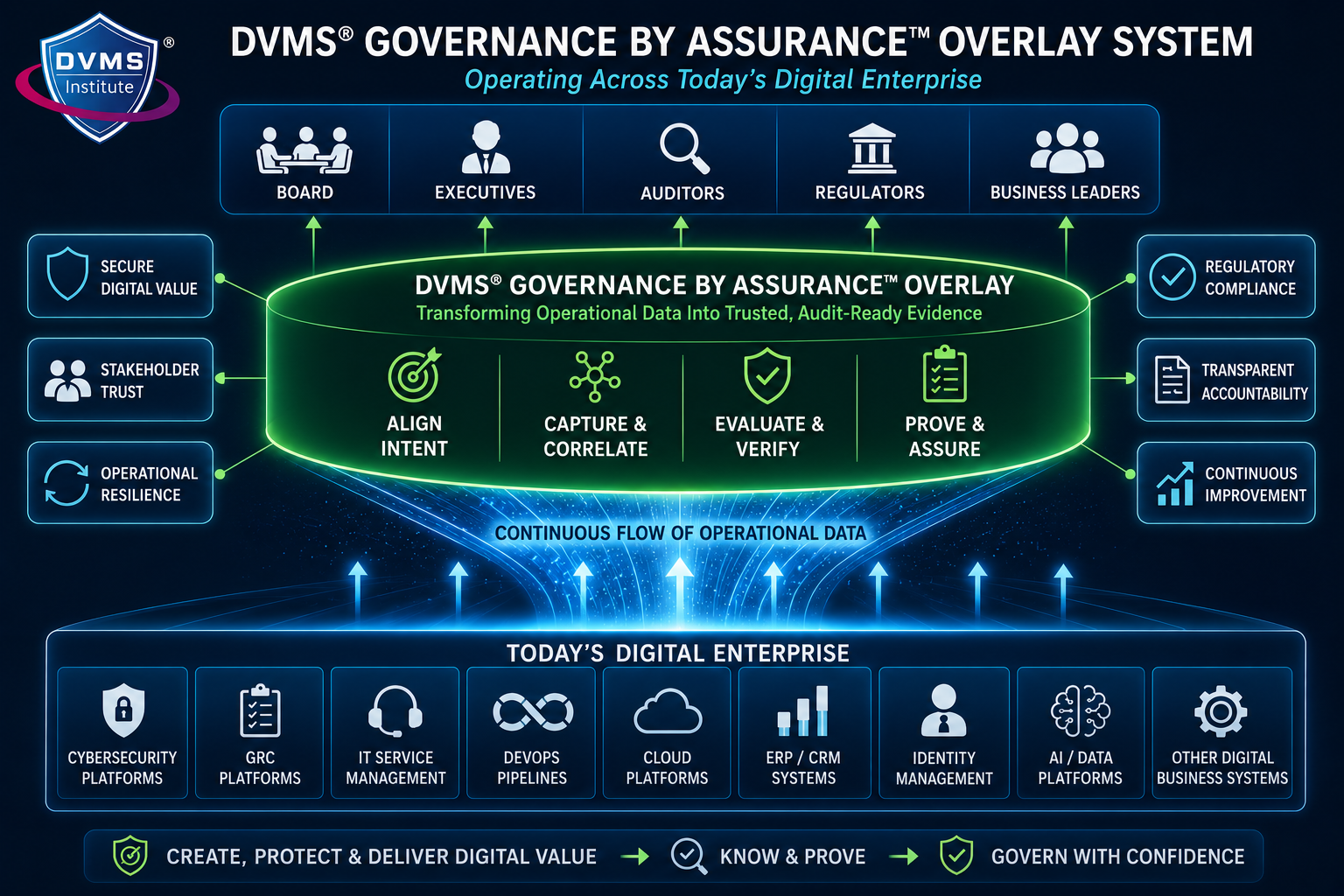
This is where a Digital Value Management System® (DVMS) fundamentally changes the conversation. Traditional governance models treated technology as an operational domain to be controlled, monitored, and maintained. DVMS reframes digital capability as an enterprise value system that must be governed with the same rigor as finance, risk, and corporate strategy.
A DVMS creates the missing translation layer between digital operations and enterprise value. Rather than measuring technology solely through operational metrics such as uptime, incidents, or service delivery, DVMS connects digital performance directly to resilience, financial accountability, governance assurance, compliance obligations, strategic outcomes, and long-term enterprise sustainability. It provides boards and executives with evidence-based insight into how digital systems contribute to value creation, risk reduction, operational continuity, stakeholder trust, and organizational performance.
Unlike siloed frameworks that address only individual domains such as IT service management, cybersecurity, ESG, or cloud governance, DVMS integrates these disciplines into a unified governance architecture. This allows organizations to understand digital business holistically rather than as disconnected operational functions. Cybersecurity, AI governance, operational resilience, ESG obligations, compliance, transformation initiatives, and financial performance become interconnected dimensions of enterprise governance rather than isolated reporting streams.
Most importantly, DVMS transforms digital governance from a reactive technical discipline into a strategic enterprise capability. It enables organizations to move beyond managing technology costs toward actively governing digital value creation. Boards gain visibility into how digital investments influence enterprise performance, resilience maturity, regulatory confidence, and long-term competitiveness. Operational teams gain a clearer line of sight between their work and enterprise outcomes. Executives gain the evidence needed to make informed decisions about capital allocation, transformation priorities, and organizational risk.
In effect, DVMS elevates digital governance from infrastructure management to enterprise value management.
The New Reality of Digital Business Governance
Organizations ignored digital value measurement for years because technology was historically treated as support infrastructure rather than a strategic asset. That model no longer reflects reality. Digital systems now sit at the center of enterprise operations, resilience, customer trust, innovation, and competitive survival.
The modern challenge is no longer simply operating technology effectively. It is governing digital business in a way that enables boards, executives, regulators, investors, and operational leaders to understand how digital capability influences enterprise value, resilience, accountability, and long-term organizational success.
The organizations that succeed in the coming decade will not be the ones that merely deploy the most technology. They will be the organizations that can govern, measure, assure, and continuously optimize the value their digital business creates.
About the Author

Rick Lemieux
Co-Founder and Chief Product Officer of the DVMS Institute
Rick has 40+ years of passion and experience creating solutions to give organizations a competitive edge in their service markets. In 2015, Rick was identified as one of the top five IT Entrepreneurs in the State of Rhode Island by the TECH 10 awards for developing innovative training and mentoring solutions for boards, senior executives, and operational stakeholders.
Digital Value Management System® is a registered trademark of the DVMS Institute LLC.
® DVMS Institute 2026 All Rights Reserved