The Three-Layered Digital Value Stack – From Fragmentation to Systemic Control
Rick Lemieux – Co-Founder and Chief Product Officer of the DVMS Institute
Modern digital enterprises no longer operate as single, unified technology environments. Instead, they are composed of interconnected layers of systems, data sources, and workflows that evolve continuously. As cloud adoption, connected devices, and automation expand, the core challenge is no longer implementation; it is coherence. Without a unifying structure, organizations experience fragmentation, limited visibility, and a disconnect between technical activity and business value.
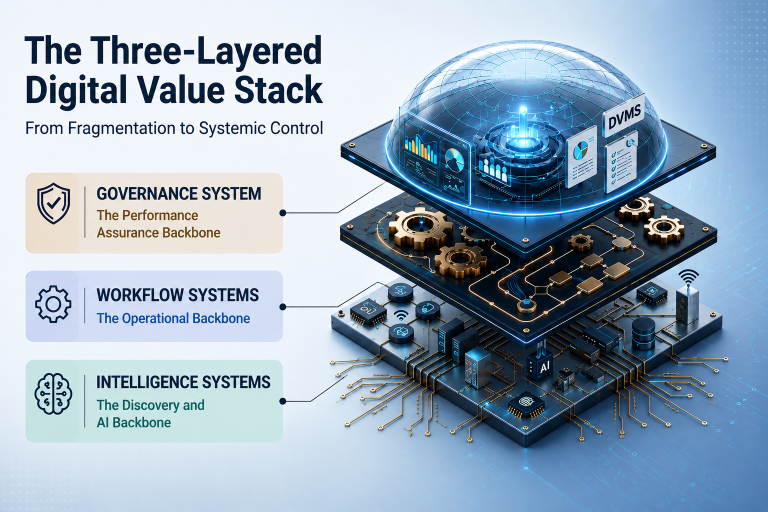
The Three-Layered Digital Value Stack provides a model for resolving this complexity. It organizes the digital enterprise into three distinct but interdependent layers: Discovery and AI Systems as the intelligence foundation, Workflow Systems as the operational backbone, and Governance as the performance assurance backbone. Together, these layers transform disconnected capabilities into a coordinated system that delivers visibility, control, and measurable value.
The Intelligence Foundation: Discovery and AI Systems
At the base of the stack sits the intelligence foundation, represented by discovery and AI-driven systems such as Armis and Anthropic. This layer is responsible for generating continuous visibility into the digital environment. It identifies assets across networks, including devices that are often unmanaged or invisible, such as IoT and operational technology. More importantly, it monitors behavior, detects anomalies, and surfaces vulnerabilities in real time.
This foundational layer addresses one of the most persistent gaps in digital operations: incomplete awareness. Without accurate visibility into what exists and how it behaves, higher-level systems operate on assumptions rather than evidence. Discovery and AI systems eliminate this uncertainty by producing high-fidelity, continuously updated intelligence about the environment.
However, this layer does not provide governance or decision-making. Its role is to ensure that the enterprise has a reliable and comprehensive understanding of its operational reality. The value of this intelligence is realized only when it is consumed and structured by the layers above.
The Operational Backbone: Workflow Systems
Above the intelligence foundation sits the operational backbone, represented by workflow platforms such as ServiceNow, Salesforce, and Atlassian. This layer transforms raw intelligence into structured, actionable processes. It is where workflows are executed, controls are enforced, and operational data is captured and managed at scale.
Workflow systems serve as the integration point for the enterprise. They ingest data from discovery and AI systems, normalize it, and connect it to services, processes, and control frameworks. In doing so, they provide context, linking technical signals to operational activities. Risks identified at the device or network level become associated with services, incidents, and workflows, enabling coordinated response and management.
This layer is also where governance becomes executable. Policies, controls, and performance measures defined at higher levels are implemented through workflows, records, and automation. The operational backbone ensures consistency, traceability, and scalability, allowing organizations to move from ad hoc responses to repeatable, managed processes.
While critical, this layer does not define what should be governed or how value is measured. It executes and operationalizes, but it requires direction and structure from the layer above.
The Governance Overlay: DVMS
At the top of the stack sits the Digital Value Management System (DVMS), which acts as the governance overlay for the entire digital enterprise. DVMS is not a tool or platform; it is a management system that defines how digital operations are structured, measured, and aligned to business value.
DVMS establishes value streams, defines performance objectives, and sets the policies and control frameworks that guide operations. It determines what matters, what should be measured, and how success is evaluated. In this role, it gives meaning to the data and activities generated by the underlying layers.
Rather than collecting raw data itself, DVMS relies on structured information from workflow systems. It interprets this information in the context of value delivery, resilience, and risk. By doing so, it enables leadership to evaluate performance not as isolated technical metrics but as indicators of business outcomes.
As a governance overlay, DVMS ensures that all digital activities, regardless of their origin, align with a coherent operating model. It connects strategy to execution and provides a consistent approach for decision-making and accountability.
Data Flow Across the Stack: From Visibility to Value
The effectiveness of the Three-Layered Digital Value Stack depends on the flow of data and intelligence across its layers. At the foundation, discovery and AI systems generate detailed insights about assets, behavior, and risk. This information flows upward into workflow systems, where it is contextualized and integrated into operational processes.
Within the operational backbone, data is enriched and linked to services, workflows, and control structures. It becomes part of a unified data model that reflects how the organization operates. This structured information is then consumed by DVMS, which evaluates it based on performance, risk, and value delivery.
This upward flow transforms raw signals into actionable intelligence and ultimately into strategic insight. It creates a system in which decisions are based on evidence, and where visibility at the lowest levels directly informs governance at the highest levels.
Aligning Risk, Performance, and Business Value
One of the most significant outcomes of this layered model is the alignment of technical risk and operational performance with business value. Risks identified at the intelligence layer are no longer isolated technical concerns. Through the operational backbone, they are linked to services and processes, and through DVMS, they are evaluated based on their impact on value streams and outcomes.
This alignment changes how organizations prioritize and respond to risk. Decisions are no longer driven solely by severity or urgency at the technical level but by their implications for business performance and resilience. As a result, risk management becomes an integrated part of the overall management system rather than a separate function.
Enabling Continuous Assurance and Feedback
The integration of these layers creates a continuous feedback loop that supports ongoing assurance. Discovery systems provide real-time monitoring of the environment. Workflow systems capture and organize this information within operational processes. DVMS uses this structured data to evaluate control effectiveness and performance against defined objectives.
This continuous cycle allows organizations to maintain an up-to-date understanding of their operational state. Changes in the environment are immediately reflected in workflows and evaluated within the governance framework. Continuous assurance becomes an inherent capability of the system rather than a periodic activity.
Establishing Accountability Across Layers
The Three-Layered Digital Value Stack also clarifies accountability by defining distinct roles for each layer. The intelligence foundation is responsible for visibility and detection. The operational backbone is responsible for execution and control. The governance overlay is responsible for structure, evaluation, and alignment to value.
This separation ensures that responsibilities are clear and traceable. When issues arise, they can be followed through the stack, from detection to response to evaluation. This traceability strengthens accountability and enables coordinated action across the enterprise.
From Fragmentation to a Structured Operating Model
The transition from fragmented systems to a structured operating model is at the heart of this approach. Instead of attempting to eliminate complexity, the stack organizes it. Each layer performs a specific function, and together they create a cohesive system that is greater than the sum of its parts.
Discovery and AI systems provide the visibility needed to understand the environment. Workflow systems connect and manage operational activities. DVMS ensures that everything is aligned, governed, and measured in terms of value. This structure reduces ambiguity, improves coordination, and enables more effective management of digital operations.
Conclusion: A Unified System for Digital Value Management
The Three-Layered Digital Value Stack illustrates how modern enterprises can move beyond disconnected technologies to a unified management system. By separating intelligence, execution, and governance into distinct yet integrated layers, organizations can see clearly, act consistently, and measure effectively.
DVMS provides a governing structure that aligns all activity to value. Workflow systems operate the structure through processes and data. Discovery and AI systems supply the intelligence that makes everything visible and measurable. Together, they form a system that is not only functional but also controlled, accountable, and continuously improving.
This is the foundation of a true Digital Value Management System, one that transforms complexity into clarity and enables organizations to deliver sustained digital business value.
About the Author

Rick Lemieux
Co-Founder and Chief Product Officer of the DVMS Institute
Rick has 40+ years of passion and experience creating solutions to give organizations a competitive edge in their service markets. In 2015, Rick was identified as one of the top five IT Entrepreneurs in the State of Rhode Island by the TECH 10 awards for developing innovative training and mentoring solutions for boards, senior executives, and operational stakeholders.
Digital Value Management System® is a registered trademark of the DVMS Institute LLC.
® DVMS Institute 2026 All Rights Reserved