Digital Fragmentation: The Hidden Root Cause of Modern Enterprise Risk
Rick Lemieux – Co-Founder and Chief Product Officer of the DVMS Institute
In today’s digital economy, organizations are more connected, data-driven, and technology-dependent than ever before. Cloud platforms, third-party services, distributed teams, and complex application ecosystems have enabled unprecedented innovation and scalability. Yet beneath this progress lies a growing and often overlooked problem: digital fragmentation.
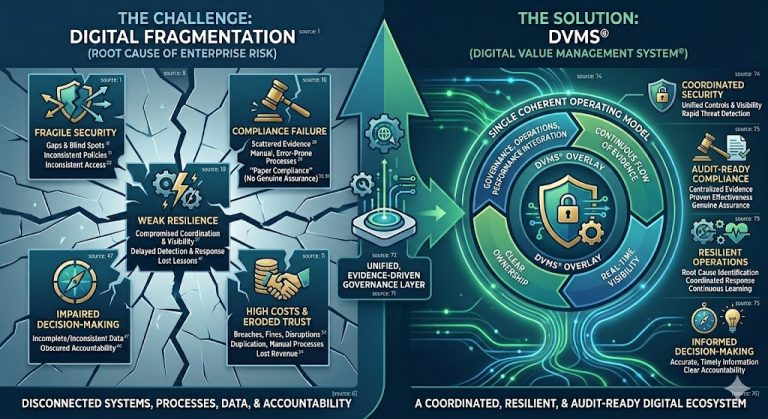
While leaders frequently focus on cybersecurity threats, regulatory compliance, and operational resilience as separate challenges, these issues are increasingly symptoms of a deeper, more systemic condition. Digital fragmentation, the disconnection of systems, processes, data, and accountability, is the root cause behind many of the most critical challenges modern organizations face.
Understanding Digital Fragmentation
Digital fragmentation occurs when an organization’s technology landscape evolves in a disconnected and uncoordinated manner. Systems are implemented to solve immediate needs, teams adopt tools independently, and processes develop in silos. Over time, this creates a patchwork of platforms, workflows, and data sources that lack integration and coherence. Information becomes scattered, responsibilities become unclear, and decision-making becomes fragmented. What begins as a natural byproduct of growth and innovation gradually turns into a structural weakness that undermines the organization’s ability to operate effectively.
This fragmentation is not limited to technology. It extends to governance, where policies and controls are inconsistently applied; to operations, where processes vary across teams; and to culture, where accountability is diffused. The result is an environment where no single view of truth exists, and where leaders struggle to understand how their organization is truly performing.
Fragmentation and Security Risk
One of the most immediate consequences of digital fragmentation is increased security risk. Cybersecurity depends on visibility, consistency, and coordination. When systems are fragmented, these foundational elements break down. Security controls may be implemented differently across platforms, creating gaps that attackers can exploit. Monitoring tools may not communicate with each other, leading to blind spots in threat detection. Incident response efforts may be delayed or ineffective due to unclear ownership and disconnected workflows.
Moreover, fragmented environments make it difficult to enforce security policies uniformly. For example, identity and access management may differ across systems, leading to inconsistent authentication and authorization practices. This inconsistency increases the likelihood of unauthorized access and data breaches. In such an environment, even well-designed security frameworks struggle to deliver their intended outcomes because the underlying structure is not cohesive.
The Link Between Fragmentation and Compliance Failure
Compliance is another area where the impact of digital fragmentation is profound. Regulatory frameworks and standards require organizations to demonstrate control, accountability, and evidence of compliance. However, in fragmented environments, evidence is often scattered across multiple systems and maintained in inconsistent formats. Gathering this evidence is a manual, time-consuming process prone to error.
Organizations frequently respond by creating documentation that does not accurately reflect reality, leading to what is often called “paper compliance.” While this may satisfy audit requirements in the short term, it does not provide genuine assurance. When auditors require proof of control effectiveness, organizations struggle to provide timely and reliable evidence. This not only increases the risk of audit failure but also erodes trust with regulators, customers, and partners.
Fragmentation also complicates the implementation of controls. When systems operate independently, controls must be duplicated or adapted, increasing complexity and the likelihood of inconsistencies. Instead of a unified compliance strategy, organizations are left managing a series of disconnected efforts that are difficult to sustain.
Operational Resilience in a Fragmented Environment
Operational resilience, the ability to withstand and recover from disruptions, is critically dependent on coordination and visibility. In a fragmented environment, both are compromised. When systems and processes are disconnected, it becomes difficult to identify the root cause of issues, assess their impact, and coordinate a response. Delays in detection and response can turn minor incidents into major disruptions.
Fragmentation also affects the organization’s ability to learn from incidents. Without a unified system for capturing and analyzing data, lessons learned are often lost or not shared across the enterprise. This prevents continuous improvement and leaves the organization vulnerable to repeated failures. In contrast, a cohesive environment enables organizations to detect patterns, implement corrective actions, and strengthen their resilience over time.
The Impact on Decision-Making and Leadership Visibility
Beyond security, compliance, and resilience, digital fragmentation also significantly impacts decision-making. Leaders rely on accurate and timely information to make informed decisions. In fragmented environments, data is often incomplete, outdated, or inconsistent. This leads to decisions based on partial insights, increasing the risk of poor outcomes.
Additionally, fragmentation obscures accountability. When responsibilities are not clearly defined, it becomes difficult to determine who is responsible for specific outcomes. This can lead to delays in decision-making, as issues are passed between teams without resolution. Over time, this lack of accountability erodes organizational effectiveness and undermines confidence in leadership.
The Cost of Fragmentation
The consequences of digital fragmentation are not limited to operational inefficiencies; they have direct financial implications. Security breaches, compliance failures, and operational disruptions can result in high costs, including fines, legal expenses, and lost revenue. Additionally, the inefficiencies created by fragmented systems—such as duplication of effort and manual processes- reduce productivity and increase operational costs.
Perhaps most importantly, fragmentation erodes trust. Customers, partners, and regulators expect organizations to operate reliably and transparently. When fragmentation leads to failures, this trust is compromised, and rebuilding it can be both difficult and costly.
Moving Toward Operational Coherence
Addressing digital fragmentation requires a shift from isolated problem-solving to a holistic approach that emphasizes operational coherence. Organizations must move beyond managing individual systems and processes to create a unified system that integrates governance, operations, and performance. This involves establishing consistent standards, aligning processes, and ensuring seamless data flow across the organization.
A key aspect of this transformation is the adoption of evidence-driven practices. By capturing and analyzing operational data, organizations can gain real-time visibility into performance and risk. This enables proactive decision-making and continuous improvement, reducing the likelihood of failures.
The Role of Unified Governance
Unified governance plays a critical role in overcoming fragmentation. By providing a structured approach to managing policies, controls, and accountability, it ensures that all aspects of the organization are aligned with strategic objectives. This alignment enables organizations to enforce consistency, maintain visibility, and demonstrate compliance effectively.
Unified governance also supports resilience by enabling coordinated responses to disruptions. When systems and processes are integrated, organizations can quickly identify issues, assess their impact, and implement corrective actions. This not only improves operational performance but also enhances the organization’s ability to adapt to changing conditions.
Eliminating Digital Fragmentation Through Unified, Evidence-Driven Governance
The Digital Value Management System® (DVMS) solves the problem of digital fragmentation by introducing a unified, evidence-driven governance layer that connects systems, processes, data, and accountability into a single coherent operating model.
Rather than replacing existing technologies, the DVMS overlays them with structured governance, aligning strategy with execution and standardizing how controls, decisions, and performance are measured and validated.
By integrating frameworks, standards, and operational activities into a continuous flow of evidence, the DVMS eliminates silos, provides real-time visibility, and establishes clear ownership across the enterprise.
This enables organizations to move from disconnected, reactive operations to a coordinated, resilient, and audit-ready digital ecosystem where security, compliance, and performance are continuously assured as part of how the business operates.
Conclusion
Digital fragmentation is not just a technical issue; it is a fundamental organizational challenge that affects every aspect of performance. It is the root cause of many of the most critical issues modern organizations face, including security risks, compliance failures, and a lack of operational resilience. By creating gaps in visibility, consistency, and accountability, fragmentation undermines the effectiveness of even the most well-designed frameworks and controls.
To address this challenge, organizations must adopt an operational coherence model that integrates systems, processes, and governance into a unified whole. By doing so, they can transform fragmentation from a source of risk into an opportunity for improvement, enabling them to operate more effectively, respond to challenges with confidence, and build a foundation for sustainable success in the digital age.
About the Author

Rick Lemieux
Co-Founder and Chief Product Officer of the DVMS Institute
Rick has 40+ years of passion and experience creating solutions to give organizations a competitive edge in their service markets. In 2015, Rick was identified as one of the top five IT Entrepreneurs in the State of Rhode Island by the TECH 10 awards for developing innovative training and mentoring solutions for boards, senior executives, and operational stakeholders.
Digital Value Management System® is a registered trademark of the DVMS Institute LLC.
® DVMS Institute 2026 All Rights Reserved