Defining the Digital Value Management System® (DVMS)
Rick Lemieux – Co-Founder and Chief Product Officer of the DVMS Institute
Modern digital enterprises are increasingly dependent on interconnected systems, cloud platforms, third-party services, data-driven processes, and the frameworks, standards, and maturity models that govern them. While these capabilities enable innovation and growth, they also introduce fragmentation, risk, and reduced visibility across operations. Many enterprises struggle to maintain consistency, enforce accountability, and demonstrate compliance in this environment.
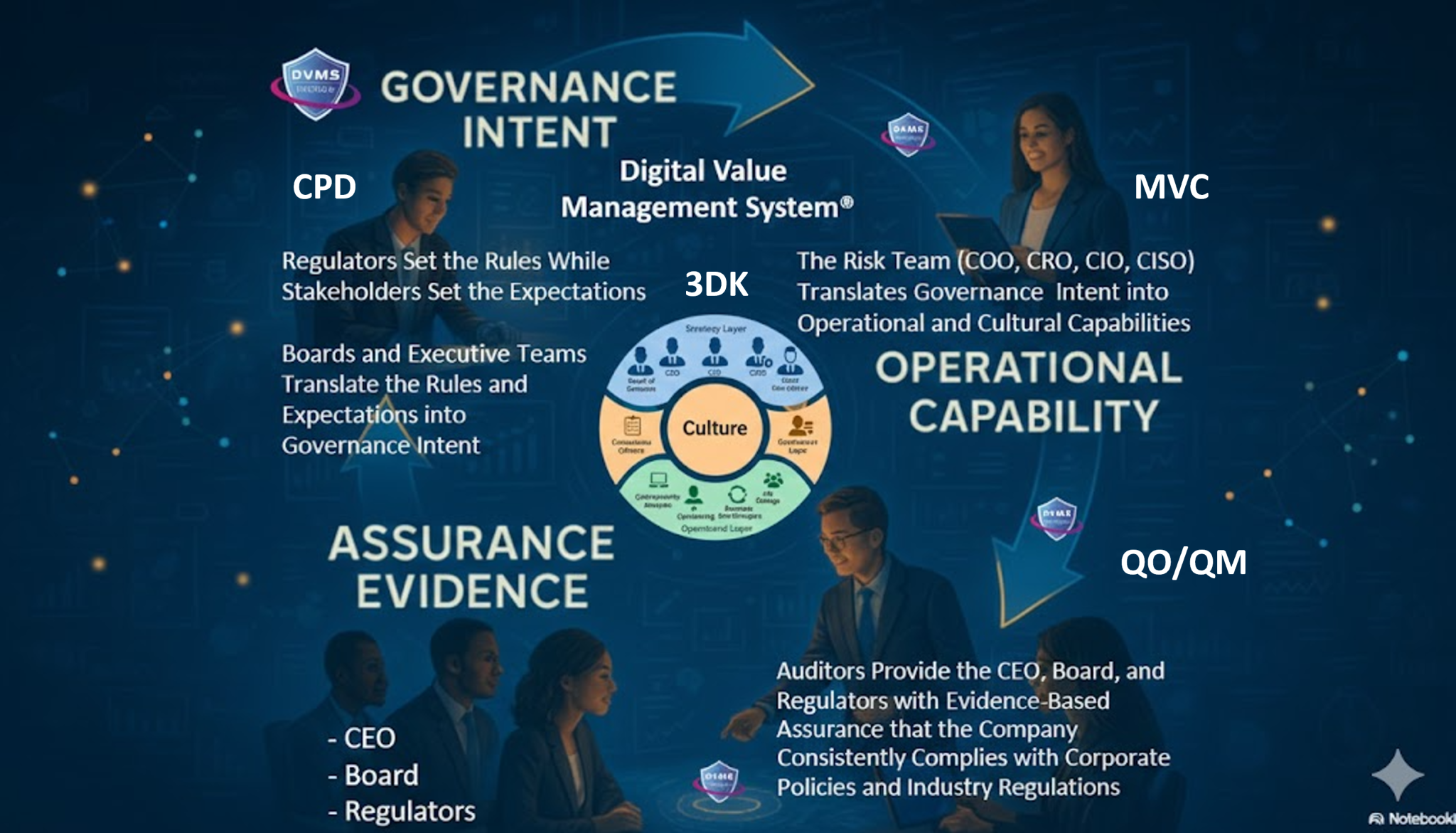
The Digital Value Management System® (DVMS) addresses this challenge by providing a unified, evidence-driven governance system that transforms fragmented digital operations into a resilient, assured, and audit-ready digital ecosystem. It represents a fundamental shift from disconnected management practices to an integrated, outcome-focused approach to digital governance.
The Challenge of Fragmented Digital Operations
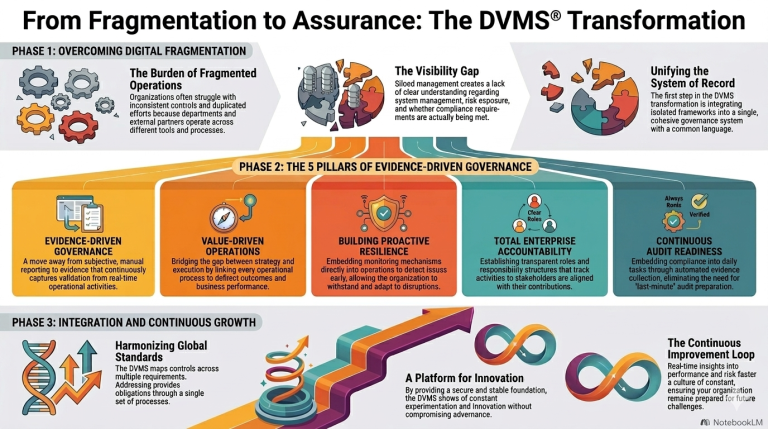
Modern digital operations are rarely centralized. Organizations operate across multiple platforms, departments, and external partners, each with its own tools, processes, and standards. This fragmentation leads to inconsistent controls, duplicated efforts, and gaps in accountability. As a result, organizations often lack a clear understanding of how their systems are performing, where risks exist, and whether compliance requirements are being met. These challenges are compounded by the increasing pace of change, as new technologies and regulatory expectations continue to evolve. Without a unified approach, organizations are forced into reactive modes of operation, addressing issues only after they arise rather than proactively managing them.
A Unified, Evidence-Driven Governance System
The DVMS brings structure and coherence to this fragmented landscape by establishing a unified, evidence-driven governance system. Instead of managing frameworks, standards, and maturity model systems in isolation, the DVMS integrates them into a single system of record. This unified approach ensures that all aspects of digital operations are aligned with organizational objectives and governed consistently across the enterprise. By creating a common language and structure, the DVMS eliminates silos and enables cross-functional collaboration. It allows organizations to move beyond isolated compliance efforts toward a holistic governance model that spans the entire digital ecosystem.
The Power of Evidence-Driven Governance
At the heart of the DVMS is the concept of evidence-driven governance. Traditional governance models often rely on periodic assessments, manual reporting, and subjective evaluations. These approaches can be time-consuming, error-prone, and insufficient for demonstrating real-time compliance. The DVMS replaces these methods with a system that continuously captures, validates, and analyzes evidence from operational activities. Every control, process, and outcome is supported by verifiable data, providing a clear and objective view of performance. This evidence-driven approach not only enhances transparency but also builds trust among stakeholders, auditors, and regulators by demonstrating that governance is grounded in measurable outcomes rather than assumptions.
Transforming Operations into a Value-Driven System
One of the most significant contributions of DVMS is its ability to transform digital operations into a value-driven system. In many organizations, operational activities are disconnected from strategic objectives, making it difficult to measure their impact on business performance. DVMS bridges this gap by linking operational processes to defined outcomes such as resilience, accountability, and compliance. It ensures that every activity contributes to the organizational overall value. By aligning operations with strategy, the DVMS enables organizations to optimize performance, reduce inefficiencies, and make informed decisions based on real-time data.
Building Resilience in a Dynamic Environment
Resilience is a critical capability in today’s digital landscape, where disruptions can occur at any time. Whether caused by cyber threats, system failures, or external events, these disruptions can have significant consequences for business continuity and reputation. The DVMS enhances resilience by embedding controls and monitoring mechanisms directly into operations. It enables organizations to detect issues early, respond effectively, and recover quickly. By maintaining continuous visibility into system performance and risk exposure, the DVMS ensures that organizations are prepared to withstand and adapt to changing conditions. This proactive approach to resilience is essential for maintaining stability and confidence in a rapidly evolving environment.
Ensuring Accountability Across the Enterprise
Accountability is a cornerstone of effective governance, yet it is often difficult to achieve in fragmented digital environments. Without clear ownership and visibility, it becomes challenging to determine who is responsible for specific processes or outcomes. The DVMS addresses this issue by establishing defined roles, responsibilities, and accountability structures for all aspects of digital operations. It tracks activities and outcomes transparently, ensuring that responsibilities are clearly assigned and monitored. This level of accountability not only improves operational efficiency but also strengthens organizational integrity by ensuring that all stakeholders are aligned and responsible for their contributions.
Achieving Continuous Audit Readiness
Audit readiness is a major concern for organizations operating in regulated industries. Traditional approaches to audits often involve significant preparation, including gathering documentation, validating controls, and addressing gaps. This process can be disruptive and resource-intensive. The DVMS transforms audit readiness into a continuous capability by embedding compliance into daily operations. Through automated evidence collection and real-time monitoring, organizations can demonstrate compliance at any moment. This eliminates the need for last-minute preparation and reduces the stress associated with audits. By maintaining a constant state of readiness, organizations can approach audits with confidence and efficiency.
Integrating Standards and Maturity Models
Organizations are often required to comply with multiple standards and maturity models, such as ISO frameworks, CMMC, and industry-specific regulations. Managing these requirements separately can lead to duplication and inefficiency. The DVMS simplifies this process by integrating these frameworks into a unified system. It maps controls and requirements across standards, allowing organizations to address multiple obligations through a single set of processes. This integration not only reduces complexity but also ensures consistency and alignment across all compliance activities. By providing a comprehensive view of governance, the DVMS enables organizations to better manage their obligations.
Driving Continuous Improvement and Innovation
The DVMS is not just a tool for maintaining compliance; it is a platform for continuous improvement and innovation. By providing real-time insights into performance and risk, it enables organizations to identify areas for enhancement and implement changes proactively. This continuous feedback loop fosters a culture of improvement, where organizations are constantly evolving to meet new challenges and opportunities. At the same time, the DVMS supports innovation by providing a stable and secure foundation for experimentation and growth. Balancing control with flexibility allows organizations to innovate without compromising governance.
Conclusion
The Digital Value Management System® represents a transformative approach to digital governance. By unifying fragmented operations, leveraging evidence-driven processes, and aligning activities with strategic outcomes, organizations can achieve resilience, assurance, and continuous audit readiness.
In a world where complexity and risk are ever-increasing, the DVMS provides the structure and visibility needed to navigate these challenges effectively. It empowers organizations of all sizes to move beyond reactive management to a proactive, integrated governance model that delivers measurable value. As digital ecosystems continue to evolve, the DVMS stands as a critical enabler of sustainable success, ensuring that organizations remain resilient, accountable, and prepared for whatever lies ahead.
About the Author

Rick Lemieux
Co-Founder and Chief Product Officer of the DVMS Institute
Rick has 40+ years of passion and experience creating solutions to give organizations a competitive edge in their service markets. In 2015, Rick was identified as one of the top five IT Entrepreneurs in the State of Rhode Island by the TECH 10 awards for developing innovative training and mentoring solutions for boards, senior executives, and operational stakeholders.
Digital Value Management System® is a registered trademark of the DVMS Institute LLC.
® DVMS Institute 2026 All Rights Reserved