DVMS and ITIL 5: Why the Overlay Becomes Necessary
David Moskowitz – Founder Member and Chief Content Architect, at the DVMS Institute
Discussions of ITIL versions typically focus on what has changed, how each version builds on the last, or how to adopt it. That framing centers on understanding ITIL 5. It is useful, but it does not address the central challenge: how organizations translate what ITIL describes into sustained activities that produce outcomes.
ITIL 5 outlines service management practices, relationships, and outcomes within a value system. However, describing them is insufficient to produce results without a structured approach to operationalize them under real-world conditions. As a descriptive framework, ITIL 5 defines what should be done but not how it’s done.
That distinction between describing what should be done and operationalizing how it is accomplished is where most attempts to translate ITIL guidance into practice break down.
The symptoms are familiar: organizations “implement ITIL” as a program based on the mistaken assumption that “ITIL says…” They expand process libraries but see limited measurable impact. Value flow concepts are acknowledged but rarely operationalized. Alignment with business outcomes is discussed without being consistently achieved, and tools are configured while that activity is treated as ITIL adoption.
The responses are predictable: more training, more certification, more process refinement, and more tools, all of which address the visible symptoms but do not resolve the underlying problem.
ITIL 5 provides meaningful guidance. The challenge is structural. Organizations often lack a system that enables sustained organizational performance from that guidance.
ITIL 5 describes what effective service management looks like. It does not define how strategy, risk, governance, culture, and execution operate together as a coherent system.
Consider a simple analogy.
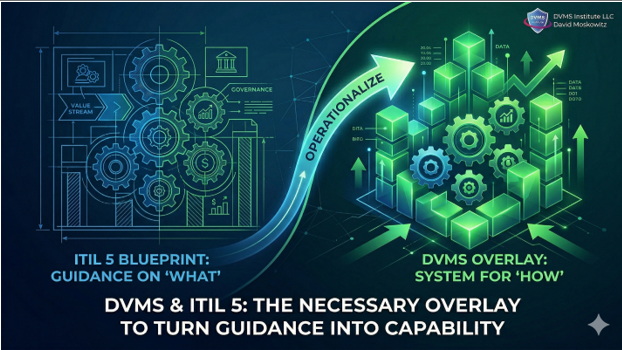
A blueprint defines how a building should be constructed. The blueprint shows structure, relationships, and intended outcomes. But a blueprint does not coordinate construction, validate materials, or adapt to changing conditions. Without a system to manage execution and feedback, the blueprint remains theoretical.
ITIL 5 is the blueprint.
At this point, the difference becomes apparent. ITIL 5 offers a solid and well-structured framework, but it does not fully explain how to integrate and implement it within existing organizational systems. This raises the question of whether the organization can achieve the outcomes described in ITIL 5 under real-world conditions.
Four structural considerations typically emerge.
First, integration as an operational challenge.
ITIL 5 describes practices across value flows that are often implemented as isolated processes. Strategy is separated from risk. Governance is separated from execution. Practices are optimized locally rather than systemically.
The result is fragmentation. Organizational structure often remains unchanged, even when some behaviors shift. The deeper constraint is cultural. Often invisible to staff, it acts as a “mind killer” that undermines sustained change.
Second, assurance as an operational discipline.
Many ITIL-aligned efforts tend to emphasize compliance. Are processes defined? Are processes followed? Have audits been passed? These are necessary questions, but they are insufficient.
An additional requirement is validation. A control, practice, or process may exist and be documented, but this does not mean that it works under current conditions or supports intended outcomes.
The relevant questions are different: How do you know…? How can you be sure…?
Without evidence-based answers, decisions rely on assumptions.
Third, culture as a conditioning factor.
Culture shapes behavior across the system. If cultural conditions reinforce silos, local optimization, or risk avoidance, then attempts to adapt any framework will not succeed. The underlying cultural conditions shape behavior in ways that prevent integration, regardless of how lucid the descriptive narrative may be.
Integration becomes difficult to sustain.
Recognizing this relationship moves culture from a secondary concern to a primary determinant of outcomes.
Fourth, governance in dynamic environments.
ITIL 5 places greater emphasis on governance and the impact of AI-enabled environments. Governance in this context is not limited to policy definition or oversight. Governance includes decision rights, accountability, and the ability to manage dynamic, technology-driven risk.
AI introduces variability, opacity, and speed. ITIL 5 acknowledges these conditions and emphasizes governance, validation, and responsible adoption. However, as a descriptive framework, it provides guidance on what must be considered rather than defining how organizations operationalize those considerations in real time.
At this point, the challenge should come into focus.
A system is needed to integrate practices, connect strategy and risk, validate outcomes through evidence, and operate effectively within existing cultural conditions. That system must also support governance in environments shaped by continual change.
That requirement exists whether it is acknowledged or not. This calls for a system that subsumes what the organization already does across the enterprise, integrating existing practices into a coherent operational model, exposing gaps and interdependencies, and enabling validation of outcomes within existing organizational structures and cultural conditions. This type of system can be understood as an overlay. The Digital Value Management System® (DVMS) fulfills this role.
The DVMS provides a set of minimum viable capabilities: Govern, Assure, Plan, Design, Change, Execute, and Innovate. These are not practices; they define enterprise-wide capabilities. “Capability,” in this context, refers to the organizational ability to achieve its intended outcomes.
All existing and future activities align with and are evaluated against one or more of these capabilities. They are not layered on top of ITIL 5. They provide the structure required to operationalize what ITIL 5 describes.
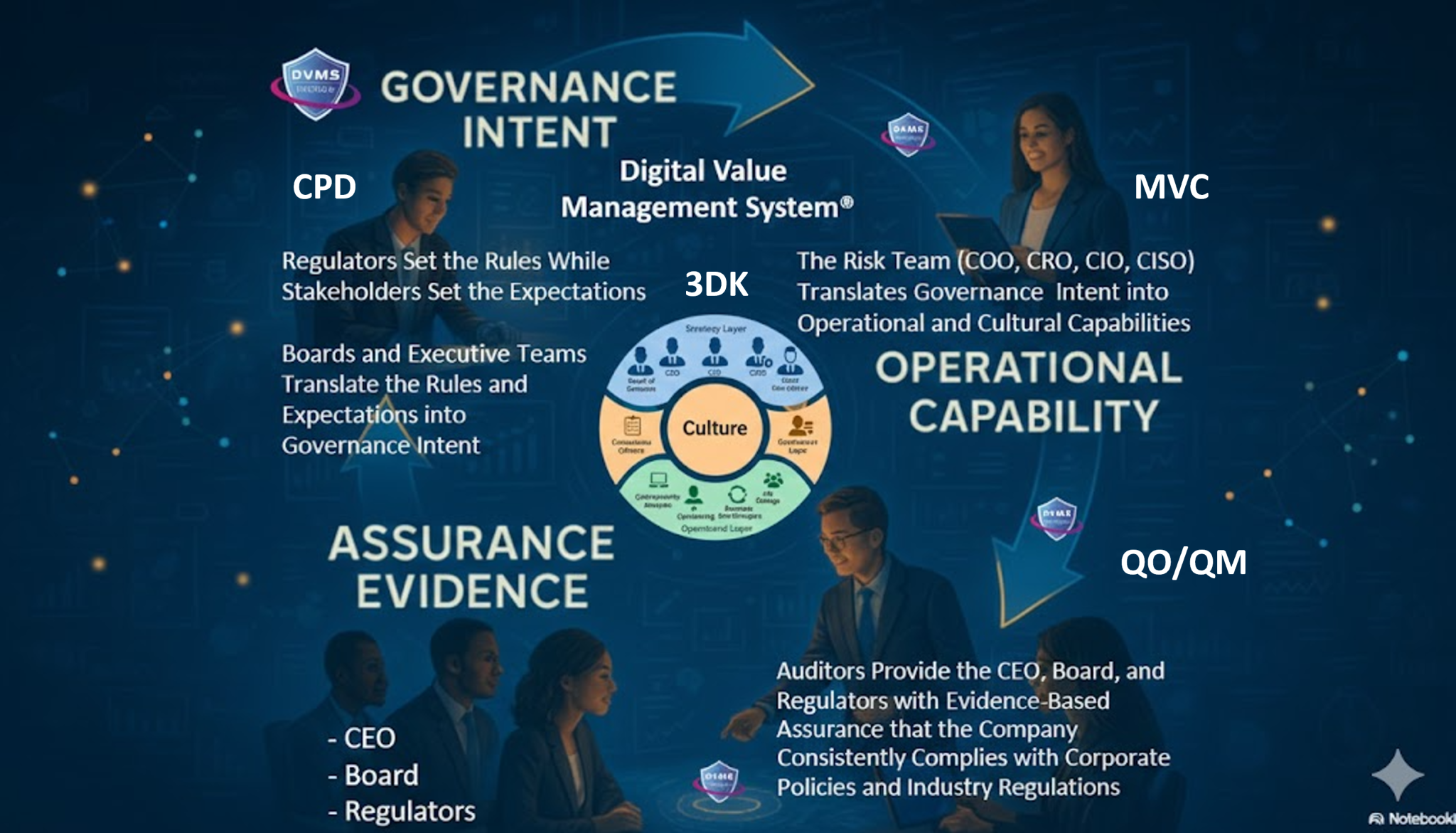
DVMS connects decisions to strategy-risk. Strategy-risk reflects the reality that every strategic decision carries uncertainty, and that every response to that uncertainty shapes strategy. Treating strategy and risk separately creates latency and blind spots. Integrating strategy and risk ensures that value creation and value protection occur together.
DVMS introduces assurance as a discipline that addresses both fit for purpose and fit for use. Controls and processes are not only defined but also continually validated against current conditions.
DVMS treats culture as a conditioning field. Culture is not embedded or engineered by the framework. Culture influences how the system behaves, and the DVMS makes that influence visible and actionable.
DVMS supports governance through feedback loops, evidence-based validation, and continual adaptation. These mechanisms support operation in environments shaped by AI and other rapidly changing technologies.
What does this mean in practice?
ITIL 5 adoption without an overlay often produces incremental improvement. Practices may mature, terminology may align, and some efficiencies may improve. However, organizations may still find it difficult to achieve the adaptive, resilient, value-centered outcomes ITIL 5 describes.
With an overlay, the same ITIL 5 guidance can be translated into operational activities that perform under the stress of real conditions.
Practices align with how the organization achieves outcomes. These outcomes connect directly to strategy-risk. Assurance validates outcomes for both purpose and use. Feedback loops drive adaptation. Culture conditions determine whether those mechanisms succeed or fail.
The distinction is not in the framework itself, but in the system used to apply it.
So, is DVMS optional for ITIL 5?
It may be considered optional if the goal is partial adoption.
If the goal is to realize what ITIL 5 describes, it must be integrated, adaptive, and value-centered service management. In that case, an overlay that operationalizes those descriptions becomes a necessary part of the approach.
About the Author

David Moskowitz – Founding Member and Chief Content Architect, at the DVMS Institute
David is a Founding Member and Executive Director of the DVMS Institute LLC. He is the lead author of the “Digital Value Management System®” publication series which include the *Fundamentals of Adopting the NIST Cybersecurity Framework* and *A Practitioner’s Guide to Adapting the NIST Cybersecurity Framework*, and Thriving on the Edge of Chaos published by TSO
Digital Value Management System® is a registered trademark of the DVMS Institute LLC.
® DVMS Institute 2026 All Rights Reserved