The New Imperative: Why Assurance, Resilience, and Audit Readiness Define the Modern Digital Enterprise
Rick Lemieux – Co-Founder and Chief Product Officer of the DVMS Institute
Explainer Video
In 2026, digital enterprises are no longer judged solely by innovation, speed, or scale. They are evaluated by something more fundamental: their ability to deliver trustworthy, continuous, and provable outcomes in increasingly complex and regulated environments.
As organizations digitize every aspect of their operations, from customer engagement to supply chains and critical infrastructure, they inherit new forms of risk, accountability, and scrutiny. In this context, three priorities have emerged as essential: Assurance, Resilience, and Audit Readiness. Together, they form the foundation of what it means to operate a credible, compliant, and competitive digital enterprise today.
Assurance: Proving Performance, Not Just Promising It
Assurance has become the cornerstone of modern digital governance because organizations are no longer trusted based on intent or documentation alone; they are expected to prove that their systems and processes are functioning as intended, continuously and measurably. Traditional approaches to governance relied heavily on policies, controls, and periodic assessments. While these elements are still necessary, they are no longer sufficient in a world where digital systems are dynamic, interconnected, and constantly evolving.
Today’s stakeholders, including regulators, customers, partners, and boards, demand evidence-based confidence. They want to know not only that controls exist, but that they are effective in real time. This shift is evident across frameworks such as NIST CSF 2.0, CMMC, and ISO standards, which all emphasize continuous monitoring, measurement, and validation. Assurance, therefore, is not a static state but an ongoing capability: the ability to continuously validate performance, compliance, and risk posture through verifiable evidence.
For digital enterprises, this means embedding assurance into the fabric of operations. It requires systems that can automatically generate, collect, and analyze evidence, and governance models that translate that evidence into actionable insights. Without assurance, organizations operate on assumptions that can quickly break down under scrutiny or disruption. With assurance, they gain the ability to demonstrate trustworthiness at scale, which is increasingly a prerequisite for doing business in regulated and high-stakes environments.
Resilience: Sustaining Operations in the Face of Disruption
While assurance answers the question “Can you prove it?”, resilience addresses an equally critical concern: “Can you keep operating when things go wrong?” In today’s threat landscape, disruption is not a matter of if, but when. Cyberattacks, system failures, supply chain interruptions, and geopolitical instability all pose significant risks to digital operations. As a result, resilience has moved from a technical consideration to a strategic, board-level priority.
Operational resilience is about more than disaster recovery or business continuity planning. It encompasses the ability to anticipate, withstand, recover from, and adapt to disruptions while maintaining critical functions. This includes not only IT systems but also the broader ecosystem of processes, people, and third-party dependencies that support digital operations. Regulations such as the EU’s Digital Operational Resilience Act (DORA) and the growing expectations of regulators worldwide underscore the importance of resilience as a measurable, enforceable capability.
For digital enterprises, achieving resilience requires a shift from reactive to proactive thinking. It involves designing systems with redundancy, observability, and fault tolerance, as well as establishing governance structures that continuously assess and improve resilience posture. Importantly, resilience is closely linked to assurance: organizations must not only be resilient but also be able to demonstrate that resilience through evidence and testing.
In a competitive landscape, resilience is also a differentiator. Organizations that maintain service continuity and protect critical operations during disruptions gain a significant advantage in customer trust and market stability. Conversely, those that fail to do so risk reputational damage, regulatory penalties, and financial loss. Resilience, therefore, is not just about survival; it is about sustained performance under pressure.
Audit Readiness: Operating in a State of Continuous Accountability
Audit readiness completes the triad by addressing the question: “Are you always prepared to demonstrate compliance and control effectiveness?” Historically, audits were periodic events that organizations prepared for in cycles—often involving significant manual effort, last-minute documentation, and reactive remediation. This model is increasingly incompatible with the pace and complexity of modern digital operations.
Today, audits are more frequent, more rigorous, and often triggered by events rather than schedules. Regulatory environments such as CMMC, financial oversight bodies, and industry standards require organizations to maintain a continuous state of readiness, with evidence readily available and controls consistently enforced. Audit readiness is no longer a project; it is an operational condition.
Achieving this level of readiness requires integrating audit considerations into everyday processes. Evidence must be captured as a byproduct of normal operations, not assembled after the fact. Controls must be continuously monitored and validated, not just periodically reviewed. Governance systems must provide clear traceability, linking policies, controls, activities, and outcomes in a way that can be easily demonstrated to auditors.
The benefits of continuous audit readiness extend beyond compliance. Organizations that are always prepared for audits experience reduced audit costs, less disruption, and greater confidence in their control environment. They avoid the inefficiencies and risks associated with last-minute preparation and are better positioned to respond to regulatory changes. In essence, audit readiness transforms compliance from a burden into a byproduct of well-governed operations.
The Power of Integration: Why These Three Priorities Must Work Together
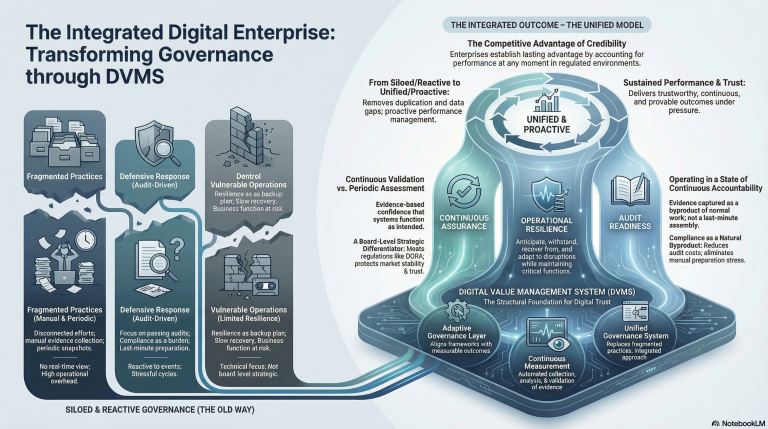
While assurance, resilience, and audit readiness are each critical on their own, their true value emerges when they are integrated into a unified operating model. In many organizations, these areas are managed in silos, assurance by GRC teams, resilience by IT and security, and audit readiness by internal audit or compliance functions. This fragmentation leads to duplication of effort, inconsistent data, and gaps in visibility.
A modern digital enterprise must instead adopt an integrated approach in which these priorities reinforce one another. Assurance provides evidence that supports both resilience and audit readiness. Resilience ensures that assured systems can continue to operate under stress. Audit readiness ensures that both assurance and resilience can be demonstrated to external stakeholders at any time. Together, they create a system of continuous, evidence-driven governance.
This integration is also what enables organizations to move from reactive compliance to proactive performance management. Instead of responding to audits, disruptions, and regulatory demands as isolated events, they can manage these factors as part of a cohesive strategy. The result is greater efficiency, reduced risk, and improved alignment between digital operations and business objectives.
How a Digital Value Management System (DVMS) Enables Continuous Assurance, Resilience, and Audit Readiness
The Digital Value Management System (DVMS) provides the structural foundation that modern digital enterprises need to move from fragmented, reactive practices to continuous, integrated, and evidence-driven operations. Rather than treating assurance, resilience, and audit readiness as separate functions managed by different teams, DVMS unifies them into a cohesive governance system that operates across the entire digital ecosystem.
At its core, DVMS enables continuous assurance by embedding measurement and validation directly into digital operations. Instead of relying on periodic assessments or manual reviews, a DVMS establishes mechanisms to continuously collect, analyze, and validate evidence of performance, control effectiveness, and compliance. This ensures that organizations are not guessing or assuming; they are operating with real-time visibility and verifiable proof. As a result, assurance becomes an ongoing capability rather than a point-in-time activity.
This same evidence-driven approach directly strengthens resilience. By continuously monitoring system behavior, dependencies, and control performance, DVMS allows organizations to identify weaknesses, detect anomalies, and respond to disruptions more effectively. It enables a proactive posture where resilience is not just about recovery after failure, but about anticipating and mitigating risk before it impacts operations. In this way, DVMS transforms resilience from a reactive function into a continuously managed and measurable capability.
At the same time, DVMS inherently enables audit readiness by ensuring that evidence is generated, organized, and maintained as part of normal operations. Instead of scrambling to prepare for audits, organizations operating under a DVMS are always ready because the required documentation, traceability, and validation are continuously maintained. This dramatically reduces audit complexity, cost, and disruption, while increasing confidence in the accuracy and completeness of audit responses.
Importantly, DVMS achieves this without adding unnecessary overhead. It acts as an adaptive governance layer that integrates with existing systems, processes, and frameworks, aligning them around measurable outcomes and evidence. Whether an organization is operating under CMMC, NIST CSF, ISO standards, or other maturity models, DVMS provides a consistent way to operationalize requirements and demonstrate compliance across all of them.
In effect, DVMS transforms how digital enterprises operate. It replaces siloed, manual, and reactive approaches with a continuous, integrated system of governance and assurance. By doing so, it enables organizations to confidently deliver assured outcomes, sustain operations under pressure, and remain audit-ready at all times, meeting the core demands of today’s digital environment.
Conclusion: Defining the Standard for Trusted Digital Operations
As digital enterprises continue to evolve, the expectations placed upon them will only increase. Stakeholders will demand greater transparency, regulators will impose stricter requirements, and the complexity of digital ecosystems will continue to grow. In this environment, Assurance, Resilience, and Audit Readiness are not optional—they are foundational.
Organizations that prioritize these capabilities will be better equipped to navigate uncertainty, demonstrate compliance, and deliver consistent value. They will move beyond fragmented, reactive governance approaches and embrace a model of continuous, evidence-driven operations. In doing so, they will not only meet the demands of today’s environment but also establish a competitive advantage for the future.
Ultimately, these three priorities define what it means to be a modern digital enterprise: an organization that can demonstrate its performance, sustain its operations, and account for its performance at any moment in time.
About the Author

Rick Lemieux
Co-Founder and Chief Product Officer of the DVMS Institute
Rick has 40+ years of passion and experience creating solutions to give organizations a competitive edge in their service markets. In 2015, Rick was identified as one of the top five IT Entrepreneurs in the State of Rhode Island by the TECH 10 awards for developing innovative training and mentoring solutions for boards, senior executives, and operational stakeholders.
Digital Value Management System® is a registered trademark of the DVMS Institute LLC.
® DVMS Institute 2026 All Rights Reserved