DVMS – Redefining Audit for Modern Digital Enterprises
Rick Lemieux – Co-Founder and Chief Product Officer of the DVMS Institute
In today’s complex digital environments, auditors are expected to do far more than verify compliance. They are increasingly responsible for validating whether organizations are delivering real digital value while meeting regulatory obligations. This dual expectation creates significant challenges, particularly in environments characterized by fragmented systems, inconsistent data, and unclear accountability.
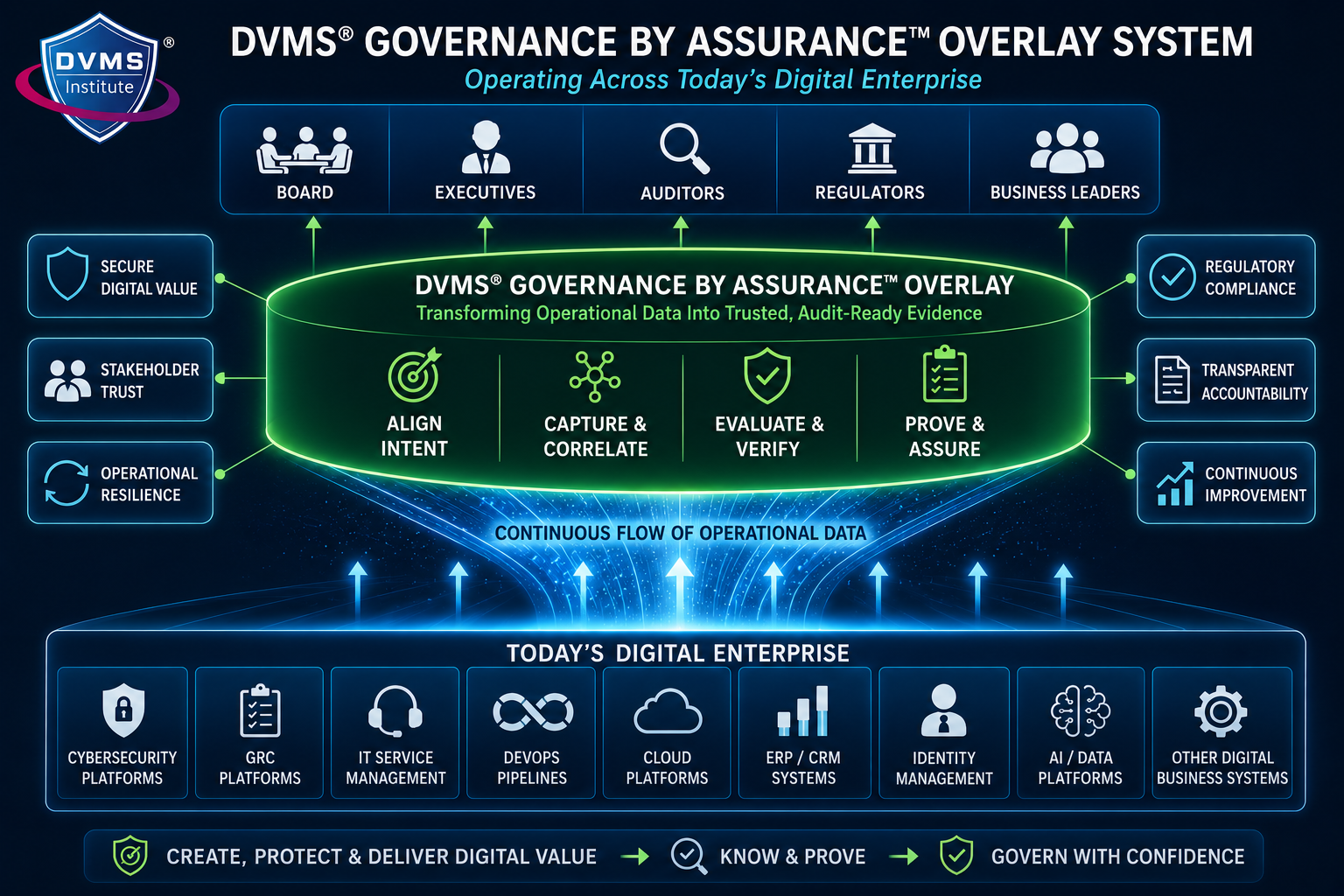
A Digital Value Management System® (DVMS) addresses these challenges by providing auditors with a structured, integrated overlay system that transforms how evidence is generated, validated, and interpreted. Rather than relying on static documentation and retrospective analysis, auditors gain visibility into how the living digital system governs and assures performance, resilience, and accountability across digital value chains.
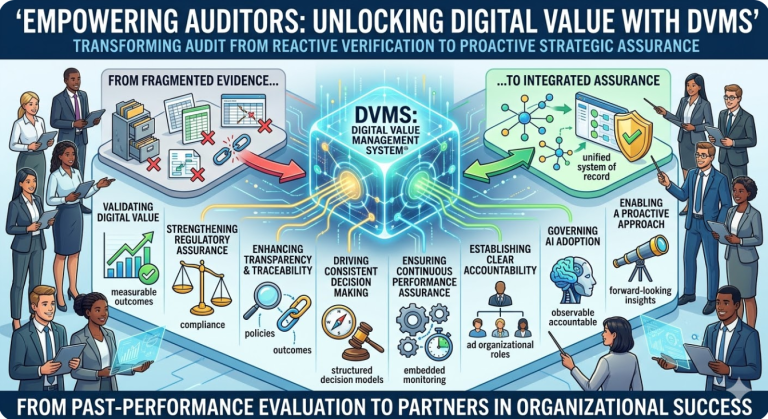
From Fragmented Evidence to Integrated Assurance
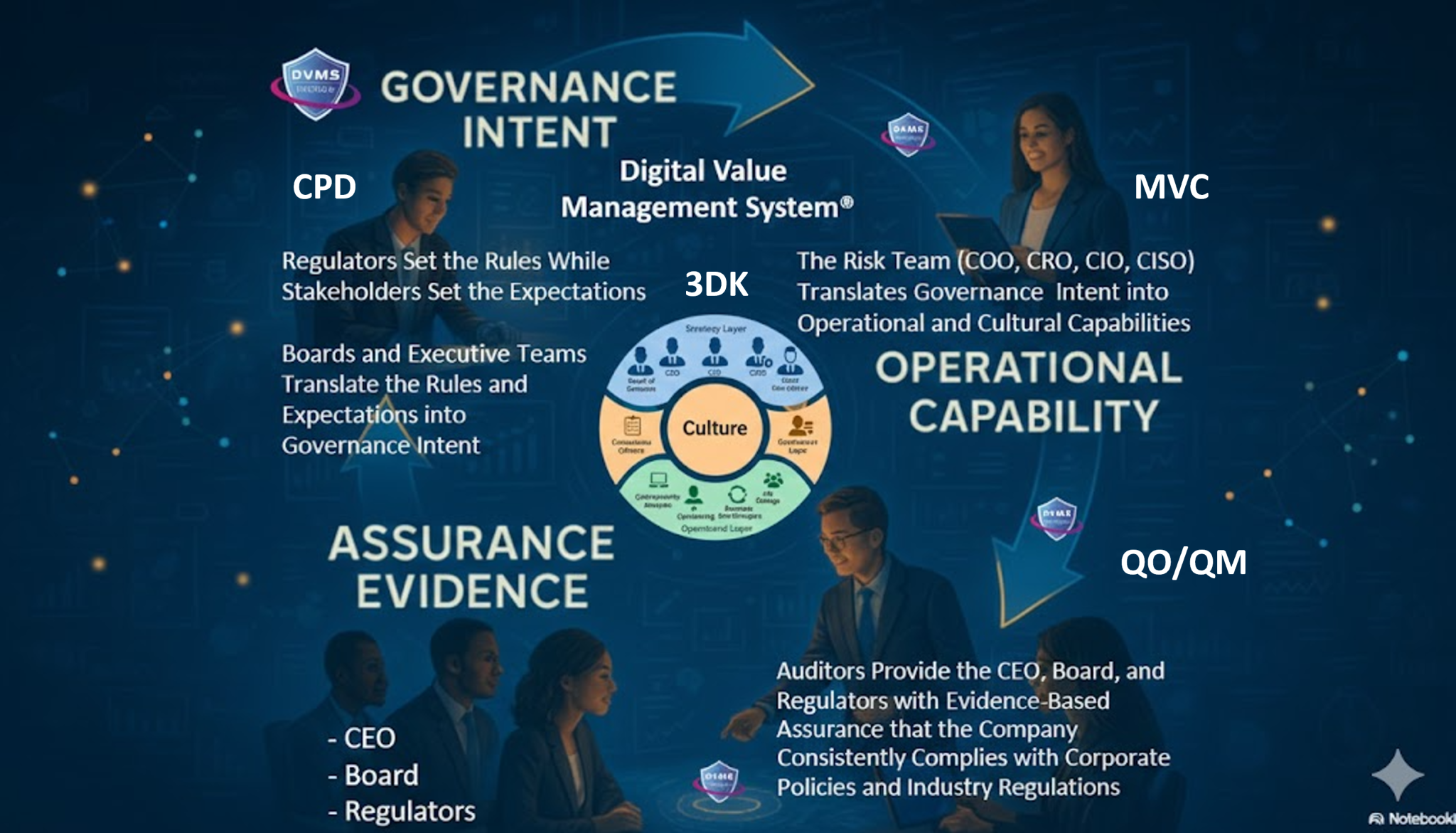
One of the primary challenges auditors face is the fragmentation of evidence across multiple systems, frameworks, and teams. In traditional environments, evidence must be manually collected, reconciled, and interpreted, often resulting in delays, inconsistencies, and gaps. DVMS eliminates this fragmentation by acting as an overlay governance system that integrates data from across the digital value chain. It connects governance intent, operational execution, and performance outcomes into a unified system of record.
This integration enables auditors to move from piecing together isolated artifacts to evaluating a coherent system. Evidence is no longer scattered but contextualized, allowing auditors to understand not only what controls exist but how they function within the broader organizational ecosystem. This shift significantly improves the reliability and efficiency of audit processes.
Validating Digital Value Through Measurable Outcomes
Auditing digital value is inherently more complex than auditing compliance. It requires assessing whether systems, processes, and investments are delivering intended business outcomes. DVMS addresses this challenge by linking activities directly to measurable results through structured models such as Question Outcome and Question Metric. These models define what success looks like and provide observable metrics that demonstrate whether outcomes are being achieved.
For auditors, this creates a clear line of sight between intent and performance. Instead of relying on subjective interpretations or indirect indicators, they can evaluate concrete evidence of value delivery. This capability is critical in modern organizations, where stakeholders expect not only compliance but demonstrable return on digital investments.
Strengthening Regulatory Assurance and Compliance Validation
Regulatory requirements are becoming increasingly complex, requiring organizations to demonstrate not only that controls are in place but that they are effective and consistently applied. DVMS enhances regulatory assurance by embedding compliance into the organizational operational fabric. Controls are not treated as isolated requirements but as integral components of a governed system.
Auditors benefit from this approach because it provides continuous, evidence-based assurance. Instead of conducting periodic reviews, they can assess a system that is constantly monitored and validated. DVMS creates a defensible audit trail that shows how regulatory requirements are met in practice, reducing the risk of noncompliance and increasing confidence in audit findings.
Enhancing Transparency and Traceability
Transparency and traceability are essential for effective auditing, yet they are often lacking in complex digital environments. DVMS addresses this by establishing clear relationships between policies, controls, processes, and outcomes. Every action within the system can be traced back to its governing intent and forward to its resulting impact.
For auditors, this level of traceability is transformative. It enables them to follow the flow of data and decisions across the organization, ensuring that nothing is hidden or obscured, and that every action, control, and outcome can be clearly understood, verified, and attributed.
Transparency also simplifies the audit process by making evidence readily accessible and verifiable. This reduces the need for extensive manual validation and increases audit efficiency.
Driving Consistent and Defensible Decision Making
A key aspect of governance is ensuring that decisions are made consistently and aligned with organizational objectives. In many organizations, decision-making is decentralized and influenced by local priorities, leading to inconsistencies and increased risk. DVMS addresses this by providing structured decision models that align actions with strategy and risk intent.
Auditors can evaluate these decision processes to determine whether they are consistent, evidence-based, and aligned with governance objectives. This adds a new dimension to auditing, moving beyond control validation to assessing the quality of decision making itself. By providing visibility into how decisions are made, DVMS enables auditors to validate not only outcomes but the processes that produce them.
Ensuring Continuous Performance Assurance
Traditional audits often rely on point-in-time assessments, which may not accurately reflect ongoing performance. DVMS introduces continuous performance assurance by embedding monitoring, measurement, and feedback mechanisms into daily operations. This ensures that systems and controls are continuously evaluated and improved.
For auditors, this means access to up-to-date, reliable data on system performance. They can assess whether controls are consistently effective and whether performance is aligned with expectations over time. This reduces uncertainty and provides a more accurate picture of organizational health, enabling more confident audit conclusions.
Establishing Clear Accountability Across the Enterprise
Accountability is a cornerstone of both governance and auditing. However, in complex digital environments, responsibilities are often unclear, leading to gaps in oversight and delayed responses. DVMS addresses this by defining roles, responsibilities, and ownership across digital value chains.
Auditors can clearly identify who is responsible for each control, process, and outcome, and how that responsibility is managed. This clarity simplifies the audit process and strengthens accountability, enabling issues to be quickly identified and addressed. It also enhances trust, as stakeholders can see that responsibilities are clearly defined and enforced.
Aligning Operations with Strategic and Regulatory Objectives
One of the most significant advantages of DVMS is its ability to align day-to-day operations with strategic and regulatory objectives. This alignment ensures that governance activities are not isolated but contribute directly to organizational goals. For auditors, this provides a comprehensive view of how strategy, operations, and compliance intersect.
Auditors can validate that regulatory requirements are not only met but are integrated into the organization’s overall strategy. This holistic perspective enhances the value of audits by demonstrating how compliance supports broader business objectives. It also helps organizations avoid the pitfalls of treating compliance as a separate or secondary activity.
Governing AI Adoption with Confidence and Assurance
As organizations rapidly deploy artificial intelligence across their digital value chains, auditors face a new layer of complexity, including opaque decision models, evolving regulatory expectations, and heightened risks around bias, data integrity, and explainability. DVMS brings critical value in this context by providing a structured governance and assurance overlay that makes AI systems observable, measurable, and accountable within the broader digital ecosystem.
Rather than treating AI as a black box, DVMS integrates AI-driven processes into its Question Outcome and Question Metric model, enabling auditors to validate not only that AI systems are functioning, but that they are producing intended, compliant, and trustworthy outcomes. It establishes traceability between training data, model decisions, and business impacts, allowing auditors to assess fairness, reliability, and alignment with regulatory requirements. As a result, auditors gain the ability to evaluate AI not as an isolated technology risk, but as a governed component of digital value delivery, ensuring that innovation does not outpace control, and that organizations can scale AI with confidence, transparency, and defensible assurance.
Enabling a Proactive and Forward-Looking Audit Approach
Perhaps the most transformative impact of DVMS is its ability to shift auditing from a reactive, retrospective activity to a proactive, forward-looking capability. By providing continuous visibility, integrated data, and structured governance, DVMS enables auditors to identify issues before they become problems and to provide insights that drive improvement.
This proactive approach enhances the strategic value of auditing, positioning auditors as partners in organizational success rather than simply evaluators of past performance. It allows audits to contribute to continuous improvement, risk management, and value creation.
Conclusion: Redefining Audit Through DVMS
A Digital Value Management System provides auditors with the tools they need to navigate the complexities of modern digital environments and to deliver meaningful assurance on both value and compliance. By integrating governance, performance, and accountability into a unified system, DVMS transforms the audit process from fragmented and reactive to structured and proactive.
Auditors gain enhanced visibility, traceability, and confidence in their assessments, enabling them to validate not only whether organizations are compliant but also whether they are effectively creating, protecting, and delivering digital value. In doing so, DVMS elevates the role of auditing, making it a critical driver of organizational performance, resilience, and trust in an increasingly complex digital world.
About the Author

Rick Lemieux
Co-Founder and Chief Product Officer of the DVMS Institute
Rick has 40+ years of passion and experience creating solutions to give organizations a competitive edge in their service markets. In 2015, Rick was identified as one of the top five IT Entrepreneurs in the State of Rhode Island by the TECH 10 awards for developing innovative training and mentoring solutions for boards, senior executives, and operational stakeholders.
Digital Value Management System® is a registered trademark of the DVMS Institute LLC.
® DVMS Institute 2026 All Rights Reserved