Operationalizing a Digital Value Management System® (DVMS) One Service at a Time

Share This Post

Operationalizing a Digital Value Management System® (DVMS) One Service at a Time

Rick Lemieux – Co-Founder and Chief Product Officer of the DVMS Institute

Introduction: Starting Small to Govern Big

Organizations often struggle to operationalize enterprise frameworks because they attempt to deploy them all at once. Digital Value Management Systems (DVMS) are no exception. While DVMS is designed to govern digital value across the enterprise, its successful adoption does not require a large-scale transformation on day one.

In fact, the most effective way to operationalize a DVMS is to start with a single, well-chosen service. By focusing on one service, organizations can validate concepts, demonstrate measurable value, establish accountability, and build confidence before scaling. This incremental approach turns DVMS from an abstract governance concept into a practical, working system.

Selecting the Right Service as a DVMS Entry Point

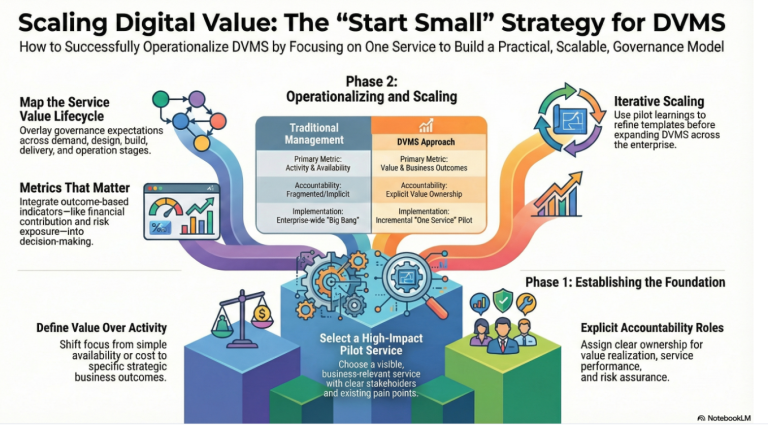
The first step in operationalizing DVMS is selecting the right service to pilot. The ideal service is business-relevant, visible, and meaningful, yet not so complex as to become unmanageable. It should have clear stakeholders, defined consumers, and measurable outcomes.

Services that support revenue generation, customer experience, regulatory compliance, or operational resilience are particularly effective starting points. Choosing a service that already has pain points or scrutiny can also accelerate adoption, as DVMS provides clarity and structure where ambiguity previously existed. The goal is not perfection, but relevance and learning.

Defining Digital Value at the Service Level

Once a service is selected, DVMS requires the organization to explicitly define what “value” means for that service. This is a critical shift away from traditional service management, which often focuses solely on activity, availability, or cost.

DVMS asks questions such as: What business outcomes does this service enable? How does it contribute to strategic objectives? What risks threaten its value? At this stage, value hypotheses are documented, benefits are articulated, and success criteria are agreed upon. This step anchors the service within the broader enterprise value context and ensures that all subsequent decisions are outcome-driven.

Assigning Ownership and Accountability

A defining characteristic of DVMS is accountability for value, not just delivery. Operationalizing DVMS through one service requires clearly assigning ownership roles. This includes a value owner responsible for benefits realization, a service owner accountable for performance, and risk and assurance responsibilities aligned with governance expectations.

These roles do not necessarily require new job titles; rather, they clarify accountability that often already exists but is implicit or fragmented. By making accountability explicit at the service level, DVMS creates transparency and eliminates ambiguity around who is responsible for outcomes.

Mapping the Service Value Lifecycle

With value defined and accountability established, the organization maps the service’s value lifecycle. This includes demand, design, build, delivery, operation, and improvement.

DVMS overlays governance expectations across this lifecycle, ensuring that value, risk, cost, and performance are considered at every stage. This mapping exercise reveals previously hidden gaps, redundancies, and misalignments. It also provides a structured view of how value is created, protected, and delivered through the service, making DVMS tangible and actionable.

Integrating Metrics That Matter

Operationalizing DVMS requires moving beyond traditional operational metrics to include value-based measures. For the selected service, the organization identifies a balanced set of indicators that cover outcomes, performance, risk, and assurance. These may include customer impact, financial contribution, service reliability, risk exposure, and compliance posture.

The key is alignment: every metric should connect back to the defined value objectives. By integrating these metrics into existing reporting and governance forums, DVMS becomes part of the decision-making process rather than an additional layer of bureaucracy.

Embedding Risk and Assurance Early

Starting with a single service enables organizations to embed risk management and assurance practices in a practical way. DVMS ensures that risks to value are identified, assessed, and monitored alongside performance. This includes operational risks, cybersecurity risks, third-party dependencies, and resilience concerns.

Assurance activities, such as controls validation and performance reviews, are aligned to value outcomes rather than checklist compliance. This approach demonstrates how DVMS proactively protects value, reinforcing trust among executives and stakeholders.

Enabling Decision-Making and Prioritization

As DVMS is operationalized through the service, it begins to inform real decisions. Investment requests, change approvals, and improvement initiatives are evaluated based on their impact on service value. Trade-offs between cost, risk, and performance become explicit rather than implicit. Leaders gain visibility into why certain decisions are made and how they support strategic objectives. This is often the moment when DVMS shifts from being perceived as a framework to being recognized as a decision-support system.

Learning, Improving, and Refining the Model

A single-service implementation provides a safe environment for learning. The organization can refine value definitions, governance workflows, metrics, and roles based on real experience. Feedback from stakeholders is used to improve clarity and usability.

DVMS is not treated as static; it evolves based on what works and what does not. This iterative approach builds organizational capability and confidence, ensuring that the system is practical and scalable.

Scaling DVMS Across the Organization

Once DVMS is operationalized successfully for one service, scaling becomes significantly easier. The patterns, templates, and governance mechanisms established during the pilot can be reused and adapted for additional services.

Leaders can point to tangible results, such as improved decision-making, clearer accountability, reduced risk exposure, or better value realization. Each new service added to the DVMS strengthens it, gradually transforming how the organization governs and delivers digital value without overwhelming teams.

Conclusion: One Service as the Catalyst for Enterprise Value Governance

Operationalizing a Digital Value Management System does not require an enterprise-wide overhaul. By starting with one service, organizations can bring DVMS to life in a controlled, meaningful way.

This approach allows value to be clearly defined, accountability to be established, risk to be managed, and performance to be assured. More importantly, it demonstrates that DVMS is not theoretical—it is operational. A single service becomes the catalyst for cultural change, governance maturity, and sustained digital value across the enterprise.

About the Author

Rick Lemieux
Co-Founder and Chief Product Officer of the DVMS Institute

Rick has 40+ years of passion and experience creating solutions to give organizations a competitive edge in their service markets. In 2015, Rick was identified as one of the top five IT Entrepreneurs in the State of Rhode Island by the TECH 10 awards for developing innovative training and mentoring solutions for boards, senior executives, and operational stakeholders.

Digital Value Management System® (DVMS)

Governing Operational Cyber-Resilience Through an Evidence-Based System for Assured and Accountable Digital Value Outcomes (GRAA)

Despite abundant frameworks and dashboards, leadership still struggles to see how their digital value streams actually perform under stress.

Leadership intent, structure, and day-to-day behavior are viewed separately, creating fragmented, flat perspectives that hide how real decisions and human responses interact within their living digital system and its digital value streams.

As a result, organizations can look well-governed on paper while still experiencing performance or catastrophic events in their living digital system. Without an integrated view, leaders end up managing isolated components and controls rather than governing the living system as a whole.

The Digital Value Management System® (DVMS) training programs teach leadership, practitioners, and employees how to integrate fragmented frameworks and systems such as NISTCSF, GRC, ITSM, and AI into a unified, culture-driven, living management system that:

  • Enables Adaptive Governance through risk-informed decision-making
  • Sustains Operational Resilience through a proactive and adaptive culture
  • Measures Performance Assurance through evidence-based outcomes
  • Ensures Transparent Accountability by making intent, execution, and evidence inseparable
At its core, the DVMS is a simple but powerful integration of:
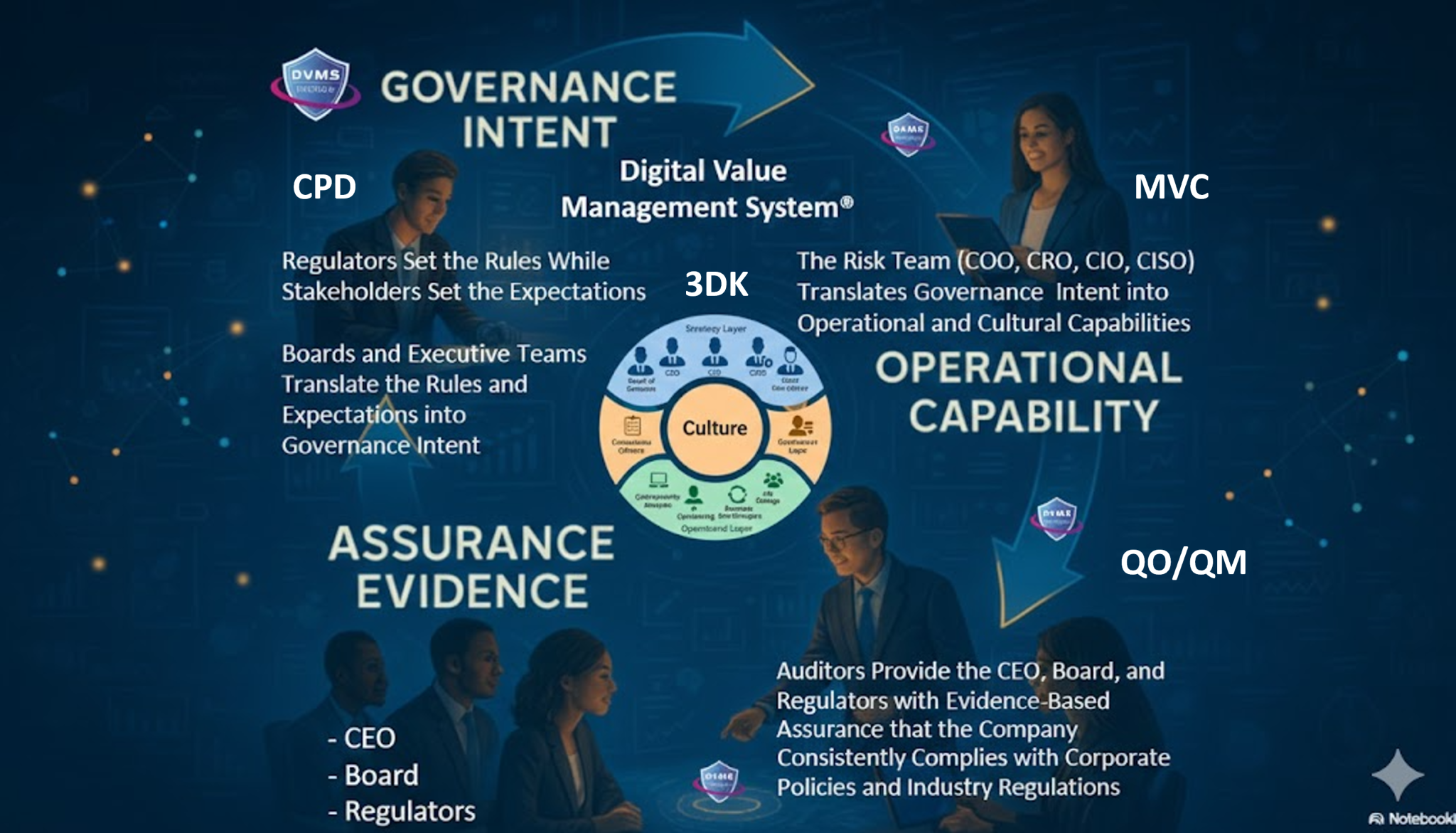
  • Governance Intent – shared expectations and accountabilities
  • Operational Capabilities – how the digital business actually performs
  • Assurance Evidence – proof that outcomes are achieved and accountable

Through its MVCCPD3D Knowledge, and FastTrack Models, a DVMS turns this integration into three distinctive capabilities:

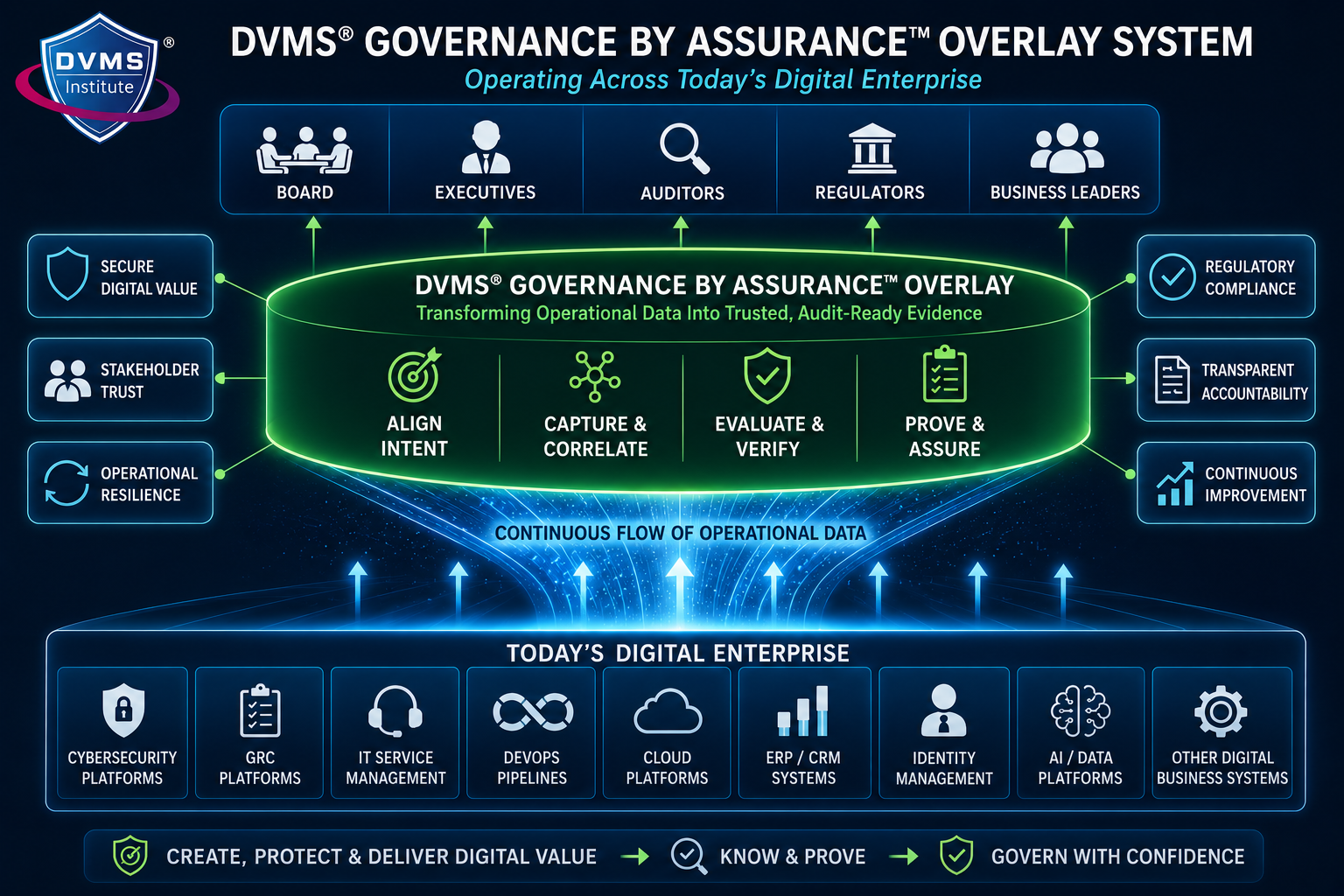
A Governance Overlay that replaces fragmentation with unity. The DVMS provides organizations with a structured way to connect strategy with day-to-day execution. Leaders gain a consistent mechanism to direct, measure, and validate performance—across every system responsible for digital value.

A Behavioral Engine that drives high-trust, high-velocity decision-making. The DVMS embeds decision models and behavioral patterns that help teams think clearly and act confidently, even in uncertain situations. It is engineered to reduce friction, prevent blame-based cultures, and strengthen organizational reliability.

A Learning System that makes culture measurable, adaptable, and scalable. Culture becomes a managed asset—not an abstract concept. The DVMS provides a repeatable way to observe behavior, collect evidence, learn from outcomes, and evolve faster than threats, disruptions, or market shifts.

DVMS Organizational Benefits

Instead of replacing existing operational frameworks, the DVMS elevates them—connecting and contextualizing their data into actionable intelligence that validates performance and exposes the reasons behind unmet outcomes.

By adopting a DVMS, organizations are positioned to:

  • Maintain Operational Stability Amidst Constant Digital Disruption
  • Deliver Digital Value and Trust Across A Digital Ecosystem
  • Satisfy Critical Regulatory and Certification Requirements
  • Leverage Cyber Resilience as a Competitive Advantage
DVMS Leadership Benefits

The Digital Value Management System (DVMS) provides leaders with a unified, evidence-based approach to governing and enhancing their digital enterprise, aligning with regulatory requirements and stakeholder expectations.

For the CEO, the DVMS provides a clear line of sight between digital operations, business performance, and strategic outcomes—turning governance and resilience into enablers of growth and innovation rather than cost centers.

For the Board of Directors, the DVMS provides ongoing assurance that the organization’s digital assets, operations, and ecosystem are governed, protected, and resilient—supported by evidence-based reporting that directly links operational integrity to enterprise value and stakeholder trust.

For the CIO, CRO, CISO, and Auditors: an integrated, adaptive, and culture-driven governance and assurance management system that enhances digital business performance, resilience, trust, and accountability

DVMS White Papers

The whitepapers below present a coherent progression that shifts organizations from compliance-driven thinking to a modern system of Governance, Resilience, Assurance, and Accountability (GRAA). Collectively, the three papers define a comprehensive system for building and governing resilient digital enterprises, grounded in evidence rather than assumptions.

The Assurance Mandate Paper sets the stage by showing why traditional GRC artifacts provide only reassurance—not evidence—and calls boards to demand forward-looking proof that their organizations can continue to create, protect, and deliver value under stress.

The Assurance in Action Paper elevates the conversation from leadership intent to managerial execution, demonstrating how the DVMS operationalizes resilience by translating outcomes into Minimum Viable Capabilities, connecting frameworks through the Create–Protect–Deliver model, and generating measurable assurance evidence that managers can use to demonstrate real performance rather than activity.

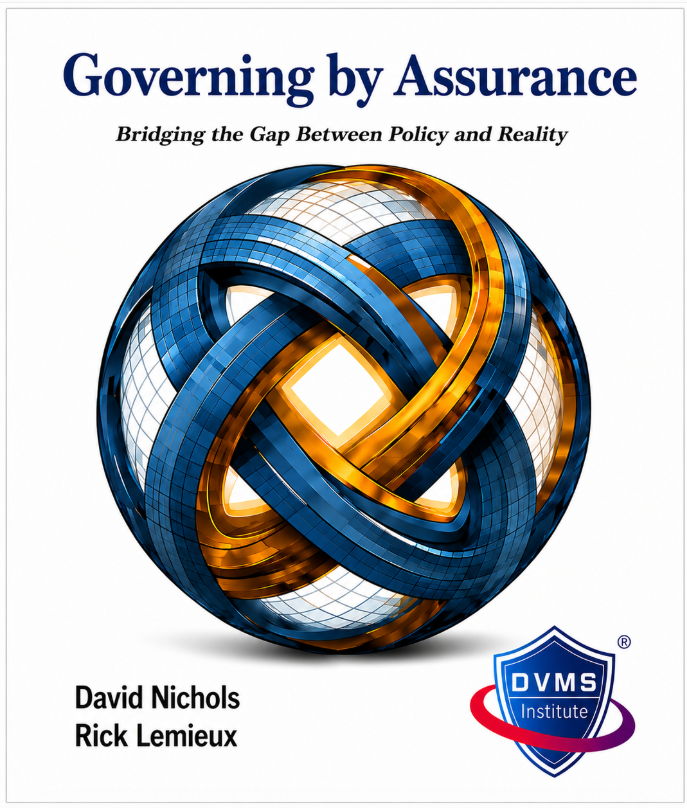
The Governing by Assurance Paper elevates the approach to the policy and regulatory level, showing how DVMS functions as a learning overlay system that links governance intent, operational capability, and verifiable evidence into a continuous loop—enabling regulators, agencies, and enterprises to govern by outcomes rather than checklists and to prove capability with measurable, auditable performance data.

DVMS Cyber Resilience Certified Training Programs

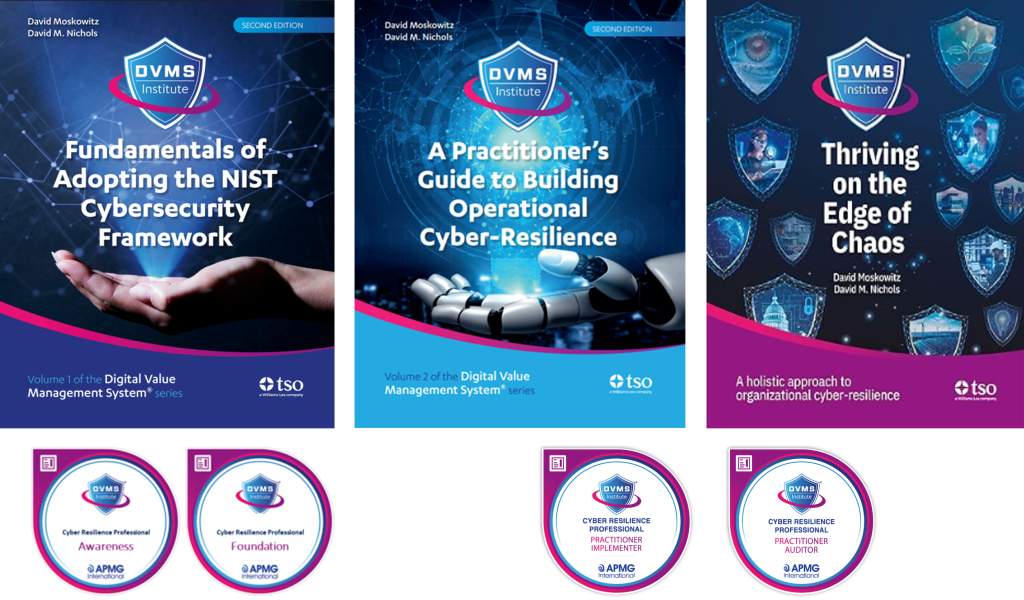
The DVMS Institute’s certification training programs and publications equip leaders, practitioners, and organizations to govern operational cyber-resilience through an evidence-based system that assures and accounts for digital value outcomes.

Grounded in real-world governance challenges and aligned to NIST CSF 2.0, DVMS Institute offerings go beyond frameworks and compliance checklists to build measurable capability, clear accountability, and defensible confidence in decision-making.

Through structured learning, applied certification, and authoritative publications, the Institute advances a disciplined, outcome-driven approach to managing digital risk, performance, and resilience as an integrated system.


DVMS Cyber Resilience Awareness Training

The DVMS Cyber Resilience Awareness course and its accompanying body of knowledge publication educate all employees on the fundamentals of digital business, its associated risks, the NIST Cybersecurity Framework, and their role within a shared model of governance, resilience, assurance, and accountability for creating, protecting, and delivering digital value.

This investment fosters a culture that is prepared to operate within a system capable of transforming systemic cyber risks into operational resilience.

DVMS NISTCSF Foundation Certification Training

The DVMS NISTCSF Foundation certification training course and its accompanying body of knowledge publications provide ITSM, GRC, Cybersecurity, and Business professionals with a detailed understanding of the NIST Cybersecurity Framework and its role in a shared model of governance, resilience, assurance, and accountability for creating, protecting, and delivering digital value.

This investment fosters IT, GRC, Cybersecurity, and Business professionals with the skills to operate within a system capable of transforming systemic cyber risks into operational resilience.

DVMS Cyber Resilience Practitioner Certification Training

The DVMS Practitioner certification training course and its accompanying body of knowledge publications teach ITSM, GRC, Cybersecurity, and Business practitioners how to elevate investments in ITSM, GRC, Cybersecurity, and AI business systems by integrating them into a unified governance, resilience, assurance, and accountability system designed to proactively identify and mitigate the cyber risks that could disrupt operations, erode resilience, or diminish client trust.

This investment fosters IT, GRC, Cybersecurity, and Business practitioners with the skills to assess, design, implement, operationalize, and continually innovate a Digital Value Management System® program that operationalizes a shared model of governance, resilience, assurance, and accountability for creating, protecting, and delivering digital value.

Company Brochures and Presentation
Explainer Videos

Digital Value Management System® is a registered trademark of the DVMS Institute LLC.

® DVMS Institute 2025 All Rights Reserved

More To Explore

It's Time to Protect Your digital business value & resiliency

Publications, Certification Training, Enterprise Solutions & Community