How the DVMS FastTrack Model Supports a DVMS Program

Share This Post

How the DVMS FastTrack Model Supports a DVMS Program

Rick Lemieux – Co-Founder and Chief Product Officer of the DVMS Institute

Introduction

The Digital Value Management System® (DVMS) is a systems-based overlay designed to help organizations create, protect, and deliver digital business value in an increasingly complex and volatile cyber landscape. While the DVMS provides the conceptual and structural foundation, the DVMS FastTrack™ Model offers a pragmatic pathway for implementation. FastTrack provides a phased, iterative approach that allows organizations to begin where they are, stabilize their environment, and progressively mature toward resilience and innovation. Rather than attempting a wholesale transformation, it emphasizes incremental, risk-informed, and adaptable progress, ensuring that organizations can align governance, culture, and execution with strategic objectives.

The Role of FastTrack in a DVMS Program

At its core, a DVMS program enables organizations to manage digital business risk through enterprise risk management, systems thinking, and cultural adaptation. The challenge is that many organizations struggle with the “how” of operationalizing such a holistic model. The DVMS FastTrack approach addresses this challenge by providing a phased adoption roadmap. It shifts the focus away from static compliance toward adaptive resilience, embedding cyber risk management into daily business practices. FastTrack ensures that organizations take manageable steps that build upon each other, creating tangible value while maintaining momentum.

The Four Phases of FastTrack

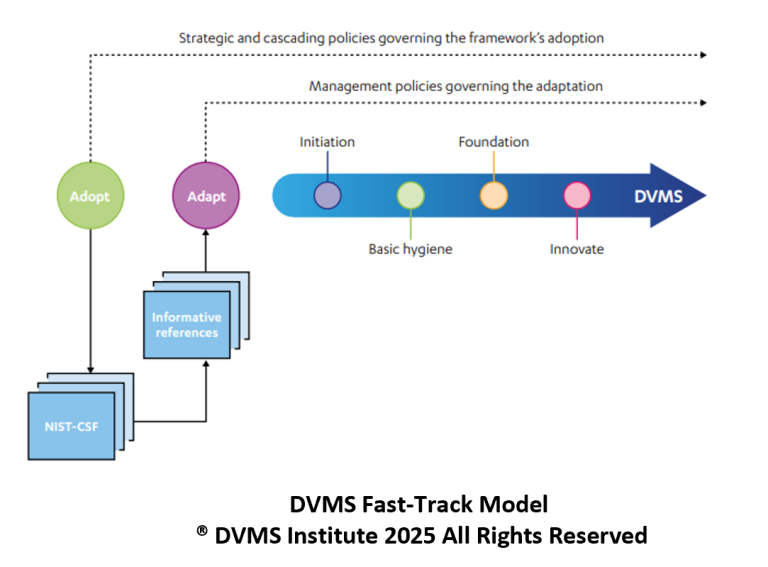
The FastTrack Model is structured into four iterative phases: Initiate, Basic Hygiene, Expand, and Innovate.

  1. Phase 0 – Initiate: Often called “getting ready to get ready,” this stage establishes the foundation for subsequent phases. It may require implementing early-stage controls, clarifying governance responsibilities, or conducting baseline risk assessments. It stabilizes organizational awareness of digital value and sets expectations for cultural and structural change.
  2. Phase 1 – Basic Hygiene: This phase focuses on stabilizing the environment. It includes essential cybersecurity practices such as patch management, identity controls, and ensuring critical assets are inventoried and protected. By securing the basics, the organization builds the confidence of stakeholders while reducing exposure to common, preventable risks.
  3. Phase 2—Expand: Once stability is achieved, organizations can expand by optimizing the environment. This may involve maturing assurance practices, strengthening risk governance, and broadening protective measures across more systems, processes, and supply chain elements. Expansion requires tighter integration of risk-informed governance with enterprise operations.
  4. Phase 3—Innovate: At this phase, the organization embeds continual innovation and adaptation into its culture. Innovation becomes a core capability, allowing the enterprise to protect value and create competitive advantage through resilience. Continuous feedback loops between governance, assurance, and execution ensure that learning and adaptation are institutionalized.


These phases are not strictly linear. Governance, assurance, and risk assessment occur across all stages, and improvements in one phase may cascade backward to strengthen earlier work. This cyclical nature reinforces the DVMS principle of treating organizations as complex adaptive systems.

Aligning FastTrack with the DVMS Z-X and CPD Models

FastTrack is more than a stepwise checklist; it is embedded within the MVCZ-X Model and the Create, Protect, Deliver (CPD) Model of the DVMS. The MVC-Z-X Model describes seven minimum viable capabilities (MVCs)—Govern, Assure, Plan, Design, Change, Execute, and Innovate—that every organization must master. FastTrack provides the temporal rhythm for maturing these capabilities. For example, the emphasis falls on Govern, Assure, and Plan in the Initiate and Basic Hygiene phases. When an organization reaches Innovate, the Execute and Innovate capabilities dominate, supported by continual governance and assurance.

The CPD Model reinforces that unprotected value has no value. FastTrack operationalizes this principle by ensuring that value creation and protection occur concurrently. Instead of a “create then protect” sequence, organizations learn to protect value as it is created, embedding resilience into processes from the outset.

Systems Thinking and FastTrack

One of the FastTrack Model’s most significant contributions to a DVMS program is its reliance on systems thinking. Organizations are not static entities but complex adaptive systems, where small changes in structure or culture can disproportionately impact behavior and outcomes. FastTrack encourages leaders to “see the whole, not the hole,” using iterative cycles to test and adapt. By applying leverage at critical points, organizations can coax systemic change without triggering destabilizing unintended consequences.

Embedding Culture and Leadership

A DVMS program succeeds or fails on culture, and FastTrack supports this by integrating cultural adaptation into each phase. In the Initiate stage, leadership signals accountability and aligns governance with enterprise risk management. In Basic Hygiene, employees across departments are engaged in establishing protective behaviors. By the Expand and Innovate phases, a questioning culture, continuous learning, and transparent accountability are institutionalized. FastTrack thus acts as a cultural scaffold, enabling leadership to cascade values, policies, and expectations from the boardroom to the front line.

Supporting Cyber Resilience and NIST CSF Adoption

The FastTrack Model is explicitly designed to help organizations operationalize the NIST Cybersecurity Framework (CSF) 2.0. The CSF provides the “what” and “why” of cybersecurity outcomes, but not the “how.” FastTrack fills this gap by giving organizations a practical, phased method to adopt CSF outcomes within their DVMS overlay. For example, the CSF’s GOVERN and IDENTIFY functions align naturally with the Initiate and Basic Hygiene phases. At the same time, PROTECT and DETECT are emphasized in Expand, and RESPOND and RECOVER are refined in Innovate.

In this way, FastTrack ensures that organizations do not treat the CSF as a compliance checklist but as a living, adaptive governance system integrated into strategy, risk, and culture.

Continuous Innovation and Competitive Advantage

The ultimate goal of FastTrack within a DVMS program is not mere compliance or even cybersecurity. It is operational resilience, sustainable digital business value, regulatory compliance, and client digital trust. By embedding a culture of continual innovation, FastTrack ensures that organizations can adapt to evolving threats, technological change, and shifting stakeholder expectations. The ability to create and protect digital business value concurrently becomes a source of competitive differentiation, allowing organizations to withstand disruption and thrive on the edge of chaos.

Conclusion

The DVMS FastTrack Model provides the structured, yet flexible path organizations need to implement a DVMS program effectively. It stabilizes environments by offering incremental, iterative phases, embeds cultural change, and enables continuous innovation. More importantly, FastTrack operationalizes the systems-based principles of the DVMS, aligning with the NIST CSF 2.0 and ensuring that value creation and value protection are inseparable. In doing so, it transforms cybersecurity from a technical silo into an enterprise-wide governance practice, fostering resilience, adaptability, and long-term success.

About the Author

Rick Lemieux
Co-Founder and Chief Product Officer of the DVMS Institute

Rick has 40+ years of passion and experience creating solutions to give organizations a competitive edge in their service markets. In 2015, Rick was identified as one of the top five IT Entrepreneurs in the State of Rhode Island by the TECH 10 awards for developing innovative training and mentoring solutions for boards, senior executives, and operational stakeholders.

DVMS Cyber Resilience Professional Accredited Certification Training

Designing an Overlay System for Governing Cyber Resilience Through Assured Evidence and Transparent Accountability (GRAA) Across Complex Digital Ecosystems

From Visibility to Viability – The Dual Pillars of Cyber Resilience 

Explainer Video –  The Dual Pillars of Cyber Resilience 

As enterprises accelerated their adoption of complex, cloud-native architectures, they encountered a new order of complexity. Infrastructure dissolved into services, workloads became ephemeral, and security boundaries blurred. In that environment, Wiz emerged as a transformational force in cloud technical security, offering radical visibility and risk prioritization across multi-cloud ecosystems.

At the same time, a broader and more consequential challenge emerged, one that extends well beyond isolated technical misconfigurations or discrete vulnerabilities.

Modern organizations function as dynamic, highly interconnected digital ecosystems shaped by siloed frameworks, technologies, applications, processes, data flows, and human actors, all operating in continuous interaction. Within this complexity, risks and outcomes are not confined to individual components; they arise from the relationships and dependencies between them.

This is the domain in which the Digital Value Management System® (DVMS) operates.

While Wiz redefined how organizations see and secure cloud environments, DVMS is redefining how enterprises govern, assure, and account for cyber resilience as an integrated dimension of digital business performance.


The Digital Value Management System® (DVMS)

Explainer Video – What is a Digital Value Management System (DVMS)

The DVMS is an overlay management system that governs cyber resilience through assured evidence and transparent accountability (GRAA) across complex digital systems. 

At its core, the DVMS is a simple but powerful integration of:
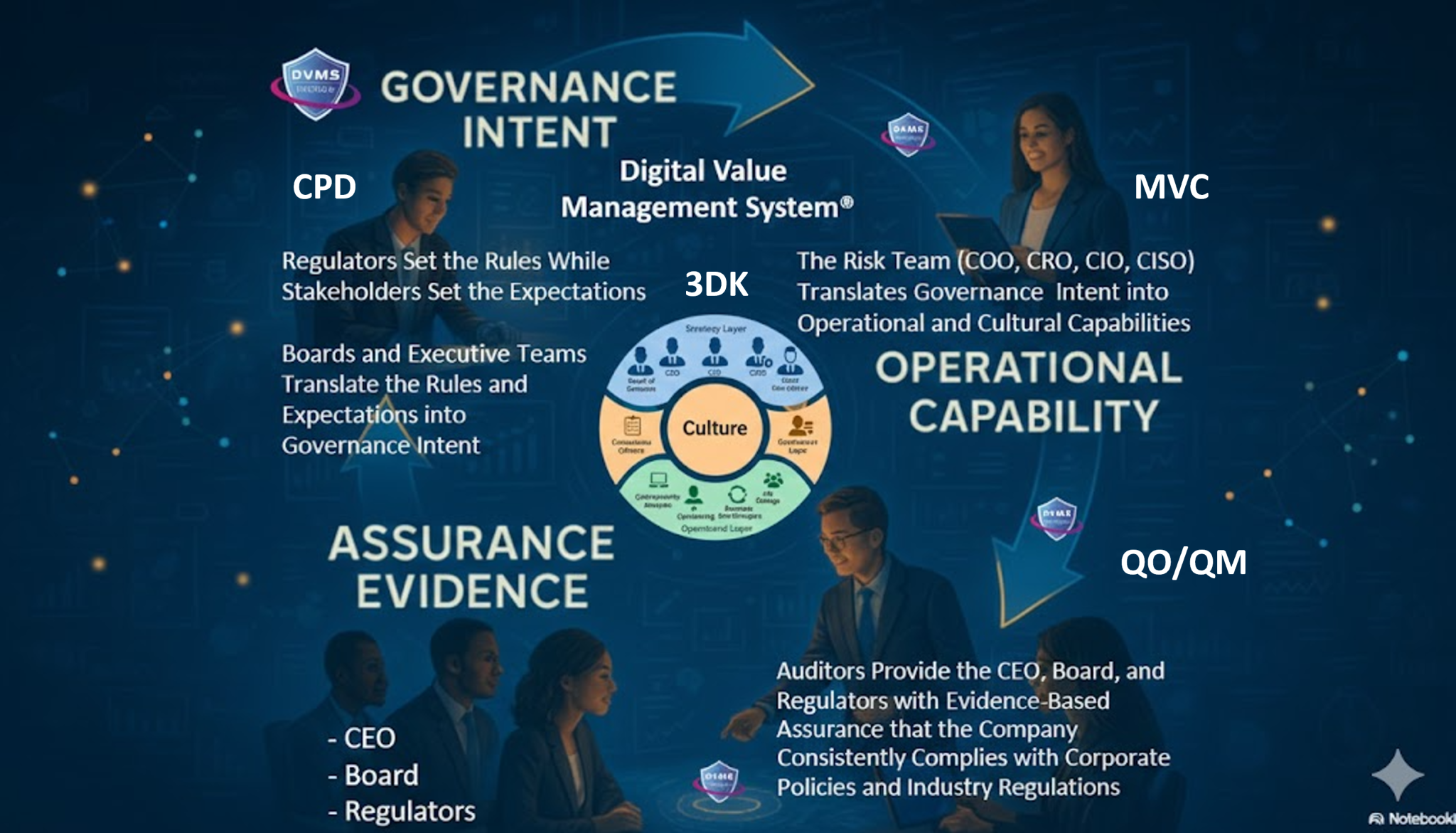
  • Governance Intent – shared expectations and accountabilities
  • Operational Capabilities – how the digital business performs under stress
  • Assurance Evidence – proof that outcomes are achieved and accountable
  • Cultural Learning – for governance and operational fine-tuning
The DVMS GRAA Engine

Explainer Video – How a DVMS GRAA Engine Works

The overlay GRAA engine is powered by four DVMS models:

Create, Protect, and Deliver (CPD) – The CPD Model™ is a systems-based model within the DVMS that links strategy-risk and governance to execution to create, protect, and deliver digital business value as an integrated, continuously adaptive capability.

Minimum Viable Capabilities (MVC) – The Minimum Viable Capabilities (MVCs) model supports the seven essential, system-level organizational capabilities—Govern, Assure, Plan, Design, Change, Execute, and Innovate—required to reliably create, protect, and deliver digital business value in alignment with strategy-risk intent.

3D Knowledge (3DK) – The 3D Knowledge Model is a systems-thinking framework that maps team knowledge over time (past, present, future), cross-team collaboration, and alignment to strategic intent to ensure that organizational behavior, learning, and execution remain integrated and adaptive in delivering digital business value.

Question Outcome / Question Metric (QO/QM) – The QO/QM approach supports governance as testable intent by defining a clear Question Outcome (QO), the specific value or resilience condition that must be true at a given boundary, and pairing it with one or more Question Metrics (QM) that provide observable, decision-relevant evidence that the system can actually create, protect, and deliver that outcome under complex, living system operating conditions

The models then work together to operationalize the capabilities below that will govern the organization’s cyber resilience through assured evidence and transparent accountability

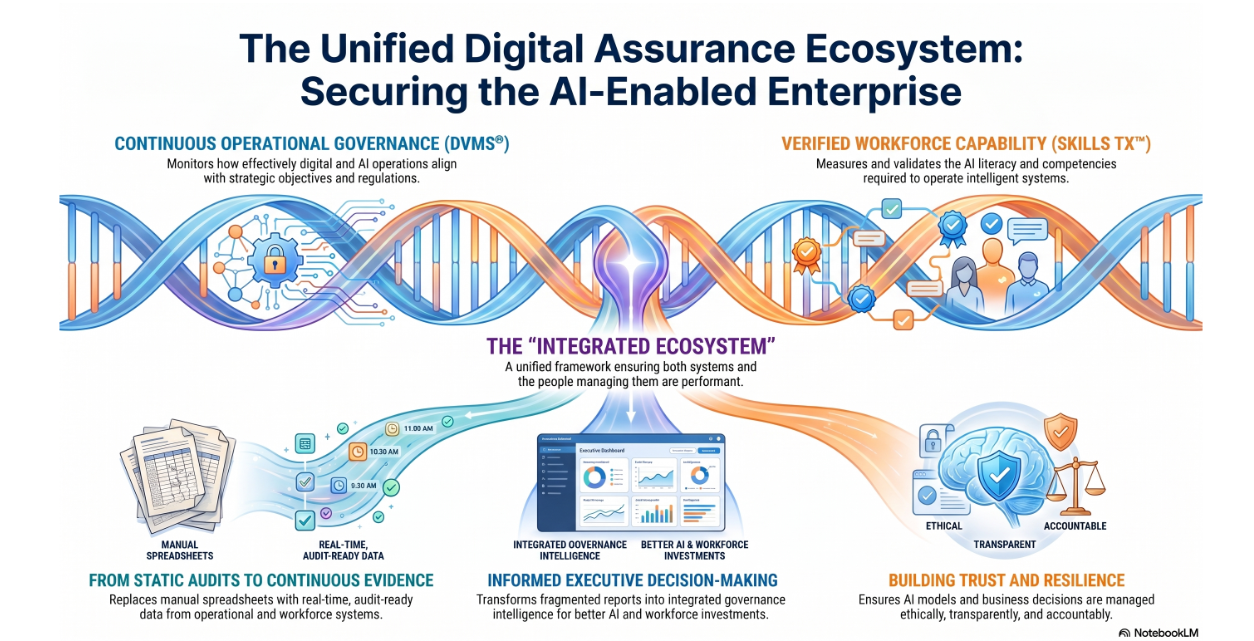
A Governance Overlay that replaces fragmentation with unity. The DVMS provides organizations with a structured way to connect strategy with day-to-day execution. Leaders gain a consistent mechanism to direct, measure, and validate performance across every system responsible for digital value.

A Behavioral Engine that drives high-trust, high-velocity decision-making. The DVMS embeds decision models and behavioral patterns that help teams think clearly and act confidently, even in uncertain situations. It is engineered to reduce friction, prevent blame-based cultures, and strengthen organizational reliability.

A Learning System that makes culture measurable, adaptable, and scalable. Culture becomes a managed asset—not an abstract concept. The DVMS provides a repeatable way to observe behavior, collect evidence, learn from outcomes, and evolve faster than threats, disruptions, or market shifts.


DVMS Benefits – Organizational and Leadership

Explainer Video – DVMS Organization and Leadership Benefits

Organizational Benefits

Instead of replacing existing operational frameworks and platforms, the DVMS elevates them, connecting and contextualizing their data into actionable intelligence that enables organizations to:

  • Maintain Operational Stability Amidst Constant Digital Disruption
  • Deliver Digital Value and Trust Across Complex Digital Ecosystems
  • Satisfy Critical Regulatory and Certification Requirements
  • Leverage Cyber Resilience as a Competitive Advantage


Leadership Benefits

For the CEO, the DVMS provides a clear line of sight between digital operations, business performance, and strategic outcomes—turning governance and resilience into enablers of growth and innovation rather than cost centers.

For the Board of Directors, the DVMS provides ongoing assurance that the organization’s digital assets, operations, and ecosystem are governed, protected, and resilient—supported by evidence-based reporting that directly links operational integrity to enterprise value and stakeholder trust.

For the CIO, CRO, CISO, and Auditors, the DVMS provides a unified approach to organizational digital value management, operational resilience, and regulatory compliance. 


DVMS – Accredited Certification Training Programs

Explainer Video – The DVMS Training Pathway to Cyber Resilience

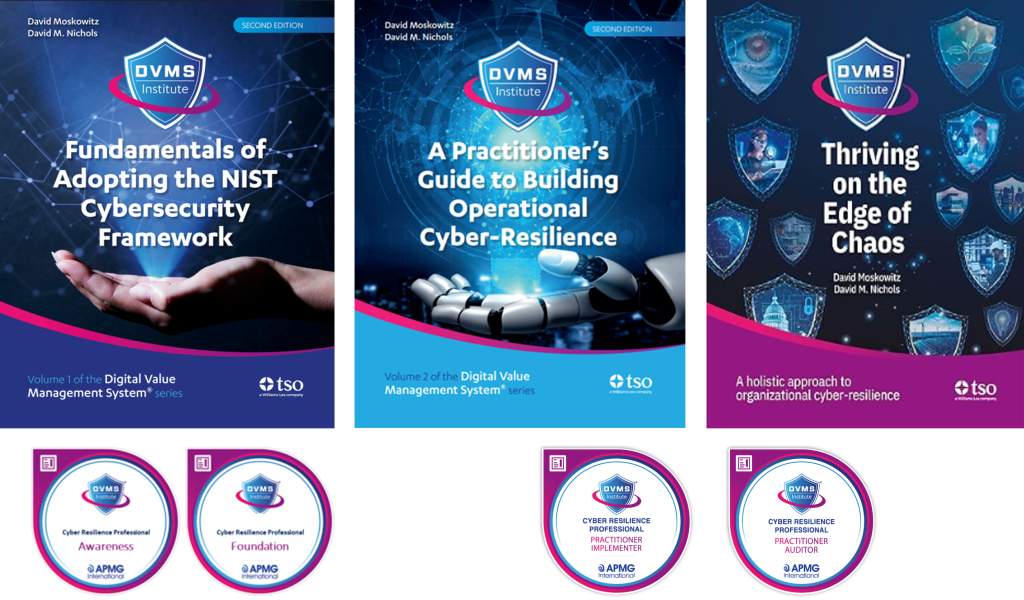
The DVMS Institute’s certification training programs equip leaders, practitioners, and employees with the skills to build a management architecture for governing, assuring, and accounting for resilience in complex digital ecosystems.

Through structured learning, applied certification, and authoritative publications, the Institute teaches a disciplined, outcome-driven approach to managing resilience as an integrated dimension of digital business performance.

DVMS Cyber Resilience Awareness Training

The DVMS Cyber Resilience Awareness non-certification course and its accompanying body of knowledge publication educate all employees on the fundamentals of digital business, its associated risks, the NIST Cybersecurity Framework, and their role within a shared model of governance, resilience, assurance, and accountability for resilience in complex digital ecosystems.

DVMS NISTCSF Cyber Resilience Foundation Certification Training

The DVMS NISTCSF Cyber Resilience Foundation certification training course and its accompanying body of knowledge publications provide ITSM, GRC, Cybersecurity, and Business professionals with a detailed understanding of the NIST Cybersecurity Framework and its role in a shared model of governance, resilience, assurance, and accountability for achieving resilience in complex digital ecosystems.

DVMS Cyber Resilience Practitioner Certification Training

The DVMS Practitioner certification training course and its accompanying body of knowledge publications teach ITSM, GRC, Cybersecurity, and Business practitioners how to build a unified governance, resilience, assurance, and accountability system designed to operationalize resilience in complex digital ecosystems.


Launching A DVMS Program

Explainer Video – Scaling a DVMS Program

 The DVMS FastTrack is a phased, iterative approach that helps organizations mature a DVMS program over time, rather than trying to do everything simultaneously. This approach breaks the DVMS journey into manageable phases of success.

It all starts with selecting the first digital service you want to make resilient. That service then becomes the blueprint for operationalizing resilience across the remaining digital services. 

DVMS Institute White Papers – The Assurance Mandate Series

Explainer Video –  From Compliance Rituals to Evidence-Based Resilience  

The whitepapers below present a clear progression from compliance-driven thinking to a modern system of Governance, Resilience, Assurance, and Accountability (GRAA). Together, they define an evidence-based approach to building and governing resilient digital enterprises.

The Assurance Mandate Paper explains why traditional compliance artifacts offer reassurance, not proof, and challenges boards to demand evidence that value can be created, protected, and delivered under stress.

The Assurance in Action Paper shows how DVMS turns intent into execution by translating outcomes into Minimum Viable Capabilities, aligning frameworks through the Create–Protect–Deliver model, and producing measurable assurance evidence of real performance.

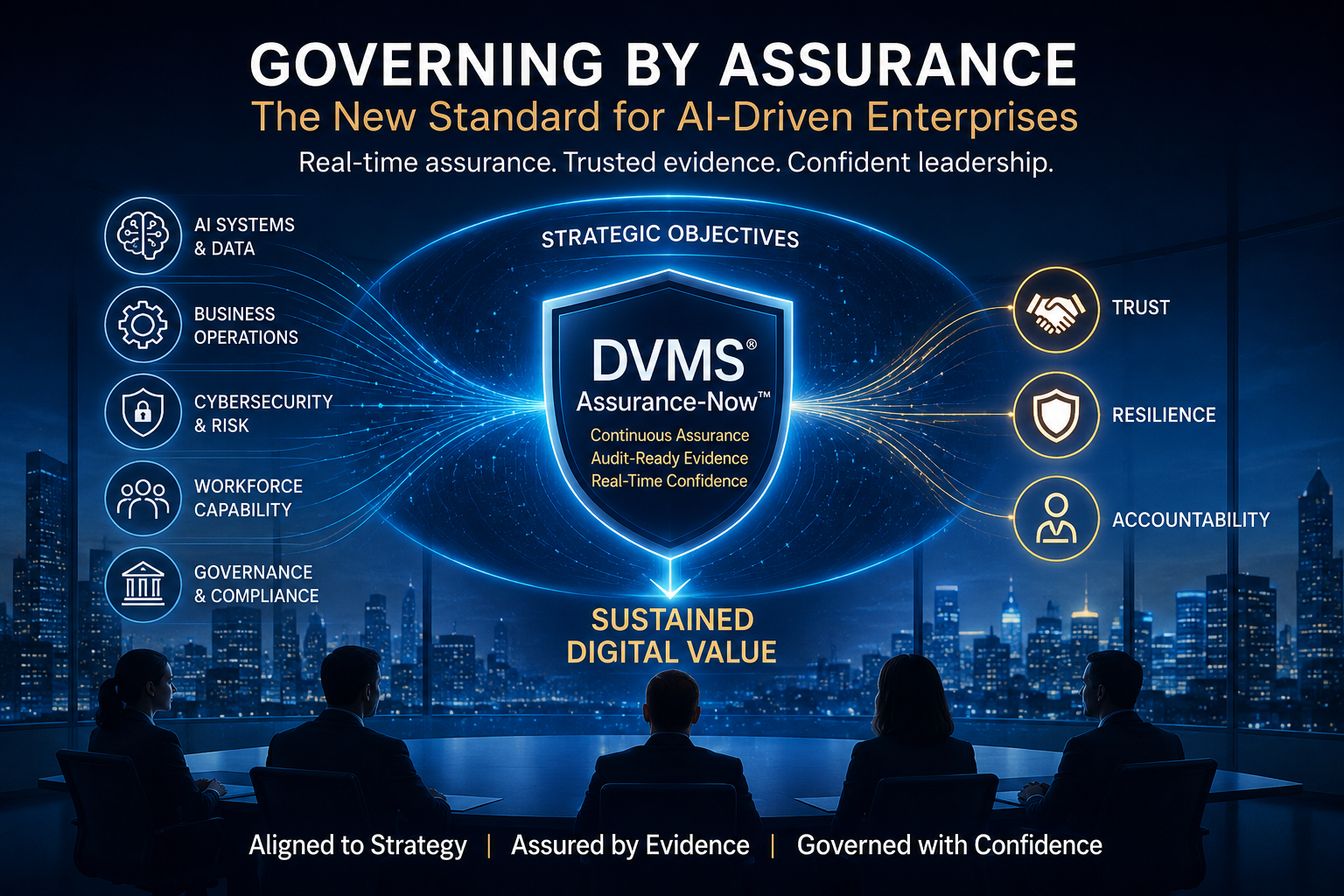
The Governing by Assurance Paper extends this model to policy and regulation, positioning DVMS as a learning overlay that links governance intent, operational capability, and auditable evidence—enabling outcome-based governance and proof of resilience through measurable performance data.

Company Brochures and Presentation

Explainer Videos

Digital Value Management System® is a registered trademark of the DVMS Institute LLC.

® DVMS Institute 2025 All Rights Reserved

More To Explore

It's Time to Protect Your digital business value & resiliency

Publications, Certification Training, Enterprise Solutions & Community