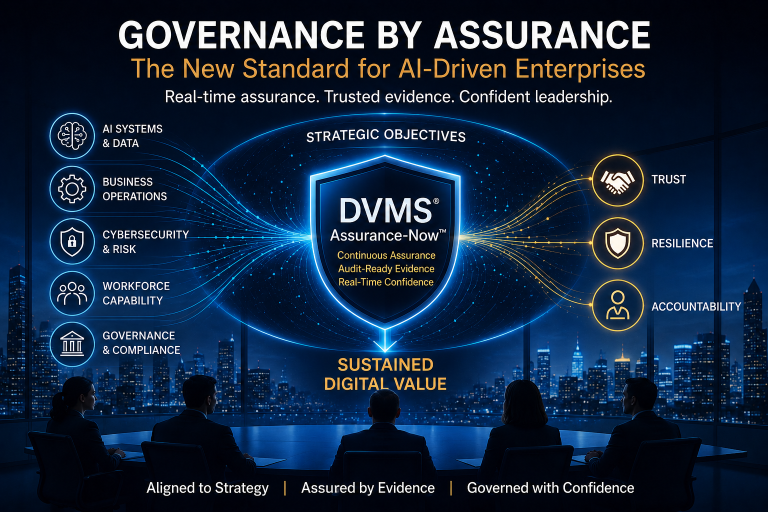
Governance By Assurance: The New Standard for the AI-Driven Enterprise:
Rick Lemieux – Co-Founder and Chief Product Officer of the DVMS Institute
The AI Revolution Requires a New Model of Enterprise Governance
Artificial intelligence is fundamentally transforming how organizations create value, make decisions, deliver products and services, engage customers, and manage risk. Modern enterprises are no longer driven solely by people and technology. They are dynamic digital ecosystems where AI continuously influences business processes, operational decisions, cybersecurity, customer experiences, software development, workforce productivity, and strategic execution. As AI becomes embedded throughout the enterprise, organizational complexity increases exponentially. Business conditions change continuously, risks evolve rapidly, regulations expand, and digital operations become increasingly autonomous. Traditional governance models that rely on policies, periodic audits, manual assessments, and historical reporting cannot keep pace with this new reality.
The challenge facing executive leadership is no longer simply governance technology. The challenge is the governance of an intelligent digital enterprise whose operations continuously evolve. This requires a governance model that provides real-time confidence that the organization remains aligned with leadership intent while adapting to constant technological and operational change. This new governance model is Governance by Assurance.
From Governance by Compliance to Governance by Assurance
For decades, enterprise governance has focused on demonstrating compliance with policies, regulations, and established control frameworks. Organizations have invested heavily in governance, risk management, compliance, cybersecurity, internal audit, and operational oversight. These disciplines remain essential, but they primarily provide periodic snapshots of organizational performance rather than continuous confidence.
Artificial intelligence changes this equation. AI systems continuously learn, adapt, make recommendations, automate decisions, and influence business outcomes. Governance these environments requires more than documenting policies or conducting annual audits. It requires continuous evidence that digital operations remain aligned with organizational objectives despite constant change.
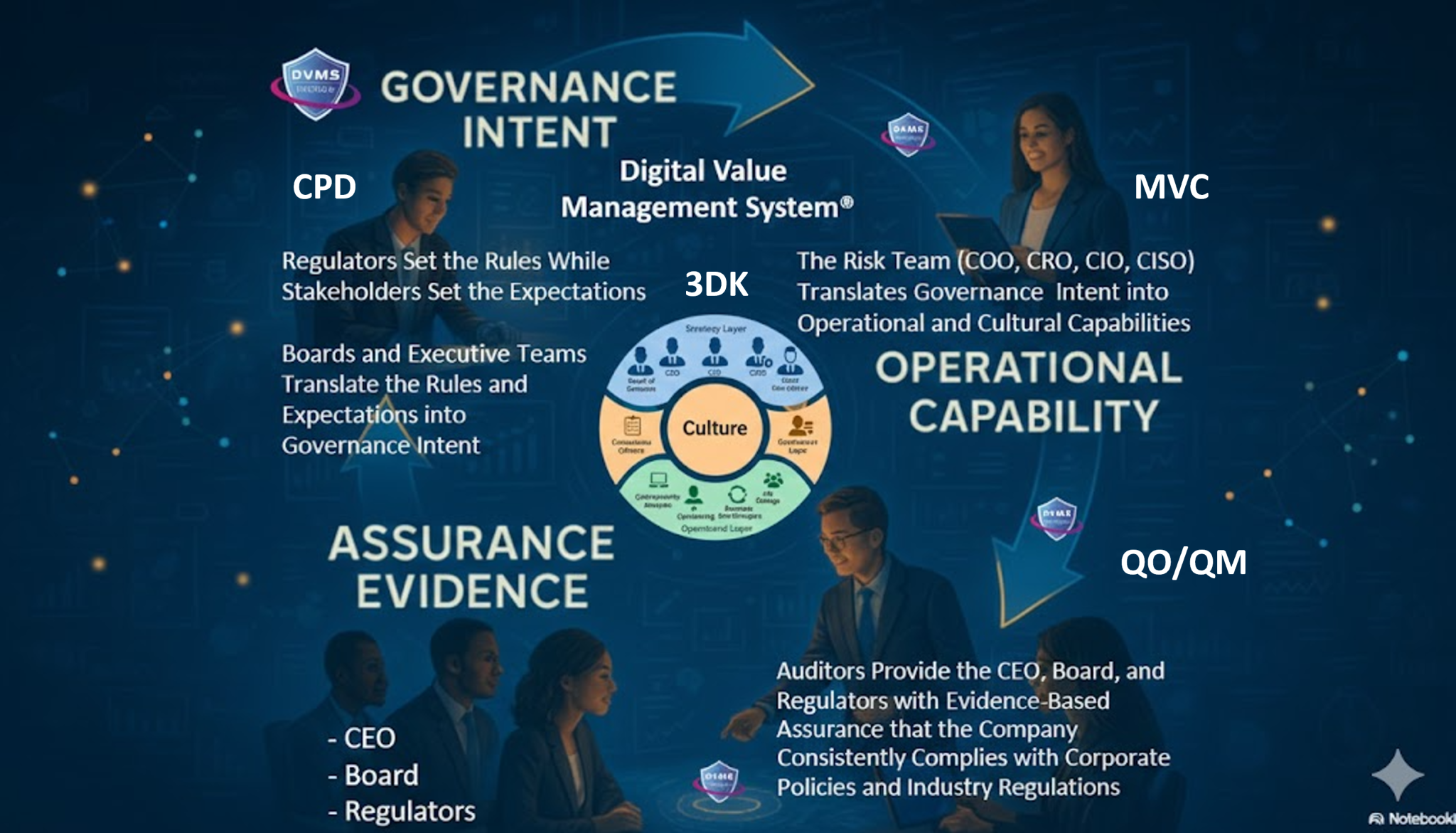
Governance by Assurance represents this evolution. Rather than relying primarily on assumptions, periodic assessments, or historical reporting, organizations continuously collect, correlate, evaluate, and present trusted evidence demonstrating that digital operations remain aligned with strategic intent. Governance becomes an evidence-driven management discipline that continuously validates organizational performance rather than periodically inspecting it.
Continuous Assurance Creates Continuous Governance
The defining characteristic of Governance by Assurance is the continuous generation of trusted, audit-ready evidence. Every digital process, operational activity, governance decision, AI interaction, cybersecurity control, workforce capability, and business outcome produces operational evidence. When this evidence is continuously evaluated against organizational objectives, governance policies, stakeholder expectations, and regulatory obligations, executives gain real-time confidence that the enterprise remains aligned with its intended direction.
Continuous assurance transforms governance from a reactive activity into an adaptive management capability. Rather than discovering problems months after they occur, organizations continuously identify emerging conditions, evaluate their impact, and provide leadership with objective evidence supporting informed decision-making. Governance, therefore, becomes an operational capability that evolves alongside the business rather than a periodic oversight exercise.
DVMS® Assurance-Now™ Enables Governance by Assurance
DVMS® Assurance-Now™ operationalizes the principles of Governance by Assurance by serving as an enterprise-wide governance overlay system. Rather than replacing existing operational technologies, cybersecurity platforms, enterprise applications, AI systems, or governance frameworks, the DVMS overlays these environments and transforms fragmented operational information into unified, trusted, and audit-ready evidence.
The platform continuously evaluates whether digital operations remain aligned with organizational objectives for creating, protecting, and delivering sustained digital value. Rather than measuring isolated technical metrics, the DVMS evaluates whether operational performance contributes to intended business outcomes while preserving the qualities that define successful digital enterprises, including trust, resilience, and accountability.
This evidence-driven approach enables leadership to govern the enterprise through objective evidence rather than assumptions. Executives no longer rely solely upon dashboards, reports, or periodic assessments. Instead, they receive continuous assurance that organizational activities remain aligned with leadership intent.
Governance AI-Enabled Digital Business Operations
Artificial intelligence introduces governance challenges unlike those posed by any previous technology. AI systems continuously influence decisions, automate business activities, generate content, interpret data, recommend actions, and interact directly with customers and employees. Organizations must therefore govern not only technology performance but also AI behavior, decision quality, workforce interaction, ethical responsibility, regulatory compliance, and operational transparency.
The DVMS enables this capability by continuously assuring that AI-enabled business operations remain aligned with enterprise governance objectives. Operational evidence is collected across business systems, AI platforms, cybersecurity environments, governance processes, and business workflows to determine whether AI is contributing positively to organizational performance while operating within approved governance boundaries.
This allows organizations to adopt AI confidently because governance evolves alongside innovation rather than restricting it. Leaders gain continuous visibility into the effectiveness, accountability, and trustworthiness of AI-enabled operations while maintaining the flexibility required to innovate rapidly.
Governance Workforce Development Through Assurance
Artificial intelligence also transforms workforce governance. As digital enterprises increasingly depend on AI-assisted decision-making, automation, intelligent workflows, and advanced analytics, workforce capability becomes one of the organization’s most important governance responsibilities.
Employees must continuously develop competencies in AI literacy, cybersecurity, digital ethics, governance, data stewardship, human AI collaboration, and intelligent decision making. Traditional workforce development models based solely on course completion or periodic certification no longer provide sufficient assurance that the workforce possesses the capabilities required to support modern digital operations.
Within the DVMS model, workforce capability becomes another source of governance evidence. Organizations continuously evaluate workforce readiness alongside operational performance, providing executives with confidence that both technology and people remain capable of achieving intended business outcomes. Governance, therefore, extends beyond technology oversight to include continuous assurance of organizational capability.
Sustaining Trust, Resilience, and Accountability
Modern enterprises succeed not only by creating digital value, but also by doing so responsibly and sustainably. Trust enables customer confidence. Resilience enables operational continuity. Accountability enables transparent leadership, regulatory confidence, and stakeholder assurance.
These qualities cannot be assumed. They must be continuously demonstrated through objective evidence.
The DVMS continuously evaluates operational activities, governance processes, AI-enabled business operations, workforce capabilities, cybersecurity controls, and organizational performance to provide leadership with evidence that trust, resilience, and accountability remain embedded within day-to-day business operations. These governance outcomes become measurable rather than aspirational.
The Future of Enterprise Governance
Artificial intelligence is redefining enterprise governance. Organizations can no longer rely upon governance models designed for slower, more predictable environments. They require governance systems that continuously adapt while providing objective evidence that digital operations remain aligned with leadership intent.
DVMS® Assurance-Now™ provides this capability by enabling Governance by Assurance across the enterprise. Through continuous, audit-ready evidence, the DVMS enables executives, boards, regulators, auditors, and stakeholders to know, rather than merely believe, that the enterprise is creating, protecting, and delivering sustained digital value while preserving trust, resilience, and accountability.
In the Age of AI, the competitive advantage will belong not simply to organizations that adopt artificial intelligence first, but to those that govern it most effectively. Governance by Assurance provides the management philosophy. DVMS® Assurance-Now™ provides the operational capability. Together, they establish a new standard for real-time governance and assurance, enabling organizations to innovate confidently while continuously demonstrating alignment between strategic intent, digital business operations, workforce capability, and sustainable business performance.
About the Author

Rick Lemieux
Co-Founder and Chief Product Officer of the DVMS Institute
Rick has 40+ years of passion and experience creating solutions to give organizations a competitive edge in their service markets. In 2015, Rick was identified as one of the top five IT Entrepreneurs in the State of Rhode Island by the TECH 10 awards for developing innovative training and mentoring solutions for boards, senior executives, and operational stakeholders.
Digital Value Management System® is a registered trademark of the DVMS Institute LLC.
® DVMS Institute 2026 All Rights Reserved