IT Systems and Frameworks That Underpin the Creation, Protection, and Delivery of Digital Value
Rick Lemieux – Co-Founder and Chief Product Officer of the DVMS Institute
Introduction
In the modern digital economy, organizations rely on information technology (IT) systems and management frameworks to create, protect, and deliver value to customers, stakeholders, and society. Digital value refers to the benefits generated through the use of digital technologies, data, information, and business processes that improve organizational performance, customer experiences, innovation, and competitiveness.
As organizations become increasingly dependent on digital assets and services, effective technology management has become a strategic necessity rather than merely an operational function. The successful creation, protection, and delivery of digital value require an integrated ecosystem of IT systems, governance structures, cybersecurity controls, and performance management frameworks that work together to ensure technology investments deliver measurable, sustainable outcomes.
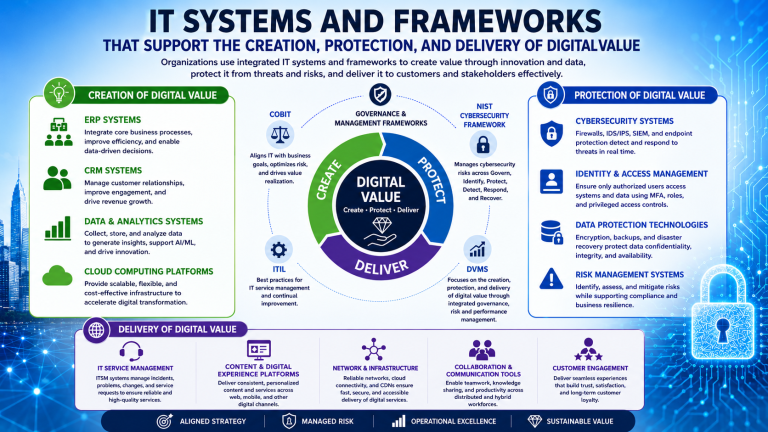
IT Systems That Enable the Creation of Digital Value
The creation of digital value begins with IT systems that support business operations, innovation, and decision-making. Enterprise Resource Planning (ERP) systems integrate core organizational functions such as finance, procurement, human resources, and supply chain management into a unified platform. By consolidating information and automating business processes, ERP systems improve efficiency, reduce operational costs, and provide management with accurate data for strategic decisions.
Customer Relationship Management (CRM) systems contribute significantly to digital value creation by enabling organizations to manage customer interactions, sales activities, marketing campaigns, and customer service processes. These systems help organizations better understand customer needs, improve customer satisfaction, and increase revenue through data-driven engagement strategies.
Data management systems, including data warehouses, data lakes, and business intelligence platforms, serve as foundational components for value creation. Organizations use these systems to collect, store, analyze, and transform data into actionable insights. Advanced analytics, artificial intelligence (AI), and machine learning technologies further enhance value creation by identifying patterns, predicting future outcomes, and supporting informed decision-making. As a result, organizations can improve operational efficiency, identify new market opportunities, and innovate more effectively.
Cloud computing platforms have become critical enablers of digital value creation by providing scalable, flexible, and cost-effective technology infrastructure. Cloud services allow organizations to rapidly deploy applications, support remote workforces, and accelerate digital transformation initiatives without significant capital investment. The agility provided by cloud technologies enables organizations to respond quickly to changing market conditions and customer expectations.
IT Systems That Protect Digital Value
While creating digital value is essential, protecting that value is equally important. Organizations face growing cybersecurity threats, including data breaches, ransomware attacks, insider threats, and supply chain vulnerabilities. Various IT systems are designed specifically to protect digital assets, information resources, and business operations.
Cybersecurity systems form the first line of defense against digital threats. Firewalls, intrusion detection systems (IDS), intrusion prevention systems (IPS), endpoint protection platforms, and security information and event management (SIEM) solutions help organizations monitor, detect, and respond to malicious activities. These systems provide visibility into security events and enable the timely mitigation of risks that could compromise digital assets.
Identity and Access Management (IAM) systems play a critical role in protecting digital value by ensuring that only authorized users can access specific systems, applications, and data. Through authentication mechanisms such as multi-factor authentication (MFA), role-based access controls, and privileged access management, IAM systems reduce the likelihood of unauthorized access and insider threats.
Data protection technologies further safeguard digital value by ensuring the confidentiality, integrity, and availability of information. Encryption technologies protect sensitive data both at rest and in transit, while backup and disaster recovery systems enable organizations to restore critical information and operations following cyber incidents, system failures, or natural disasters. These technologies support organizational resilience and business continuity.
Risk management systems also contribute to value protection by helping organizations identify, assess, monitor, and mitigate risks. These systems provide structured approaches for evaluating threats and vulnerabilities while supporting compliance with regulatory requirements and organizational policies.
IT Systems That Deliver Digital Value
The delivery of digital value involves ensuring that technology-enabled products, services, and information reach intended users effectively and efficiently. Various IT systems support this objective by facilitating communication, service delivery, operational performance, and customer engagement.
Digital service management platforms enable organizations to deliver reliable and high-quality services to customers and stakeholders. IT Service Management (ITSM) systems support incident management, problem management, service requests, and change management processes that help maintain service availability and performance. These systems ensure that technology services align with business requirements and customer expectations.
Content management systems (CMS) and digital experience platforms facilitate the delivery of information, products, and services through websites, mobile applications, and digital channels. These platforms enable organizations to provide consistent, personalized, and accessible experiences for users across multiple touchpoints.
Network infrastructure systems, including telecommunications networks, cloud connectivity solutions, and content delivery networks (CDNs), support the efficient transmission of data and services. Reliable network performance is essential for ensuring that digital services remain accessible and responsive to users, regardless of geographic location.
Collaboration and communication platforms have also become increasingly important for delivering digital value. Tools such as video conferencing systems, enterprise messaging applications, and collaborative workspaces support workforce productivity and enable organizations to coordinate activities across distributed teams. These systems contribute directly to organizational effectiveness and service delivery capabilities.
Frameworks That Govern and Optimize Digital Value
While IT systems provide technological capabilities, frameworks provide the governance, structure, and best practices necessary to maximize value creation, protection, and delivery. Several widely recognized frameworks support effective digital business management.
COBIT (Control Objectives for Information and Related Technologies) provides a comprehensive governance and management framework that helps organizations align IT activities with business objectives. COBIT emphasizes value creation through the balancing of benefits realization, risk optimization, and resource optimization. By establishing clear governance practices, organizations can ensure that technology investments contribute directly to strategic goals.
The Information Technology Infrastructure Library (ITIL) focuses on service management and continual improvement. ITIL provides guidance for designing, delivering, operating, and improving IT services. Its processes help organizations maintain service quality, improve customer satisfaction, and optimize operational efficiency.
The NIST Cybersecurity Framework (CSF) provides a structured approach for managing cybersecurity risks. Organized around the core functions of Govern, Identify, Protect, Detect, Respond, and Recover, the framework helps organizations strengthen their cybersecurity posture while supporting business resilience and trust. NIST CSF enables organizations to systematically protect digital assets and maintain operational continuity.
The Digital Value Management System® (DVMS) overlay system extends traditional governance approaches by focusing specifically on the creation, protection, and delivery of digital value. The DVMS overlay integrates governance, risk management, performance management, cybersecurity, and operational resilience into a unified system. By establishing clear relationships among digital assets, organizational objectives, risks, controls, and outcomes, DVMS continuously transforms fragmented operational data into trusted evidence, providing real-time assurance that digital value creation, protection, and delivery systems are achieving their intended outcomes for value, trust, resilience, accountability, and audit-readiness.
Conclusion
The creation, protection, and delivery of digital value depend on the effective integration of IT systems and management frameworks. Systems such as ERP platforms, CRM applications, cloud services, cybersecurity technologies, and IT service management solutions provide the technological capabilities necessary to generate and sustain value.
At the same time, frameworks and overlay systems such as COBIT, ITIL, NIST CSF, and DVMS provide governance structures and best practices that ensure technology investments remain aligned with organizational objectives.
As digital transformation continues to reshape industries and economies, organizations that successfully combine robust IT systems with effective governance frameworks will be better positioned to drive innovation, achieve competitive advantage, and sustain long-term success in the digital age.
About the Author

Rick Lemieux
Co-Founder and Chief Product Officer of the DVMS Institute
Rick has 40+ years of passion and experience creating solutions to give organizations a competitive edge in their service markets. In 2015, Rick was identified as one of the top five IT Entrepreneurs in the State of Rhode Island by the TECH 10 awards for developing innovative training and mentoring solutions for boards, senior executives, and operational stakeholders.
Digital Value Management System® is a registered trademark of the DVMS Institute LLC.
® DVMS Institute 2026 All Rights Reserved