Enabling Continuous Audit Readiness with a Digital Value Management System® (DVMS)
Rick Lemieux – Co-Founder and Chief Product Officer of the DVMS Institute
In today’s regulatory and risk-intensive environment, organizations of all sizes face mounting pressure to demonstrate compliance with a growing number of standards and frameworks. From CMMC in the defense sector to ISO 27001 for information security, HITRUST in healthcare, and ISO 20000 for service management, the expectation is no longer periodic compliance but continuous audit readiness. Traditional approaches to audits, which rely on manual processes, fragmented tools, and last-minute preparation, are increasingly inadequate. A Digital Value Management System (DVMS) addresses this challenge by providing a unified, evidence-driven governance model that enables organizations to continuously pass audits while delivering board-level assurance of resilience, accountability, and operational performance across fragmented digital ecosystems.
From Reactive Audits to Continuous Readiness
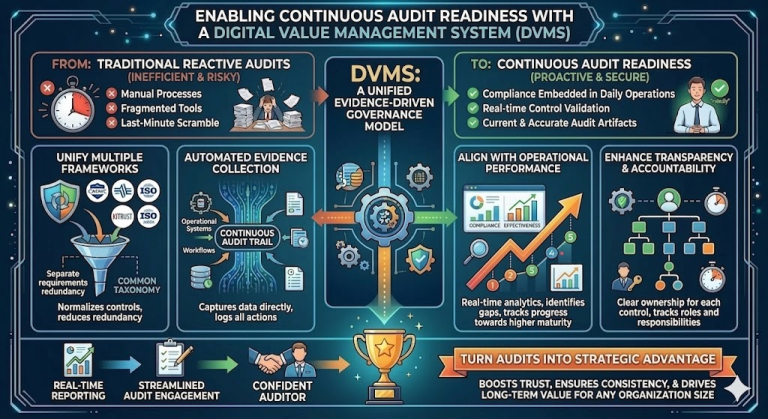
At its core, the DVMS transforms audit readiness from a reactive, point-in-time exercise into a continuous, integrated capability. Historically, organizations have treated audits as isolated events, scrambling to gather documentation, validate controls, and demonstrate compliance in the weeks or months leading up to an audit. This approach is inefficient and introduces unnecessary risk, often exposing gaps too late in the process. The DVMS eliminates this reactive cycle by embedding compliance into daily operations. Through continuous monitoring, automated evidence collection, and real-time control validation, organizations maintain a constant state of readiness where audit artifacts are always current, accurate, and accessible.
Unifying Multiple Frameworks into a Single Governance Model
One of the key ways DVMS enables continuous audit success is by integrating multiple frameworks into a single, unified governance structure. Organizations rarely operate under a single standard. Instead, they must navigate overlapping requirements across CMMC, ISO 27001, HITRUST, ISO 20000, and other maturity models. Each framework introduces its own terminology, control sets, and assessment criteria, creating duplication and complexity when managed separately. The DVMS addresses this fragmentation by normalizing and mapping controls across frameworks into a common taxonomy. A single control implementation, such as access management or incident response, can simultaneously satisfy multiple regulatory requirements. This reduces redundancy, streamlines compliance efforts, and provides a holistic view of governance across the enterprise.
Evidence Driven Assurance and Continuous Audit Trails
Another critical capability of the DVMS is its emphasis on evidence-driven assurance. Auditors require proof that controls are not only defined but are also operating effectively. In many organizations, evidence collection is manual and inconsistent, relying on screenshots, spreadsheets, and ad hoc documentation. This approach is time-consuming and prone to error. The DVMS automates evidence generation by capturing data directly from operational systems, workflows, and control activities. Every action is logged, time-stamped, and linked to the appropriate control. This creates a continuous audit trail that provides verifiable, real-time evidence of compliance and significantly reduces the burden of audit preparation.
Scalability Across Organizations of Any Size
Scalability is a defining advantage of the DVMS. Small and mid-sized organizations often struggle with compliance due to limited resources and a lack of specialized expertise. Large enterprises face a different challenge: managing complexity across multiple business units, systems, and geographies. The DVMS is designed to support both scenarios. For smaller organizations, it simplifies compliance by providing structured frameworks, automated processes, and centralized visibility, reducing reliance on manual effort. For larger enterprises, it enables standardization, consistency, and aggregation of compliance data across the organization. In both cases, audit readiness is a function of the system rather than the organization’s size or maturity.
Aligning Compliance with Operational Performance
The DVMS also aligns compliance with operational performance, ensuring that audit readiness is sustainable over time. In traditional models, compliance activities are often disconnected from business operations and viewed as administrative overhead. This separation can lead to resistance and a lack of accountability. The DVMS integrates compliance into value streams and performance metrics, embedding controls directly into workflows. Controls are measured not just for compliance but for their contribution to operational effectiveness. For example, incident response processes aligned with ISO 27001 or CMMC are evaluated based on their ability to minimize disruption and protect assets. This alignment ensures that compliance supports business objectives rather than competing with them.
Driving Continuous Improvement and Maturity
Continuous improvement is essential for maintaining compliance with evolving standards and maturity models. Frameworks such as CMMC and HITRUST require organizations to demonstrate progress over time. The DVMS provides the tools and insights needed to support this evolution. Through real-time dashboards and analytics, organizations can identify control gaps, prioritize remediation efforts, and track progress toward higher levels of maturity. This proactive approach strengthens both compliance and resilience, enabling organizations to adapt to new requirements and emerging risks with confidence.
Enhancing Transparency and Accountability
Transparency and accountability are critical components of audit success. Auditors need to understand not only what controls exist but also how they are managed and who is responsible for them. The DVMS establishes clear ownership for each control, process, and outcome. Roles and responsibilities are defined, and all activities are tracked within the system. This creates full visibility into governance processes and simplifies audit engagement. Organizations can quickly demonstrate control effectiveness, accountability structures, and governance practices without relying on manual explanations or disconnected documentation.
Real Time Reporting and Streamlined Audit Engagement
Another significant benefit of the DVMS is its ability to support real-time reporting and audit engagement. Instead of preparing static reports, organizations can provide auditors with dynamic, up-to-date views of their compliance posture. Auditors can access dashboards, review evidence, and validate controls in real time. This reduces delays, minimizes back-and-forth communication, and accelerates the audit process. More importantly, it builds trust by demonstrating that compliance is consistently maintained rather than assembled temporarily for audit purposes.
Turning Audits into Strategic Advantage
The DVMS shifts the perception of audits from a burden to a strategic advantage. When compliance is embedded into operations and supported by continuous assurance, audits become a validation of performance rather than a disruption. Organizations can approach audits with confidence, knowing that their controls, processes, and systems are consistently aligned with regulatory expectations. This shift enables leadership teams to focus on innovation, growth, and value creation without being constrained by compliance challenges.
Conclusion
The Digital Value Management System represents a fundamental shift in how organizations approach audit readiness and compliance. By integrating frameworks, automating evidence collection, and embedding controls into daily operations, the DVMS enables continuous audit readiness across standards such as CMMC, ISO 27001, HITRUST, and ISO 20000. Its scalability ensures that organizations of any size can achieve and maintain compliance, while its alignment with performance and resilience drives long-term value. In a world where trust, transparency, and accountability are essential, the DVMS provides the foundation for organizations to not only pass audits but to do so consistently, efficiently, and with confidence.
About the Author

Rick Lemieux
Co-Founder and Chief Product Officer of the DVMS Institute
Rick has 40+ years of passion and experience creating solutions to give organizations a competitive edge in their service markets. In 2015, Rick was identified as one of the top five IT Entrepreneurs in the State of Rhode Island by the TECH 10 awards for developing innovative training and mentoring solutions for boards, senior executives, and operational stakeholders.
Digital Value Management System® is a registered trademark of the DVMS Institute LLC.
® DVMS Institute 2026 All Rights Reserved