The Four Pillars of Modern Digital Enterprises
Rick Lemieux – Co-Founder and Chief Product Officer of the DVMS Institute
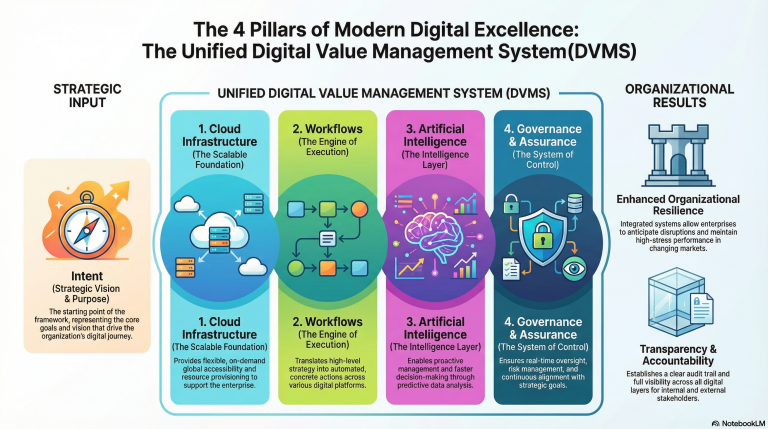
Modern digital enterprises are no longer defined solely by their technological stacks but by how effectively they integrate technology, processes, intelligence, and governance into a cohesive system of value creation. As organizations evolve, four critical dimensions have emerged as the foundation to success: cloud infrastructure, digital workflows, artificial intelligence, and assurance-based governance. Each dimension represents a distinct capability, but their true power lies in their collective operation as an integrated, adaptive system. Organizations that understand and align these dimensions are better positioned to navigate complexity, deliver value, and sustain performance in an increasingly dynamic environment.
Cloud as the Scalable Foundation of the Enterprise
Cloud computing forms the structural backbone of the modern digital enterprise. It provides the scalability, flexibility, and accessibility required to support rapid innovation and global operations. Unlike traditional infrastructure, the cloud enables organizations to provision resources on demand, scale dynamically, and deploy services with unprecedented speed.
This capability transforms how businesses operate. Infrastructure is no longer a constraint but an enabler of experimentation and growth. Organizations can launch new products, enter new markets, and respond to changing demands without the delays associated with physical systems. However, this flexibility also introduces complexity. Multi-cloud environments, distributed architectures, and shared responsibility models create challenges in visibility, cost management, and security.
To fully leverage the cloud, organizations must treat it as a strategic platform rather than a collection of services. This requires aligning cloud usage with business objectives, implementing consistent governance practices, and ensuring that resources are optimized for both performance and cost. When managed effectively, the cloud becomes a powerful foundation for digital capability.
Digital Workflows as the Engine of Execution
While the cloud provides the infrastructure, digital workflows define how work is performed within the enterprise. Digital workflows connect people, systems, and processes, enabling organizations to execute tasks efficiently and consistently. They represent the operational layer where strategy is translated into action.
In modern enterprises, workflows are increasingly automated and integrated across platforms. This integration enables seamless information flow, reducing manual intervention and minimizing errors. Processes such as customer onboarding, supply chain management, and incident response can be executed quickly and precisely, improving efficiency and the user experience.
However, the proliferation of workflows can lead to fragmentation if not properly managed. Different teams may develop workflows independently, resulting in inconsistencies and inefficiencies. To avoid this, organizations must adopt a systems-based approach to workflow design. Workflows should be standardized where possible, aligned with business objectives, and continuously optimized based on performance data.
When effectively managed, digital workflows become a source of competitive advantage, enabling organizations to deliver consistent outcomes on a scale.
Artificial Intelligence as the Intelligence Layer
Artificial intelligence introduces a new dimension to digital enterprises by adding intelligence to systems and processes. AI enables organizations to analyze vast amounts of data, identify patterns, and make predictions that inform decision-making. It enhances both operational efficiency and strategic insight, allowing businesses to move from reactive to proactive management.
AI can be embedded across various aspects of the enterprise, from customer interactions and fraud detection to predictive maintenance and resource optimization. It augments human capabilities, enabling faster and more informed decisions. However, AI also introduces new challenges, including transparency of models, data quality, bias, and regulatory compliance.
To effectively integrate AI, organizations must ensure that it is governed and aligned with business objectives. AI systems should not operate as isolated components but as integrated elements of the digital ecosystem. This requires clear definitions of intended outcomes, measurable performance metrics, and mechanisms for continuous monitoring and improvement.
When properly integrated, AI becomes a powerful driver of innovation and efficiency, transforming how organizations operate and compete.
Governing Assurance as the System of Control and Confidence
The fourth dimension, governed by assurance, provides the structure that ensures cloud, workflows, and AI operate effectively and responsibly. Traditional governance models, based on periodic reviews and static controls, are insufficient for the dynamic nature of modern digital environments. Governing by assurance represents a shift toward continuous, outcome-based governance.
This approach integrates governance, risk management, and performance into a unified system that operates in real time. It focuses not only on whether controls exist but also on whether they deliver the intended outcomes. By embedding monitoring, measurement, and feedback mechanisms into daily operations, governance by assurance enables organizations to maintain alignment with strategic objectives while proactively managing risk.
For organizations deploying complex digital systems, this dimension is critical. It provides visibility into performance, ensures accountability, and enables informed decision-making. Governing by assurance transforms governance from a reactive function into a proactive capability that supports both resilience and innovation.
Integrating the Four Dimensions into a Cohesive System
While each dimension is important on its own, its true value emerges when they are integrated into a cohesive system. Cloud provides the infrastructure, digital workflows drive execution, AI adds intelligence, and governance by assurance ensures alignment and effectiveness. Together, they create a dynamic system capable of creating, protecting, and delivering digital value.
This integration enables organizations to move beyond siloed operations. Data flows seamlessly between systems, decisions are informed by real-time insights, and governance ensures that all activities are aligned with strategic objectives. The result is a more coherent and efficient enterprise, capable of responding quickly to change and delivering consistent outcomes.
Organizations that fail to integrate these dimensions often experience fragmentation. Cloud environments become difficult to manage, workflows become inefficient, AI operates in isolation, and governance becomes reactive. In contrast, integrated enterprises achieve greater clarity, coordination, and control.
The Role of DVMS in Unifying the Four Dimensions
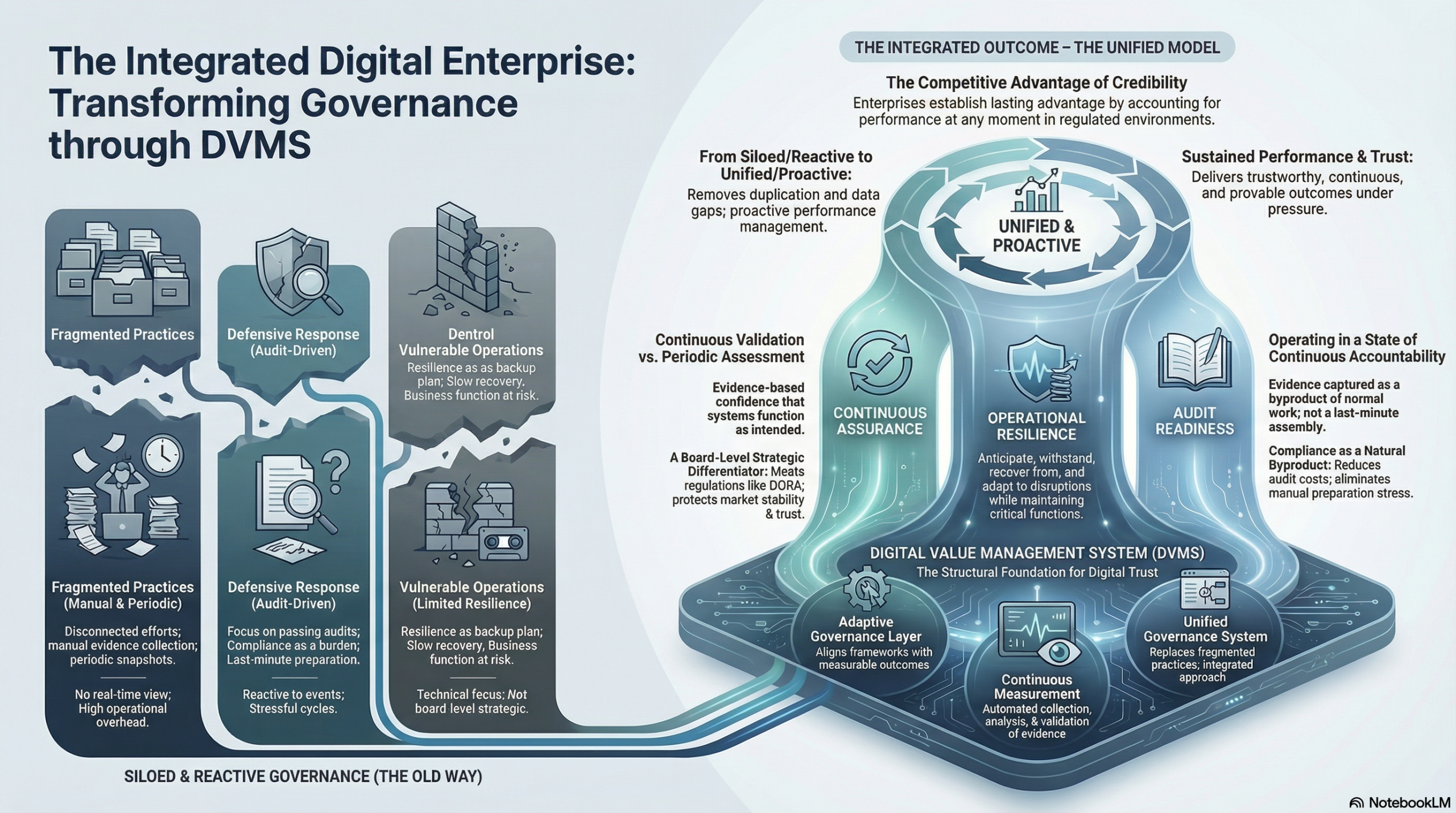
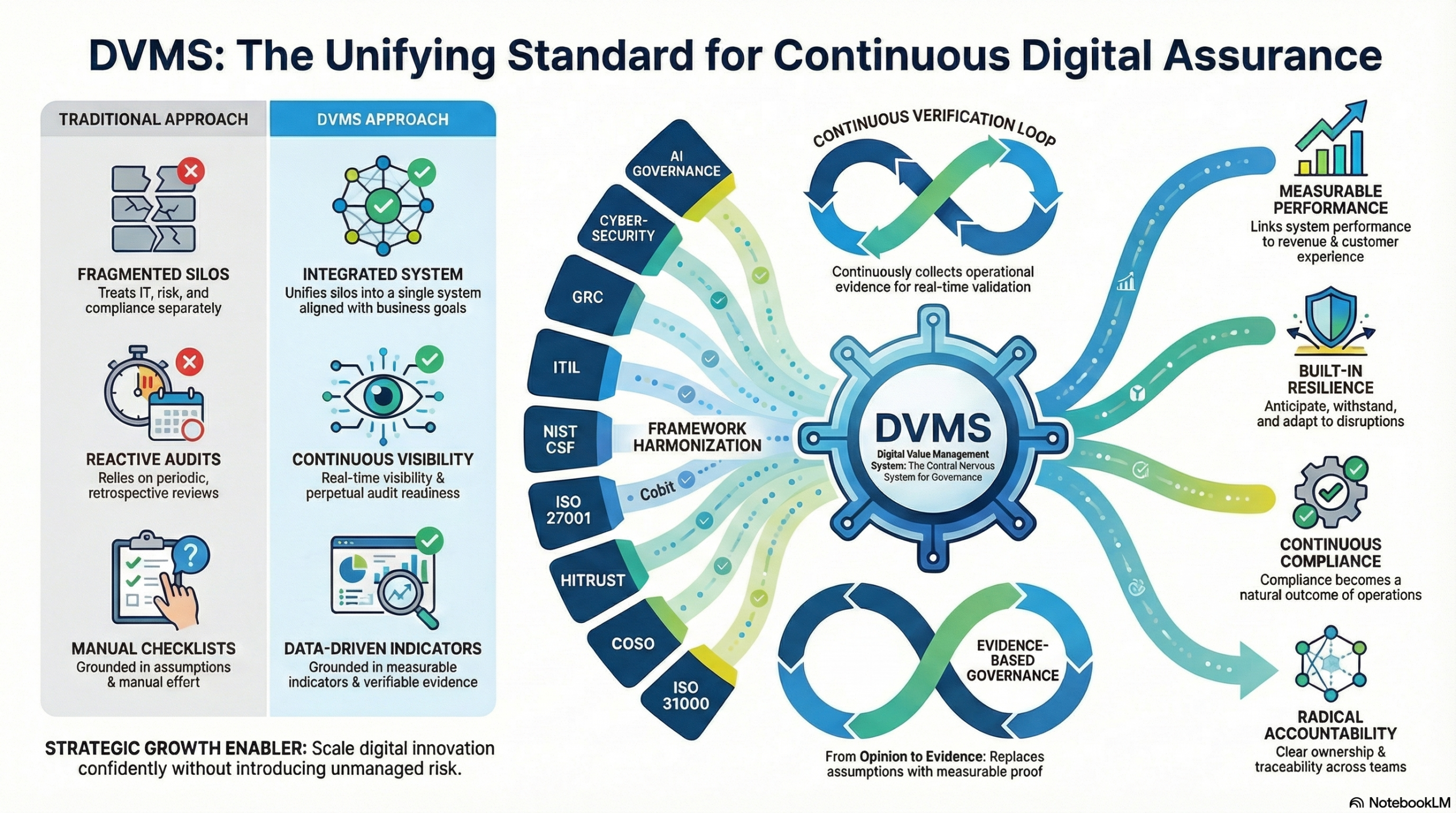
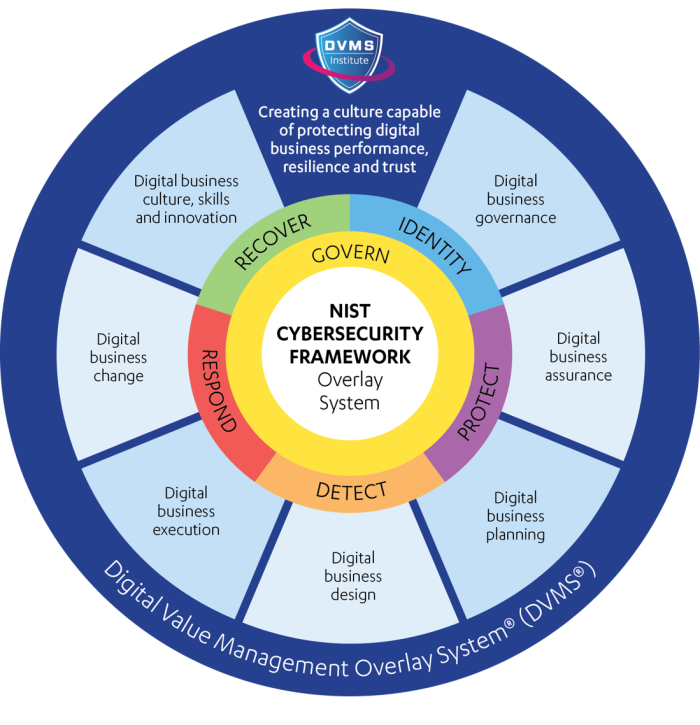
A Digital Value Management System® (DVMS) serves as the unifying overlay that brings coherence, alignment, and assurance across the four dimensions of modern digital enterprises. While cloud provides scale, workflows drive execution, and AI delivers intelligence, these capabilities can remain fragmented without a governing system that connects intent to outcome. DVMS fulfills this role by integrating governance, operational performance, and evidence into a single, continuously adaptive system. It establishes a clear linkage between strategy, risk, execution, and measurable outcomes, ensuring that each dimension operates not in isolation but as part of a coordinated value delivery system. Through its models and assurance mechanisms, DVMS enables organizations to observe, measure, and validate how cloud environments are utilized, how workflows perform, how AI systems behave, and how governance objectives are achieved in practice. This unified approach transforms complexity into clarity, enabling leaders and auditors alike to ensure that digital capabilities are not only deployed but are consistently delivering resilient, compliant, and value-driven outcomes across the enterprise.
Enhancing Resilience and Adaptability
One key benefit of integrating these dimensions is enhanced resilience. Modern enterprises must operate in environments characterized by uncertainty and disruption. By combining scalable infrastructure, efficient workflows, intelligent systems, and continuous governance, organizations can build resilience into every aspect of their operations.
Cloud enables rapid recovery and scalability, workflows ensure continuity of operations, AI provides predictive insights, and governance by assurance ensures coordinated response. This layered approach allows organizations to anticipate disruptions, respond effectively, and maintain performance under stress.
Adaptability is also enhanced, as organizations can quickly adjust their systems and processes in response to changing conditions. This ability to adapt is essential for long-term success in a rapidly evolving digital landscape.
Driving Performance and Value Creation
The integration of clouds, workflows, AI, and assurance also drives performance and value creation. Each dimension contributes to efficiency, effectiveness, and innovation. Cloud reduces infrastructure constraints, workflows streamline operations, AI enhances decision making, and assurance ensures that all activities are aligned with business objectives.
Together, these capabilities enable organizations to optimize performance, reduce waste, and maximize the return on digital investments. Performance becomes a measurable and manageable outcome, supported by data and continuous feedback. This ensures that digital transformation efforts deliver tangible value rather than simply increasing complexity.
Establishing Transparency and Accountability
Transparency and accountability are critical in complex digital environments. The integration of these four dimensions provides the structure needed to achieve both. Cloud and workflows provide visibility into operations, AI provides insight into decision-making, and governance by assurance establishes clear accountability for outcomes.
This transparency enables organizations to understand how their systems are functioning, who is responsible for each component, and how decisions are made. It supports better governance, faster issue resolution, and greater trust among stakeholders. It also enhances compliance, as organizations can demonstrate clear control and accountability across their operations.
Conclusion: A Unified Overlay System for Digital Excellence
The modern digital enterprise is defined by its ability to integrate cloud infrastructure, digital workflows, artificial intelligence, and governance by assurance into a unified system. Each dimension plays a vital role, but it is their interaction that creates true value. Together, they enable organizations to operate more efficiently, intelligently, and with greater control.
By embracing these four dimensions, organizations can move beyond fragmented approaches to create a cohesive, adaptive system for value creation. They can manage complexity, respond to change, and deliver consistent outcomes in an increasingly competitive environment. This integrated model provides the foundation for sustainable success, ensuring that digital transformation is achieved and continuously optimized.
About the Author

Rick Lemieux
Co-Founder and Chief Product Officer of the DVMS Institute
Rick has 40+ years of passion and experience creating solutions to give organizations a competitive edge in their service markets. In 2015, Rick was identified as one of the top five IT Entrepreneurs in the State of Rhode Island by the TECH 10 awards for developing innovative training and mentoring solutions for boards, senior executives, and operational stakeholders.
Digital Value Management System® is a registered trademark of the DVMS Institute LLC.
® DVMS Institute 2026 All Rights Reserved