Solving the Operational Resilience Problem in Today’s Digital Enterprise
Rick Lemieux – Co-Founder and Chief Product Officer of the DVMS Institute
The Digital Enterprise Has Become a Complex System
Modern organizations no longer operate as simple collections of applications, infrastructure, and business processes. Instead, they function as complex digital ecosystems composed of interconnected technologies, cloud services, data pipelines, software platforms, and automated processes operating alongside human and AI actors. These systems evolve continuously as organizations adopt cloud-native architectures, artificial intelligence, distributed platforms, and third-party services. Infrastructure has dissolved into services, workloads have become ephemeral, and operational boundaries now span multiple environments, providers, and jurisdictions.
As a result, the digital enterprise has become a complex adaptive system, one where outcomes emerge from interactions among components rather than from individual systems operating independently. In such environments, failures rarely originate from a single point of breakdown. Instead, they arise from cascading interactions across systems, dependencies, and operational processes. Security breaches, service disruptions, compliance failures, and operational incidents increasingly emerge at the boundaries where systems intersect. Traditional management approaches that treat risk, security, and performance as isolated technical issues are no longer sufficient. Governing modern digital ecosystems requires a systemic approach that orchestrates resilience, accountability, and assurance across the entire enterprise.
The Fragmentation of Governance in Digital Organizations
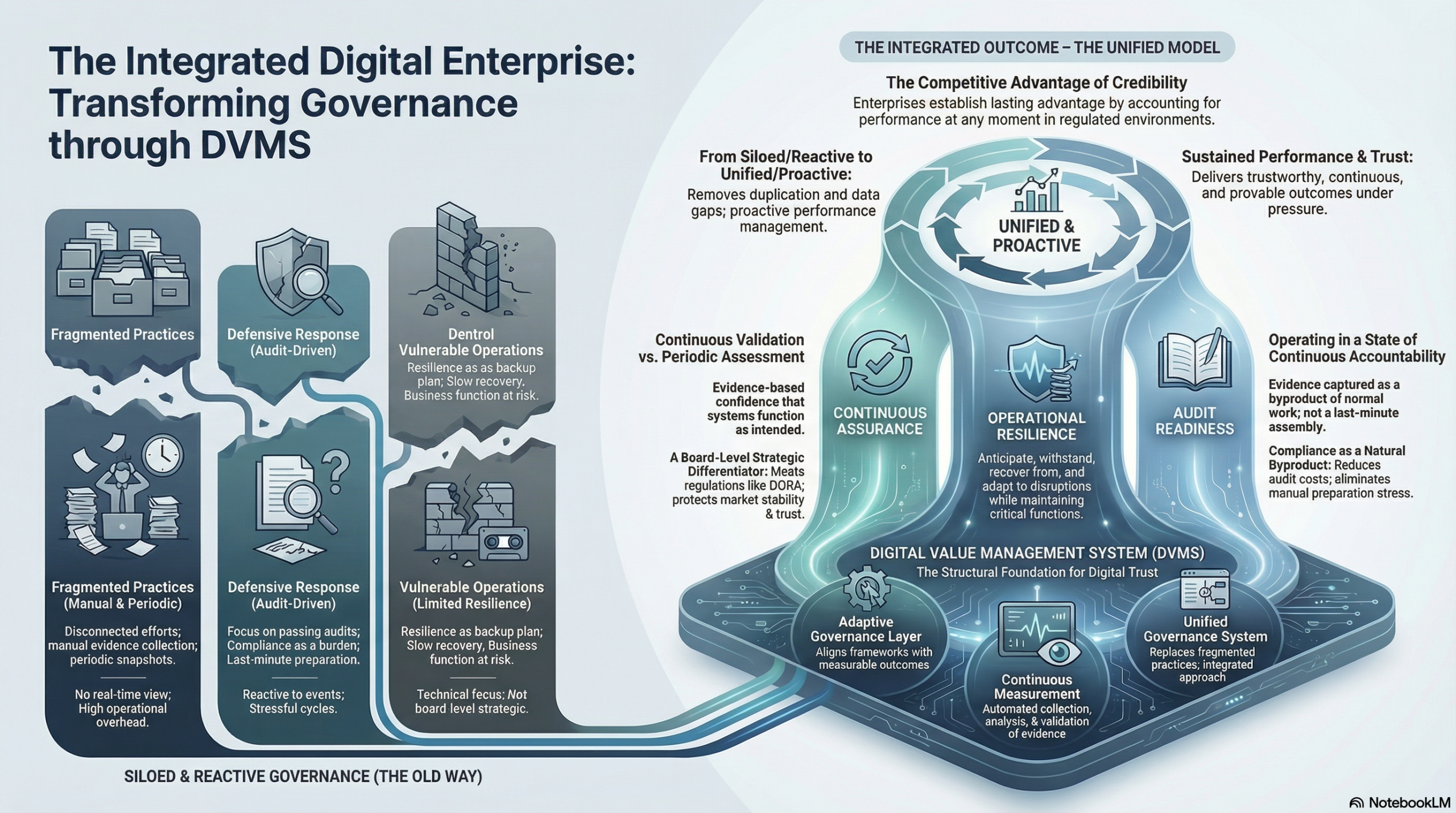
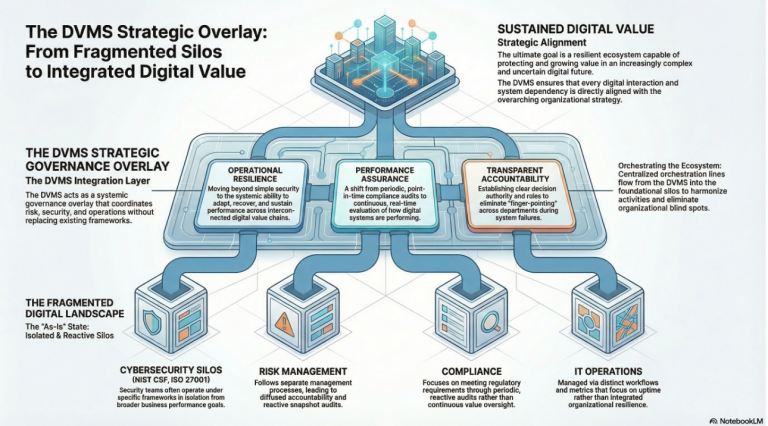
Despite the complexity of modern digital systems, most organizations manage their technology and risk environments through fragmented governance structures. Cybersecurity teams operate under security frameworks such as NIST CSF or ISO 27001. Risk management functions follow enterprise risk methodologies. Compliance teams focus on regulatory obligations. IT operations manage reliability and service delivery. Meanwhile, business leadership remains focused on strategic performance and value creation.
While each of these disciplines is important, they often function in organizational silos, guided by separate frameworks, metrics, and management processes. This fragmentation leads to several critical challenges. First, organizations struggle to maintain consistent oversight across interconnected digital systems. Second, leadership lacks a unified view of how digital capabilities contribute to—or threaten—enterprise value. Third, assurance mechanisms become reactive, focused on compliance rather than performance and resilience. Finally, accountability becomes diffused across departments, making it difficult to determine who is responsible for ensuring digital systems operate reliably, securely, and in alignment with business objectives.
In complex digital environments, this fragmented governance model creates significant blind spots. Organizations may implement strong security controls yet still experience operational disruptions due to poorly governed dependencies. They may achieve regulatory compliance while failing to ensure that digital systems support strategic outcomes. The absence of an integrated governance approach undermines the organization’s ability to protect and sustain digital value.
The Need for a Systemic Governance Overlay
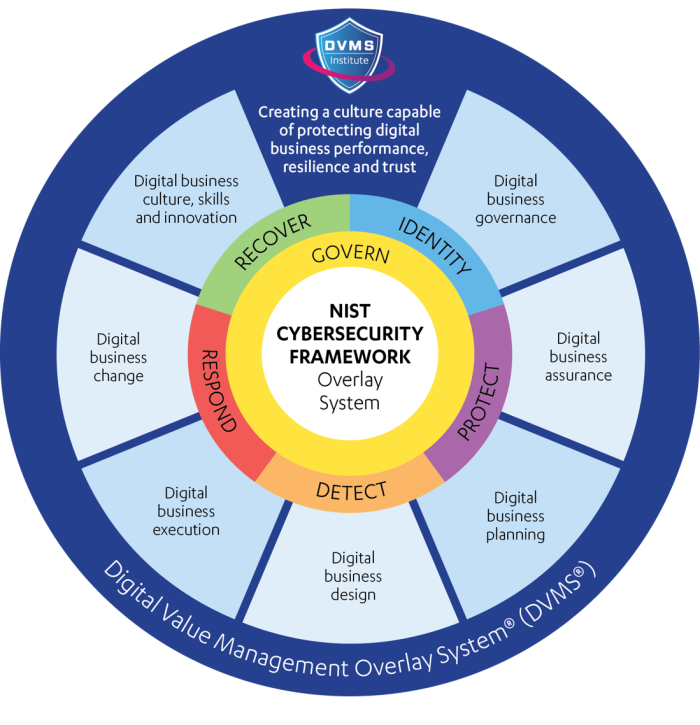
To effectively manage complex digital ecosystems, organizations require more than individual frameworks or compliance programs. They need a systemic governance overlay that can coordinate risk management, security, operational resilience, performance assurance, and accountability across the enterprise. This is the role of a Digital Value Management System (DVMS).
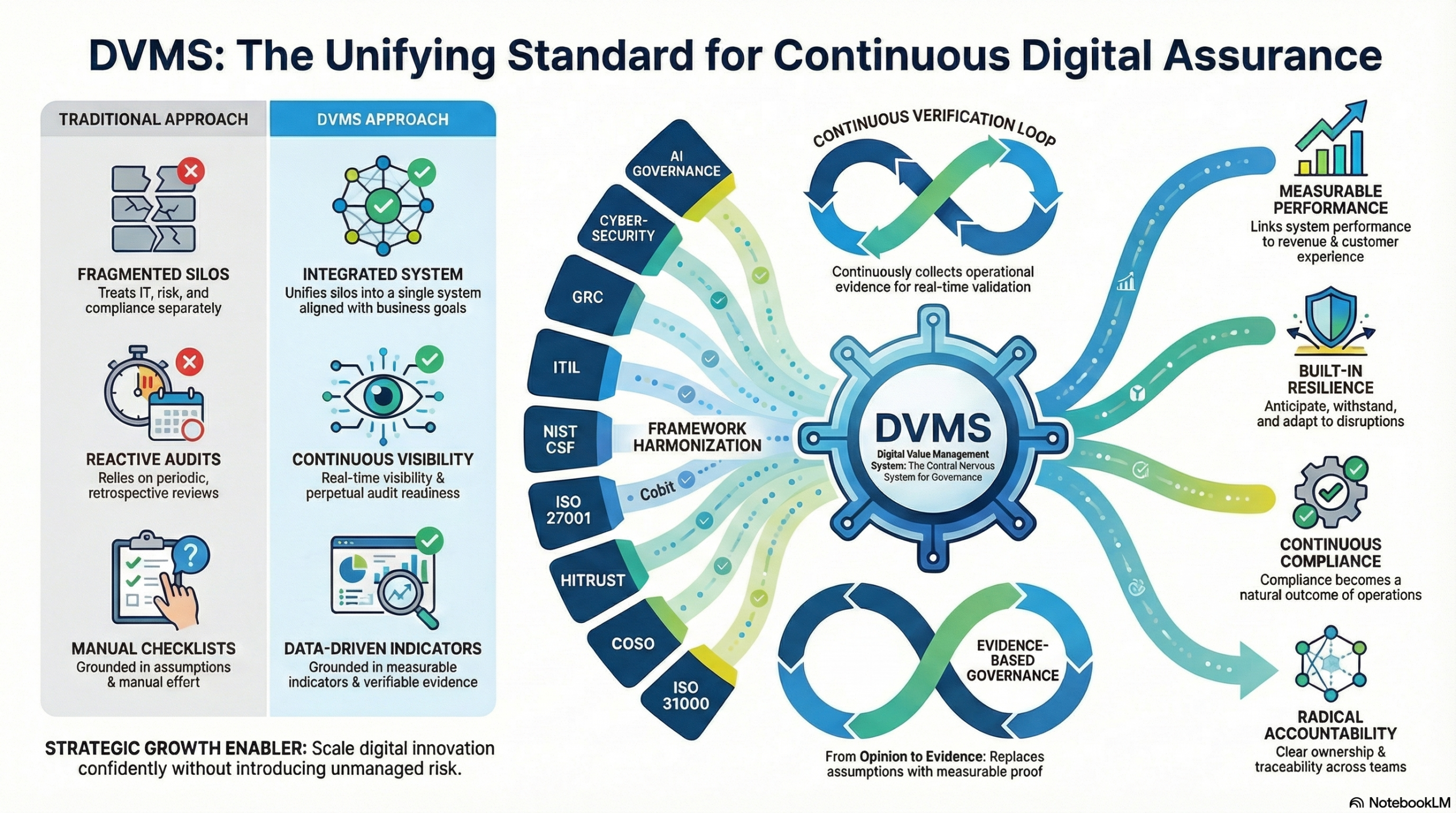
A DVMS functions as an overlay governance and management system that integrates multiple management disciplines into a unified framework focused on sustaining digital value. Rather than replacing existing frameworks such as NIST CSF, ISO standards, or enterprise risk management programs, a DVMS orchestrates them. It provides the structural governance layer that aligns these activities with organizational strategy and ensures they collectively support operational resilience, performance reliability, and accountability.
Through this overlay structure, a DVMS enables organizations to coordinate how digital systems are governed, measured, and assured. It establishes clear accountability for the outcomes of digital operations while enabling leadership to understand how digital capabilities contribute to business performance and organizational resilience.
Ensuring Operational Resilience in Interconnected Systems
Operational resilience has become one of the most critical challenges facing digital organizations. Cloud platforms, microservices architectures, and globally distributed supply chains have created environments where disruptions can propagate rapidly across interconnected systems. A failure in a single service provider, software dependency, or configuration layer can cascade through the ecosystem, affecting business operations, customer trust, and financial performance.
A DVMS addresses this challenge by orchestrating resilience across the entire digital ecosystem rather than focusing only on individual systems or controls. It establishes governance mechanisms that ensure dependencies are understood, critical services are protected, and resilience capabilities are continuously evaluated. By integrating resilience planning with governance, risk management, and operational oversight, organizations can better anticipate disruptions and respond effectively when incidents occur.
Importantly, resilience in a DVMS context is not limited to cybersecurity. It encompasses the broader ability of digital systems to adapt, recover, and sustain performance under changing conditions. This systemic view enables organizations to manage disruptions that arise from cyber threats, operational failures, supply chain disruptions, and technological change.
Providing Assurance of Digital Performance
In digital enterprises, leadership must be able to trust that technology systems are delivering the outcomes required to support the organization’s mission and strategy. Yet many organizations lack effective mechanisms for providing assurance that digital systems are performing as intended.
Traditional assurance mechanisms often focus on periodic audits or compliance assessments. While these activities are important, they typically provide only a snapshot of organizational performance at a particular point in time. They rarely offer continuous insight into how digital systems operate across complex environments.
A DVMS addresses this challenge by embedding performance assurance within governance structures. It integrates monitoring, metrics, reporting, and oversight mechanisms that enable leadership to evaluate how digital systems perform in real time. Through this integrated approach, organizations gain visibility into operational performance, resilience capabilities, and emerging risks. This enables decision-makers to take proactive actions that sustain digital value and protect organizational outcomes.
Establishing Transparent Accountability
One of the most persistent challenges in digital governance is accountability. When failures occur within complex systems, responsibility often becomes unclear. Security teams may blame infrastructure teams, infrastructure teams may blame developers, and developers may point the finger at external providers. This diffusion of responsibility undermines effective governance and slows organizational response to incidents.
A DVMS addresses this problem by establishing transparent accountability structures for digital systems and their outcomes. Governance mechanisms clearly define roles, responsibilities, and decision authority across the organization. Leadership gains visibility into who is responsible for managing digital risks, maintaining operational resilience, and ensuring performance reliability.
This transparency strengthens organizational trust and enables faster, more effective decision-making. When accountability is clearly defined, organizations can respond more rapidly to incidents, allocate resources more effectively, and continuously improve digital operations.
Sustaining Digital Value in an Uncertain Future
Digital technology now underpins nearly every aspect of modern business operations. From financial transactions and customer interactions to supply chain coordination and strategic decision-making, organizations rely on complex digital systems to create and sustain value. As these systems continue to grow in scale and complexity, the risks of failure also increase.
Implementing a Digital Value Management System provides organizations with the governance structure necessary to navigate this complexity. By orchestrating resilience, performance assurance, and accountability across digital ecosystems, a DVMS enables organizations to protect the value created by their digital capabilities while ensuring those capabilities remain aligned with strategic objectives.
In an era where digital systems define organizational success, governance cannot be fragmented or reactive. It must be systemic, integrated, and capable of managing complexity. For this reason, every digital organization must implement a DVMS to ensure that its digital ecosystem remains resilient, accountable, and capable of sustaining value in an increasingly interconnected world.
About the Author

Rick Lemieux
Co-Founder and Chief Product Officer of the DVMS Institute
Rick has 40+ years of passion and experience creating solutions to give organizations a competitive edge in their service markets. In 2015, Rick was identified as one of the top five IT Entrepreneurs in the State of Rhode Island by the TECH 10 awards for developing innovative training and mentoring solutions for boards, senior executives, and operational stakeholders.
Digital Value Management System® is a registered trademark of the DVMS Institute LLC.
® DVMS Institute 2026 All Rights Reserved