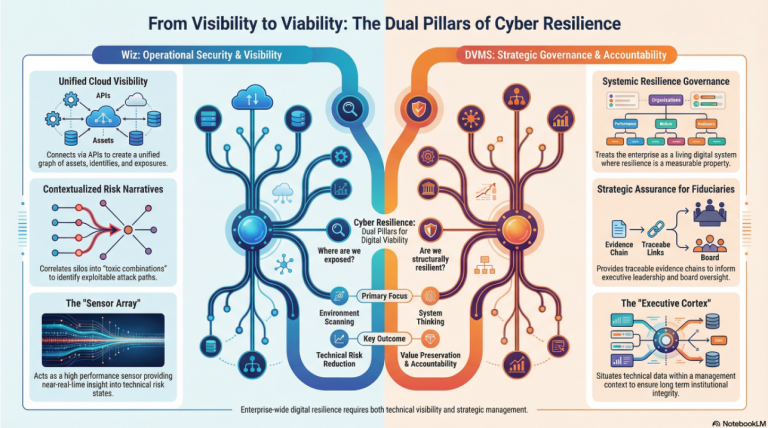
From Cloud Visibility to Digital Viability: Wiz and DVMS in the Evolution of Cyber Resilience
Rick Lemieux – Co-Founder and Chief Product Officer of the DVMS Institute
Introduction: Two Responses to Digital Complexity
As enterprises accelerated their adoption of cloud-native architectures, they encountered a new order of complexity. Infrastructure dissolved into services, workloads became ephemeral, and security boundaries blurred. In that environment, Wiz emerged as a transformational force in cloud security, offering radical visibility and risk prioritization across multi-cloud ecosystems. At the same time, a broader and more systemic challenge has been unfolding—one that extends beyond misconfigurations and vulnerabilities. Organizations are now complex, living digital systems composed of interdependent technologies, processes, data flows, and human actors. Governing, assuring, and accounting for cyber resilience in such systems requires more than detection; it requires a management architecture. This is the domain in which the Digital Value Management System (DVMS) operates.
While Wiz redefined how organizations see and secure cloud environments, DVMS is redefining how enterprises govern, assure, and sustain cyber resilience as an integrated dimension of digital business performance.
Wiz: Transforming Cloud Security Through Unified Visibility
Wiz’s primary innovation was applying conceptual simplicity to technical complexity. Instead of deploying intrusive agents across cloud workloads, Wiz connected via APIs to cloud service providers and built a unified graph of cloud assets, identities, vulnerabilities, configurations, and network exposures. By correlating these elements into attack paths, Wiz shifted security from siloed alert streams to contextualized risk narratives.
Before Wiz, cloud security often meant juggling multiple tools—CSPM for misconfigurations, CWPP for workload protection, vulnerability scanners for code and containers. Security teams faced alert fatigue, fragmented dashboards, and unclear prioritization. Wiz collapsed these silos. It provided a single, agentless platform capable of mapping toxic combinations—such as a public-facing workload with a critical vulnerability and excessive identity privileges—into actionable findings.
This was more than product consolidation; it was cognitive consolidation. Wiz helped security teams answer a crucial question: What matters? By focusing on exploitable attack paths rather than isolated control failures, it aligned technical risk with real-world exposure. In doing so, Wiz significantly improved the operational efficiency of cloud security teams and accelerated remediation cycles.
Yet Wiz’s scope, by design, centers on cloud security posture and exposure management. It secures environments. It reduces technical risk. It informs operational action. What it does not attempt to do is govern the enterprise-wide cyber resilience of the digital business system.
The Limits of Tool-Centric Security
The success of platforms like Wiz highlights an important truth: visibility is foundational. However, visibility alone does not equate to governance, assurance, or accountability. A cloud may be well-configured and continuously monitored, yet the enterprise could still lack coherent policies linking cyber risk to business objectives, financial reporting, regulatory compliance, or board oversight.
Modern digital enterprises are not merely collections of cloud assets. They are dynamic systems in which digital capabilities generate economic value. Cyber resilience, therefore, is not simply a security function; it is an enterprise performance attribute. It influences revenue continuity, regulatory standing, brand trust, and shareholder value.
In complex living digital systems, resilience must be governed as a management discipline—defined in terms of objectives, measured against outcomes, assured through evidence, and accounted for within corporate structures. This is the conceptual terrain that DVMS addresses.
DVMS: Governing Cyber Resilience as a System Property
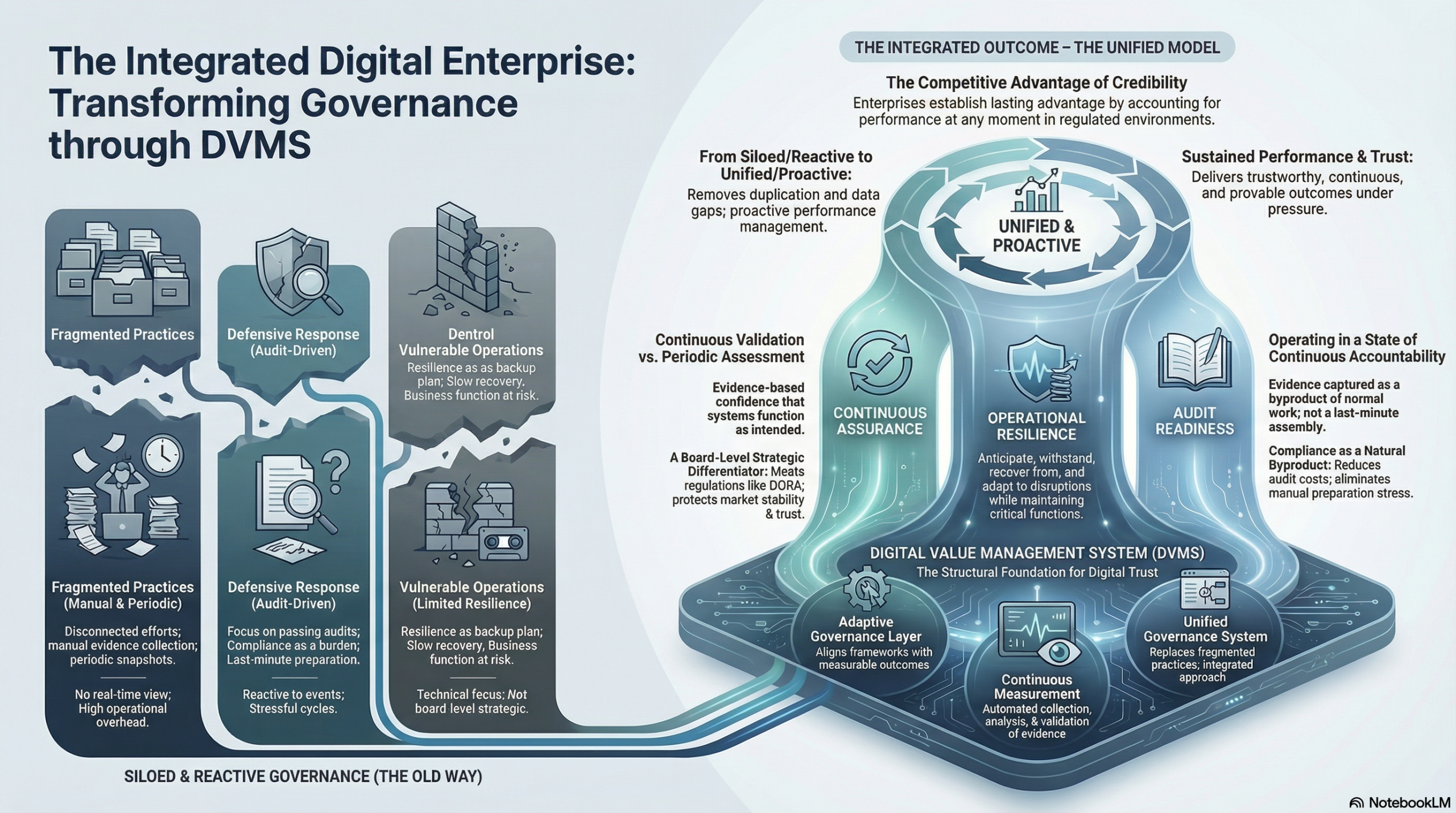
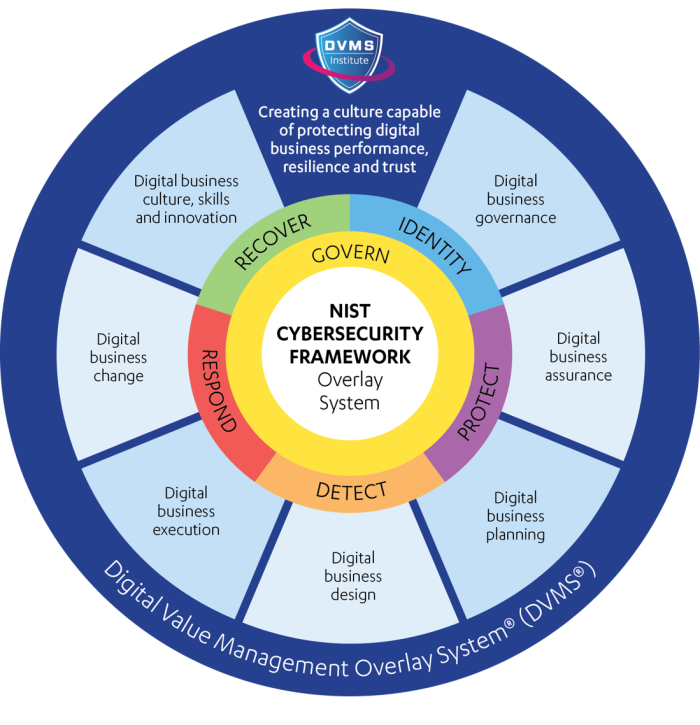
The Digital Value Management System (DVMS) operates at a different altitude than cloud security tooling. Rather than focusing primarily on identifying vulnerabilities or exposures, DVMS provides a structured framework for governing, assuring, and accounting for digital value and cyber resilience across the enterprise.
At its core, DVMS treats the organization as a living digital system—a network of interacting capabilities that produce and protect value. Cyber resilience is embedded in this system as a measurable, governable property. Instead of asking only, “Are we secure?” DVMS asks, “How does our digital system sustain value under stress, disruption, or attack?”
This shift reframes cybersecurity from a defensive cost center into a value-preserving and value-enabling function. DVMS integrates governance structures, performance metrics, risk management processes, and assurance mechanisms into a coherent management architecture. It aligns cyber resilience with business strategy, operational objectives, and regulatory obligations.
Where Wiz surfaces exploitable cloud exposures, DVMS establishes enterprise accountability for resilience outcomes.
From Detection to Assurance
One of the most significant distinctions between Wiz and DVMS lies in the concept of assurance. Wiz delivers near-real-time insight into cloud risk states. It enables rapid remediation and improves security posture. But it does not inherently provide structured assurance that resilience objectives are being met across business units, supply chains, or digital ecosystems.
DVMS introduces formal mechanisms for assurance. It defines resilience objectives, establishes measurable controls and performance indicators, and creates traceable evidence chains. This enables executive leadership and boards to understand—not just assume—the state of cyber resilience.
Assurance within DVMS is continuous and systemic. It is not limited to control validation; it encompasses governance effectiveness, operational performance, incident response capability, and recovery readiness. In this way, DVMS extends beyond technical telemetry into organizational accountability.
Wiz informs operators. DVMS informs decision-makers and fiduciaries.
Accounting for Cyber Resilience
A further distinction emerges in the domain of accounting. Modern regulatory and investor environments increasingly demand demonstrable oversight of cyber risk. Cyber resilience is becoming a reportable enterprise attribute, influencing financial disclosures and risk statements.
Wiz contributes data that may inform such reporting, but it is not designed as an accounting framework. DVMS, by contrast, embeds accounting principles into cyber resilience governance. It structures how resilience performance is documented, measured, and communicated. It creates traceability from digital risk conditions to enterprise impact metrics.
In a complex living digital system, resilience failures can cascade across operations, revenue streams, and stakeholder relationships. DVMS enables organizations to map these interdependencies and quantify exposure at the system level. This capability supports executive accountability and aligns cyber governance with enterprise risk management.
Thus, while Wiz strengthens operational security, DVMS strengthens institutional integrity.
System Thinking vs. Environment Scanning
Wiz excels at environment scanning—continuously analyzing cloud infrastructure for vulnerabilities, misconfigurations, and toxic combinations. It operates within the technical plane of the digital estate.
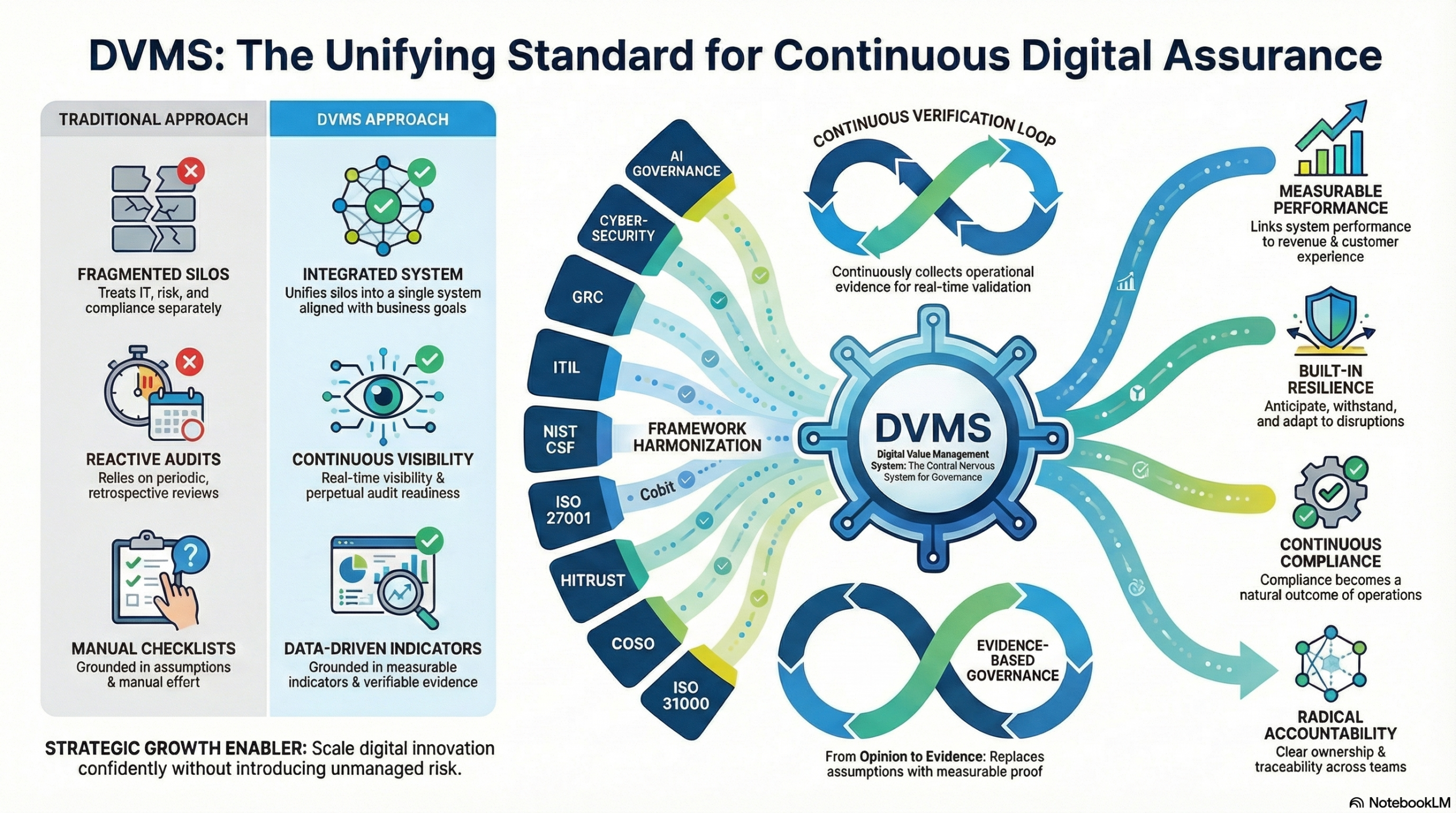
DVMS operates within the systemic plane. It views the enterprise as an adaptive organism composed of digital capabilities, governance mechanisms, and performance feedback loops. It does not replace tools like Wiz; rather, it situates them within a broader management context.
In this sense, Wiz can be understood as a high-performance sensor array within the digital system. DVMS is the nervous system and the executive cortex that interpret signals, set objectives, coordinate responses, and ensure long-term viability.
Both are necessary. One provides visibility into technical risk. The other ensures that resilience is governed as a strategic enterprise function.
The Evolution of Cyber Resilience
The progression from traditional perimeter security to cloud-native risk platforms marked a major evolution in cybersecurity. Wiz represents the maturation of that phase—bringing clarity and coherence to complex cloud environments.
DVMS represents the next evolution: integrating cyber resilience into digital business governance. As digital transformation deepens and systems become more interconnected, resilience must be managed not only as a technical state but as a systemic capability. It must be measurable, auditable, and accountable.
The future of cyber resilience will likely combine both paradigms. Advanced security platforms will continue to refine visibility and response. Simultaneously, management systems like DVMS will embed resilience into enterprise governance structures, linking digital risk to value creation and protection.
Conclusion: Complementary Transformations
Wiz revolutionized how organizations understand and secure their cloud environments. By unifying visibility and prioritizing real risk, it reduced complexity and empowered security teams to act decisively. Its contribution lies in operational clarity and technical precision.
DVMS addresses a broader and more strategic challenge. It governs, assures, and accounts for cyber resilience across the entire digital value system. It transforms resilience from a reactive security concern into a managed enterprise capability.
If Wiz answers the question, “Where are we exposed?” DVMS answers, “Are we structurally resilient as a digital enterprise?”
In an era defined by complex living digital systems, both perspectives are essential. Visibility without governance leaves gaps in accountability. Governance without visibility lacks operational grounding. Together, they reflect the maturation of cybersecurity from tool-centric defense to system-centric resilience.

Rick Lemieux
Co-Founder and Chief Product Officer of the DVMS Institute
Rick has 40+ years of passion and experience creating solutions to give organizations a competitive edge in their service markets. In 2015, Rick was identified as one of the top five IT Entrepreneurs in the State of Rhode Island by the TECH 10 awards for developing innovative training and mentoring solutions for boards, senior executives, and operational stakeholders.
Digital Value Management System® is a registered trademark of the DVMS Institute LLC.
® DVMS Institute 2026 All Rights Reserved