Resilience Is Designed into Daily Delivery– The GRAA Management Series Part 2
David Nichols – Co-Founder and Executive Director of the DVMS Institute
In Part One of this series, I argued that governance is about setting boundaries; this one is about the other side of that coin. Boundaries matter only if the system can behave within them, especially when conditions change.
That is what operational resilience is, not “we have a continuity plan,” but “the way we deliver work includes the ability to sustain outcomes through disruption, degrade safely when necessary, and recover predictably when possible.”
Most managers already understand this intuitively. What’s often missing is a shared design approach that connects daily delivery decisions to resilience outcomes and generates evidence along the way. That’s the gap this article closes.
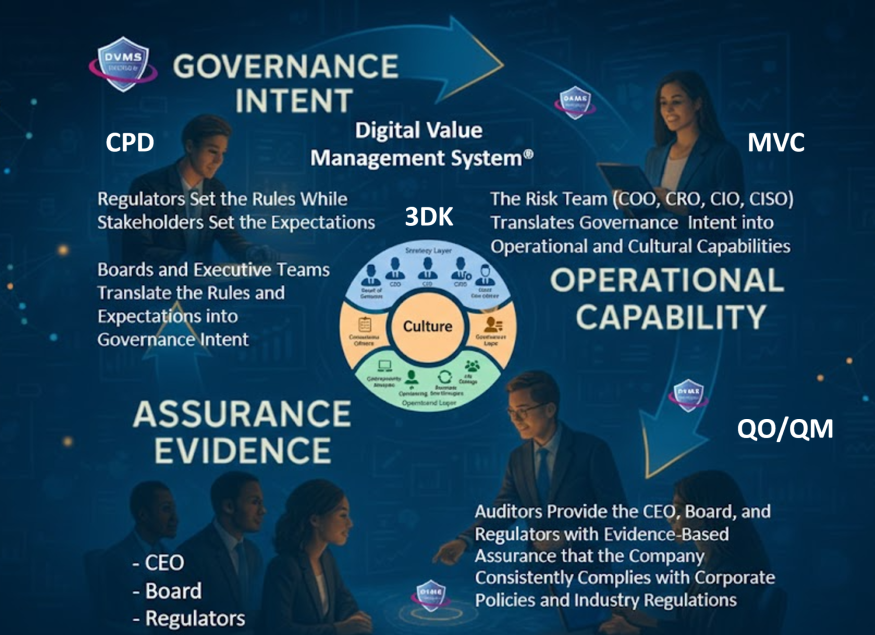
It also aligns with what you’ve already put on the table in the GRAA Leadership Series. In Part Three, “The Hardest Control Surface in Your Enterprise Is Culture,” the point is not that culture is soft; it is that culture governs behavior at the moment decisions are made. In Part Four, “Seeing the System, A 3D View of Leadership, Structure and Behavior,” the point is that if you cannot see how intent, structure, and behavior align, you will continue to be surprised. And in Part Six, “Running on CPD,” the point is that Create, Protect, and Deliver is not a slogan; it is how the enterprise actually runs when it is healthy.
Managers live in that reality every day, and resilience has to be built there, not bolted on later.
The most useful definition of resilience for managers
“Resilience” can mean many things, so let’s start with the version managers can operationalize. Operational resilience is the ability to maintain a critical outcome despite disruptions, with controlled degradation and predictable recovery, without unacceptable harm. That definition matters because it gives you three practical design targets.
You need a way to sustain the outcome for as long as possible. You need a way to degrade safely when sustaining is no longer feasible. You need a way to recover in a known sequence, with verification, so you don’t restore a broken state and declare victory by accident. None of that requires heroics. It requires design.
Why resilience must be designed into delivery, not into documents
Here is a pattern most of us have seen. An organization builds robust documentation. It has policies, plans, and procedures. It passes audits. It has “owners.” On paper, it appears mature.
Then something changes. A dependency fails. A patch has an unexpected consequence. A supplier experiences an outage. A data store behaves differently under load. A team rotates, and tacit knowledge disappears. A process that was “fine” becomes fragile as the environment changes. The failure is rarely that you did not have a plan. The failure lies in the plan not being integrated into how work is delivered. It existed as an artifact, not as behavior.
This is precisely why the tone of the leadership series is essential. You are not trying to shame anyone. Most audit programs were built for a world where change was slower, dependencies were simpler, and controls could be evaluated as static conditions. In modern digital operations, resilience is dynamic, and evidence must come from how the system performs, not just from what the system claims.
So, the shift is not from GRC to “something else.” It is from artifacts to evidence and from static control assumptions to operational behavior. Managers are the ones who can make that shift real.
DVMS gives managers a design lens: Create, Protect, Deliver
The DVMS approach is effective here because it treats resilience as a property of the operating model rather than a separate program. It presents Create, Protect, and Deliver as three views of the same system. When managers adopt that lens, resilience stops being “the security team’s concern” or “the continuity team’s concern” and becomes a shared design discipline.
In Create, the resilience question is, “What outcome are we committing to, and what does acceptable performance look like under variance?” That is where you define criticality, tolerances, and priorities.
In Protect, the resilience question is, “What must not happen, which failure modes are unacceptable, and what constraints must always hold?” This is where safety, integrity, and non-negotiables reside.
In Deliver, the resilience question is, “How do we actually produce the outcome in the real world, with real dependencies, and what behaviors do we execute when things drift?” This is where resilience becomes a daily operating practice.
If you have read “Thriving on the Edge of Chaos: Managing at the Intersection of Value and Risk in the Digital Era,” the book reinforces this inseparability. Value and risk are not separate conversations; they are intertwined. They are the same conversation, viewed from different angles. Delivery is where that conversation becomes reality.
Resilience design patterns that managers can actually control
When managers hear “design resilience,” it can sound expensive or abstract. In practice, most early gains are achieved by embedding a few key patterns into daily delivery. One pattern is graceful degradation. Every critical service has functions that matter more than others. Resilience improves when you intentionally decide what can be reduced, delayed, or disabled first and build that into your operational playbooks. Graceful degradation is not only about technology; it’s also about people. It is also about process. What manual modes exist? What can be deferred without violating obligations? What can be rerouted? What can be throttled?
A second pattern is recovery sequencing. Recovery is not “everything comes back at once.” It is a controlled reassembly of dependencies and functions in the correct order. Managers can make recovery predictable by defining a sequence that aligns with business outcomes, not with team boundaries. That sequence should include verification points to ensure you have restored both integrity and availability.
A third pattern is verification discipline. Resilience is not just about restoring power; it’s about building a stronger foundation. It is about knowing the service is safe and trustworthy once it is back. Verification is where many organizations are surprised, because they restore systems that look “up” but are logically incorrect, incomplete, or inconsistent. A strong verification discipline defines what must be proven true before you declare normal operations.
A fourth pattern is dependency awareness. Most modern outcomes depend on shared platforms and suppliers. Resilience improves when you explicitly map those dependencies into your delivery design and build fallback paths or manual modes where feasible.
A fifth pattern is decision rights and escalation triggers, which we covered in Part 1. These are also resilience patterns. When decision rights are clear, and escalation is condition-based, you can execute degrade and recover behaviors quickly, proving what you did and why you did it.
These patterns are manager-friendly because they are grounded in reality. They describe how you work. They become real when they are incorporated into change planning, release readiness, incident response, and routine operational reviews.
The seam problem: where resilience actually fails
If you want a blunt truth that most managers know, it is this. Resilience usually fails at seams. The seam between product and operations. The seam between operations and security. The seam between internal teams and suppliers. The seam between “policy says” and “delivery must.” Seams create ambiguity. Ambiguity creates delay. Delay creates impact.
This is why the GRAA Leadership Series – Part Four, “Seeing the System, A 3D View of Leadership, Structure and Behavior,” matters so much. Managers often do the right things within their lane, but the system still fails because it is not aligned.
Resilience design is a seam discipline. It involves defining boundaries, designing degradation and recovery behaviors, and assigning evidence expectations across the seams. When done well, resilience stops being a scramble and becomes a practiced behavior.
A manager scenario: a controlled degradation beats an uncontrolled outage
Let’s use a scenario that is common enough to be real but generic enough to fit most enterprises. Your organization offers a customer-facing service that relies on identity, payment capabilities, and a data platform. You have good documentation, a continuity plan, and an incident process. Your control environment is decent.
Then a change lands, and your identity service begins to fail intermittently. Authentication latency increases, sessions drop, and some customers are unable to log in. The immediate question is, “Do we roll back, degrade, or wait?”
If governance is artifact-based, the team often hesitates. A rollback might violate a change policy. A degradation might breach a service commitment. Waiting might increase customer harm. Escalation becomes a meeting, not a trigger. If governance is boundary-based and resilience is designed into delivery, the team behaves differently.
They have agreed tolerances for authentication latency and failure rate. They know which features can be temporarily disabled. They have a pre-authorized degrade mode that preserves core transactions while limiting non-critical functionality. They know who can authorize the change and when escalation is necessary.
They execute the degrade mode. They communicate clearly. They capture evidence as they operate. They roll back if the tolerance is further threatened. They recover in a known sequence and verify integrity before declaring normal.
From the outside, customers experience a degraded service, not a total collapse. From the inside, managers see a system behaving as designed. That is the difference between “having a plan” and “designing resilience into delivery.”
Notice what also happened. Auditing becomes easier. Not because you produced more documents, but because you produced operational evidence that the system operated within defined boundaries. Evidence is not a scramble. It is the natural output of disciplined delivery.
How managers build “degrade and recover” into daily work
So how do you do this without launching a major initiative? You make resilience a regular part of delivery planning and operational cadence. When you plan changes, you don’t just ask, “Is it tested?” You ask, “What is the degradation mode if this goes wrong? What is the rollback path? What is the recovery sequence? And what do we verify?”
When reviewing incidents and near misses, you do not stop at identifying the root cause. You ask, “Did we act within boundaries? Did decision rights help or hinder? What evidence was missing? And what should we design into the next iteration?”
When you work with risk, security, and audit partners, you do not treat them as the team that approves work. You treat them as the team that helps define constraints and evidence expectations, enabling you to move faster with confidence.
This aligns with the spirit of the GRAA Leadership Series – Part Six, “Running on CPD.” CPD is not a separate process. It is an operating rhythm. Managers operationalize that rhythm by embedding resilience patterns into delivery, not by creating a parallel program.
A simple management practice: one outcome, one playbook, one rehearsal
If you want a practical starting point, here’s a discipline that works. Pick one critical outcome. Not a system, an outcome. Define a playbook for degradation and recovery. Keep it short. Make it executable. Then rehearse it. Even a tabletop is enough. You are not practicing theater. You are discovering seams.
During the rehearsal, watch for four situations where decision rights are unclear, escalation triggers are vague, recovery sequencing is disputed, and verification is missing. Those are your design gaps. They are also your audit and assurance gaps, because without those elements, evidence will be thin when scrutiny arrives.
After the rehearsal, update the playbook and capture the evidence expectations. Make that playbook part of daily delivery, part of release readiness, part of operational reviews. This is how resilience becomes a behavior, not a document.
Why is this positive for GRC, not a rejection of it?
It is worth saying this explicitly because managers are often caught in the middle. GRC exists for a reason. Audit exists for a reason. They protect the enterprise, its customers, and usually its license to operate. The frustration is not that these functions exist. The frustration arises when the enterprise invests heavily in artifacts yet still cannot demonstrate resilient behavior.
If you shift to evidence-based resilience, you are helping GRC and audit do their jobs. You are providing them with a more transparent chain of events from intent to operation. You are reducing the paper chase because evidence is continuously generated through everyday work.
This also respects the reality that managers live with. You cannot always prevent incidents. You can avoid chaos. You can prevent slow decisions. You can prevent avoidable harm. And you can prove what you did and why you did it. That is where evidence trumps artifacts without devaluing artifacts.
What to do this week
If you are a manager and you want to act on this without waiting for a program, here’s a simple move. Select one outcome that your team supports, which has a real business impact. Define the degradation mode and recovery sequence. Identify what must be verified before declaring a normal condition. Align decision rights and escalation triggers with the boundaries you set in Part One. Then run one rehearsal, even if it is just the right people in a room for 45 minutes. Capture what you learned. Update the playbook. Make evidence expectations explicit.
In Part Three – Assurance Is Operational Evidence, Not Compliance Artifacts, we focus on assurance, not as documentation, but as operational evidence that proves your system can operate within its boundaries, and that your decisions can be defended without a scramble for artifacts.
About the Author

Dave is the Executive Director of the DVMS Institute.
Dave spent his “formative years” on US Navy submarines. There, he learned complex systems, functioning in high-performance teams, and what it takes to be an exceptional leader. He took those skills into civilian life and built a successful career leading high-performance teams in software development and information service delivery.
Digital Value Management System® is a registered trademark of the DVMS Institute LLC.
® DVMS Institute 2026 All Rights Reserved