Accountability That Works Under Pressure – The GRAA Management Series Part 4
David Nichols – Co-Founder and Executive Director of the DVMS Institute
If you are a manager, you already know the truth about accountability. Everyone wants it, and everyone fears what it can become. When things go well, accountability is praised as “ownership.” When things go wrong, accountability can become shorthand for “who is going to take the hit.” In that mode, it stops being a management capability and becomes a cultural stress test. This article is about keeping accountability on the healthy side of that line.
In the first three articles of this series, we established a practical foundation. Governance becomes boundary-setting that managers can execute. Resilience becomes a daily delivery behavior, including degrade-and-recover playbooks. Assurance becomes operational evidence, not a scramble for artifacts.
Once you have those three, accountability takes on a different meaning. It becomes actionable, fair, and fast because it is grounded in decision rights and evidence.
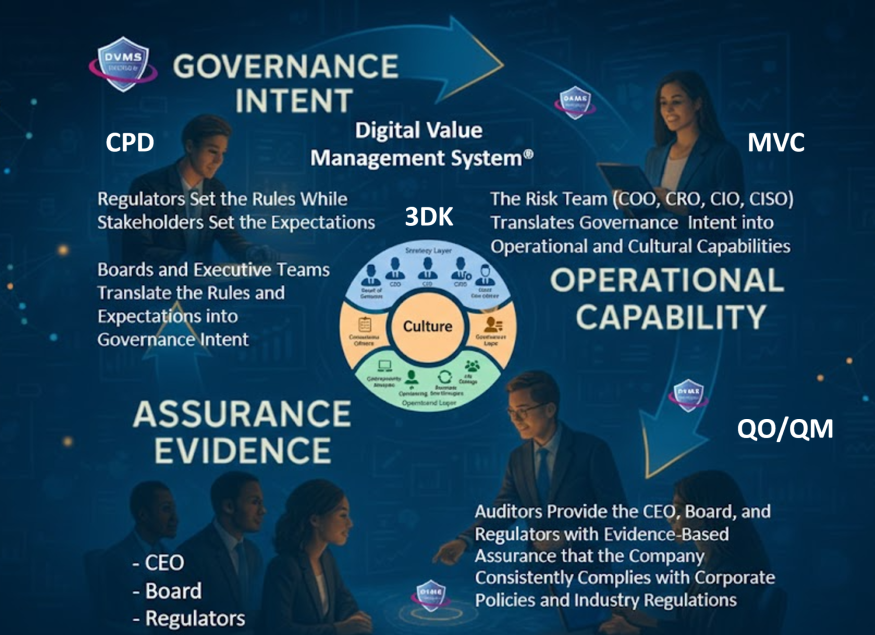
This directly connects to the leadership paradigm you outlined in the GRAA Leadership Series. In Part Three, “The Hardest Control Surface in Your Enterprise Is Culture,” the point is that culture shapes behavior at the edge. In Part Four, “Seeing the System, A 3D View of Leadership, Structure and Behavior,” the point is that misalignment among intent, structure, and behavior produces surprises. Accountability sits at the intersection of those two ideas. You cannot “install” accountability with a policy. Accountability is expressed through behavior, and behavior is shaped by culture and structure. Managers are the ones who make that real.
A manager’s definition of accountability
The simplest definition I use is this. Accountability is the obligation to make decisions within defined boundaries, escalate when those boundaries are threatened, and maintain evidence that the decisions were reasonable and that the system behaved as intended. That definition does three essential things.
It ties accountability to boundaries, not to personality. It ties accountability to escalation triggers, not to politics. And it ties accountability to evidence, not to hindsight. It also makes accountability workable in complex systems. A manager cannot control everything. A manager can control how decisions are made, how risk is managed within established tolerances, how issues are escalated, and how evidence is captured and utilized to drive improvement.
That is what accountability looks like when it is healthy.
Why accountability breaks under pressure
Accountability usually does not fail because someone refuses to take responsibility for their role. It fails because the system creates ambiguity in ownership. Here are the failure patterns managers see most often.
Decision rights are unclear. The team hesitates because they are unsure who can authorize a degraded mode, a rollback, or risk acceptance. Or worse, multiple people believe they have the right, and the debate burns time.
Escalation is undefined. Teams escalate based on emotion and confidence rather than conditions. That creates inconsistent behavior, and leaders lose trust because they cannot predict when they will be pulled in.
Evidence is missing. During or after an incident, the organization cannot reconstruct what happened, who knew what, or why decisions were made. Without evidence, narratives fill the gap, and accountability becomes a personal matter.
Culture punishes escalation. People learn that raising issues causes pain, so they delay. That is a cultural control surface problem, exactly as your GRAA Leadership Series – Part Three describes it. When culture punishes escalation, accountability becomes performative. People will “own” things after the fact, but they will not act early when the system is drifting.
The structure is misaligned. Teams are organized around functions rather than outcomes, and no one owns the seam. The 3D view in the GRAA Leadership Series – Part Four makes this visible. If the structure does not align with outcomes, accountability becomes a negotiation between org charts rather than a disciplined behavior.
These are not moral failures. They are design failures. Managers can address them, but only if we treat accountability as an operational capability, not just a slogan.
DVMS makes accountability operational because it maps to Create, Protect, Deliver
One of the reasons DVMS helps is that it provides a shared language for accountability that transcends departmental boundaries.
Create, Protect, and Deliver are operating modes that every value stream must perform well. When you map accountability across these modes, you avoid the trap of assuming “accountability equals a role title” or “accountability equals a team.”
In Create, accountability means owning the definition of outcomes and the trade-offs associated with them. Who is responsible for defining what matters, what success looks like, what tolerances apply, and what must be prioritized when conditions change? If this is vague, the rest of the system will drift.
In Protect, accountability means owning constraints and risk-acceptance thresholds. Who sets the non-negotiables? Who defines what harm is unacceptable? Who has the authority to stop the line when a protective boundary is threatened? Protect accountability should be explicit because it shapes behavior under pressure.
In Deliver, accountability means owning operational behavior and verification. Who owns the degrade and recover playbooks? Who owns the recovery sequence? Who owns integrity checks and the evidence that the system is safe to operate? Deliver accountability is where managers live, and it is often where accountability gets muddled by competing priorities.
When you map accountability this way, you achieve a healthy effect. Accountability becomes distributed yet coherent. Different people have different obligations, and these obligations fit together because they are tied to a common outcome and shared boundaries.
This is a practical expression of the theme of inseparability in “Thriving on the Edge of Chaos: Managing at the Intersection of Value and Risk in the Digital Era.” The Thriving book makes it clear that value and risk are part of one system. DVMS provides managers with a way to assign accountability across the system.
Accountability has three anchors that managers can design
When I examine organizations that handle pressure effectively, I identify three accountability anchors. The first is decision rights. Clear decision rights reduce hesitation and prevent “meeting-based recovery.”
The second is escalation obligations. When escalation is condition-based, people are protected from the influence of politics. They can point to a boundary and say, “We escalated because tolerance was threatened.” That keeps the focus on outcomes, not on personalities.
The third is evidence obligations. Accountability without evidence becomes blame, because evidence makes decisions defensible and learnable. Evidence allows leaders to delegate with confidence. It also enables audits to validate operational reality without becoming a mere paperwork exercise.
These anchors do not require complex systems. They need clarity and a disciplined approach to execution.
The decision rights map, accountability’s practical tool
Managers need a tool that makes accountability visible. A decision rights map does that. It is simple and ties decisions to boundaries and escalation.
The map should answer questions like:
- Who can authorize a controlled degraded mode, and under what conditions?
- Who can pause a release, and what triggers that pause?
- Who can accept a temporary exception, and what evidence must be recorded?
- Who can trigger supplier escalation, and when?
- Who declares recovery complete, and what verification is required?
When teams lack this map, accountability becomes unclear. People do not refuse to act because they are irresponsible. They refuse because they do not want to be punished for making the wrong call.
A decision rights map makes it safe to act within boundaries. It also makes it clear when you are outside those boundaries and must escalate the issue. That is what accountability should feel like. Safe within defined limits and clear about obligations when those limits are threatened.
Evidence transforms accountability from blame to learning
Managers often get stuck because accountability is framed in moral language. Who failed? Who dropped the ball? In complex systems, that is rarely the best question to ask. A better question is, “What did the system allow, and what did it discourage?” Evidence shifts the conversation.
When you have an evidence chain, you can reconstruct the decision context. You can see which signals were present. You can see when tolerances were threatened. You can see which decision rights were in place and which were missing. You can see whether escalation triggers were clear. You can see what verification occurred.
With evidence, accountability becomes about improvement. Without evidence, accountability becomes a matter of narratives, which are shaped by position and power. This is why, in Part Three, we emphasized operational evidence over compliance artifacts. Evidence supports both assurance and accountability, and also creates fairness. A manager can be accountable only when the system provides clarity, authority, and the ability to prove what they did.
A manager scenario: the incident where accountability was held
Let’s use a scenario that illustrates the difference. A critical business outcome is at risk. A dependency begins to fail. The service is deteriorating, and customers are feeling the impact.
In a weak accountability environment, the team hesitates. People are unsure who can authorize a degraded mode of operation. Someone wants to “wait five minutes,” while someone else wants to “roll back immediately.” Escalation is delayed because no one wants to be accused of overreacting. Eventually, the impact grows, and leadership is pulled in. Afterward, accountability becomes a hunt for the “owner,” and the lesson is fear.
In a healthy accountability environment, the team behaves differently. They have a Boundary Card for the outcome. Tolerances are explicit. Decision rights are mapped. Escalation triggers are clear. They have a degraded mode that preserves the core outcome. They execute, record the decision rationale, and escalate when tolerance thresholds are approached, not when someone panics. Recovery follows a defined sequence, and verification confirms integrity.
Afterward, the review is evidence-based. The team can show what happened and why. Improvement actions are tied to seams, decision rights, and verification gaps. No one is ashamed. Accountability is expressed through disciplined behavior and learning.
That is the kind of environment where managers can lead confidently. It is also the kind of environment where leaders can trust what they are told because it is grounded in evidence rather than reassurance.
Accountability and culture, the subtle management work
It is impossible to discuss accountability without also discussing culture. Not culture as posters, but culture as what happens when people make decisions under uncertainty. The GRAA Leadership Series – Part Three, “The Hardest Control Surface in Your Enterprise Is Culture,” underscores this point. Culture is the control surface that determines whether people escalate early, admit uncertainty, follow verification discipline, and treat risk as real rather than theoretical. Managers shape culture in two ways that are particularly relevant in this context.
We shape it through what we reward and tolerate. If we reward speed at any cost, accountability becomes reckless. If we punish escalation, accountability becomes silent. If we tolerate unclear decision rights, accountability becomes slow. We also shape it through routines. When we conduct boundary reviews, rehearse degrade-and-recover playbooks, insist on verification, and document decision rationale in a concise manner, we teach the organization how to behave. Culture follows what gets practiced.
This is where the Manager Series supports the Leadership Series. Leaders can set intent and expectations. Managers operationalize those expectations through routines that shape behavior. That is how accountability becomes real.
How to improve accountability without making it heavy
Managers do not need a complicated transformation to enhance accountability. You can improve it with a few targeted steps.
Clarify decision rights for one outcome. Make it explicit who can authorize degrade, rollback, and recovery completion, and what verification is required.
Define escalation triggers tied to tolerances. If tolerances are threatened, escalation is an obligation, not a negotiation.
Build a lightweight decision record habit. For key decisions, capture the boundary, the observed signals, the decision, and the rationale behind it. Two or three sentences are enough. The point is not paperwork; it is traceability.
Rehearse one degrade-and-recover playbook. A rehearsal is where decision-making rights gaps and cultural friction become apparent.
Then connect the evidence to improvement. Ensure every rehearsal or incident review ends with one or two specific changes that reduce recurrence or impact, and track those changes until they are implemented.
All of that is operational work. It is not overhead. It is how managers make the system governable under pressure.
Accountability becomes fair when boundaries and evidence exist
Here is the simplest way I can put it. Accountability is only fair when boundaries are clear, decision rights are explicit, escalation is condition-based, and evidence is maintained. Without those, accountability becomes blame. With them, accountability becomes a management capability that increases speed, resilience, and trust.
In the following article, we will explore where accountability is most tested, including dependencies, handoffs, and suppliers. This is where managers often feel most exposed, as we do not control the entire system yet are accountable for the outcome. We will discuss how DVMS and boundary thinking make dependency resilience practical and how evidence-based assurance shifts the conversation with suppliers in a positive way.
About the Author

Dave is the Executive Director of the DVMS Institute.
Dave spent his “formative years” on US Navy submarines. There, he learned complex systems, functioning in high-performance teams, and what it takes to be an exceptional leader. He took those skills into civilian life and built a successful career leading high-performance teams in software development and information service delivery.
Digital Value Management System® is a registered trademark of the DVMS Institute LLC.
® DVMS Institute 2026 All Rights Reserved