Reimagining Governance for Today’s Complex Digital Ecosystems
Rick Lemieux – Co-Founder and Chief Product Officer of the DVMS Institute
Introduction: The Limits of Static Governance in a Dynamic World
Organizations today operate in environments characterized by rapid technological change, escalating cyber risk, regulatory complexity, and increasing stakeholder expectations for transparency and accountability. Yet, many organizations continue to rely on static, paper-based governance systems composed of policies, procedures, and controls that are periodically documented and infrequently reviewed. These systems were designed for predictability and compliance in slower-moving environments, rather than for continuous change, digital interdependence, and real-time risk management. As a result, static governance often provides the illusion of control rather than meaningful oversight. To remain viable and trustworthy, organizations must move toward a living, evidence-based system of Governance, Resilience, Assurance, and Accountability (GRAA) that continuously reflects how the organization operates and performs.
The Illusion of Control in Paper-Based Governance Systems
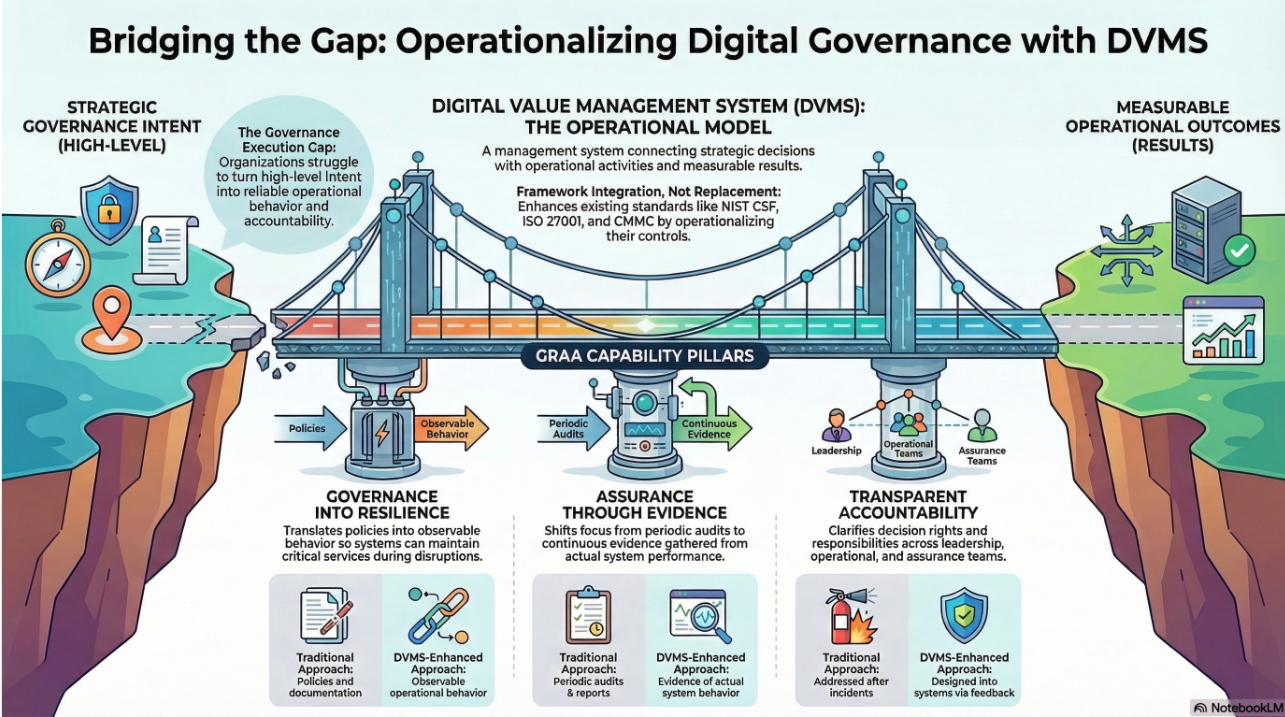
Traditional governance systems emphasize documentation over execution. Policies are written, controls are defined, and compliance checklists are completed; however, there is little evidence that these controls are consistently operating or producing the intended outcomes. Audits and assessments frequently rely on snapshots in time, capturing whether a document exists rather than whether a process is effective. This creates a dangerous gap between “governed on paper” and “governed in practice.” When risks materialize—such as cyber incidents, operational disruptions, or regulatory failures—organizations discover that their documented controls did not translate into real-world resilience. Static governance systems fail because they are disconnected from day-to-day operations and do not adapt to changes in risks, technologies, and business models.
Digital Transformation Demands Continuous Governance
Digital transformation has fundamentally altered how organizations create and deliver value. Cloud computing, automation, data-driven decision-making, and interconnected ecosystems have increased both opportunity and exposure. In this environment, governance cannot remain a periodic, manual activity. Risks emerge and evolve in real time, and controls must adapt accordingly. Static, paper-based governance systems are unable to keep pace with continuous deployment, agile development, and dynamic supply chains. A living GRAA system embeds governance into digital workflows, enabling organizations to continuously monitor performance, risk, and compliance, rather than retrospectively. This shift allows for leaders to govern the organization as it operates, rather than as it was documented months or years earlier.
Evidence-Based Governance Replaces Assumptions with Truth
One of the most critical shortcomings of traditional governance is its reliance on assumptions. Leaders assume that controls are working because they were designed and approved, or because an audit passed at a point in time. Evidence-based governance replaces assumptions with verifiable proof. In a GRAA system, controls generate observable evidence through logs, metrics, workflows, and outcomes. This evidence demonstrates not only that controls exist, but that they are functioning as intended and contributing to business objectives. Evidence-based governance enhances decision-making by providing leaders with factual and timely insights into organizational performance, risk exposure, and control effectiveness.
Resilience Requires More Than Compliance
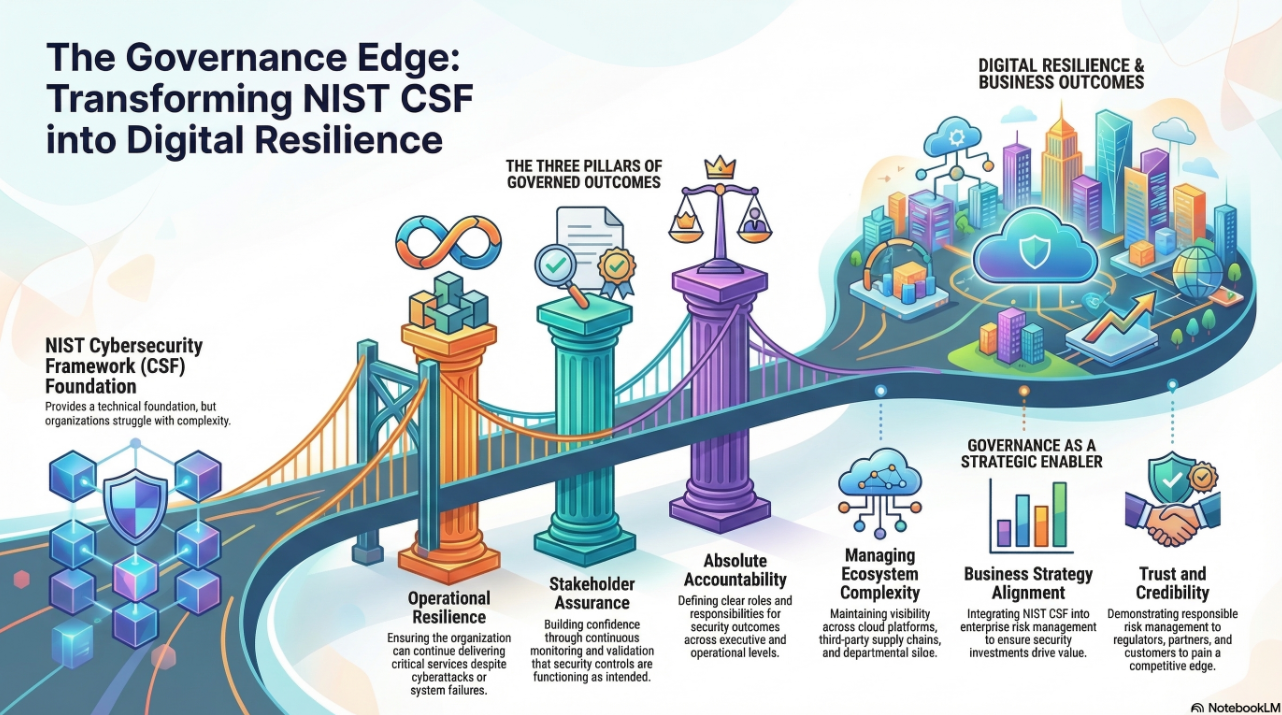
Resilience is not achieved solely through compliance. While regulatory compliance is essential, it does not guarantee that an organization can anticipate, withstand, recover from, and adapt to disruption. Static governance systems are inherently reactive, focusing on meeting minimum requirements rather than building adaptive capacity. A living GRAA system integrates resilience into governance by continuously assessing dependencies, vulnerabilities, and recovery capabilities across the organization. It aligns operational resilience with strategic objectives, ensuring that critical services remain viable even under stress. By utilizing real-time evidence and scenario-based insights, organizations can proactively enhance their resilience rather than discovering weaknesses during a crisis.
Assurance Must Be Continuous, Not Episodic
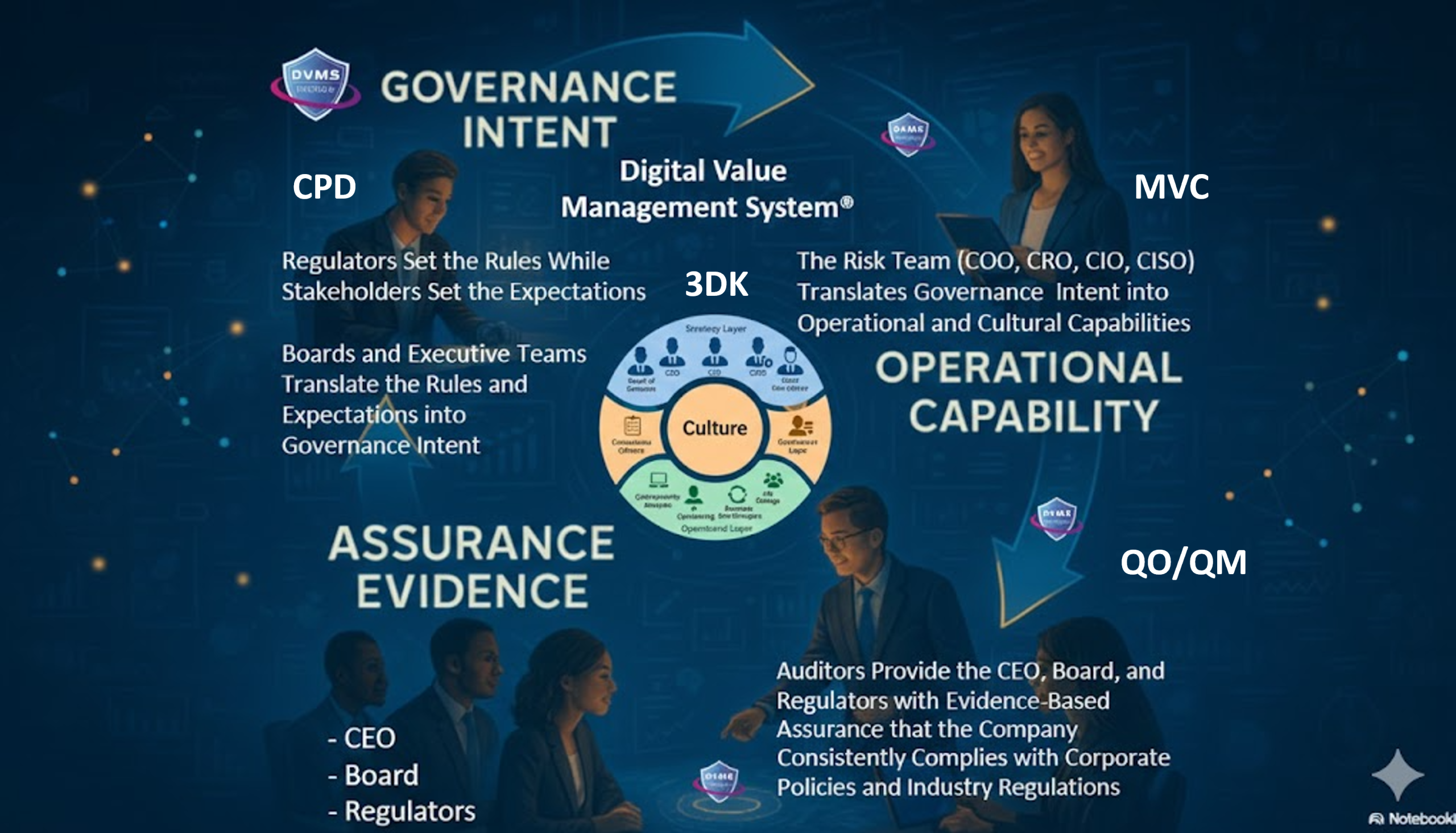
Traditional assurance models rely heavily on periodic audits, assessments, and certifications. While these activities provide value, they are inherently episodic and quickly become outdated. In fast-changing environments, assurance that is months old may no longer be relevant. A living GRAA system enables continuous assurance by leveraging operational data and control evidence as it is produced. This allows internal audit, risk management, and compliance functions to transition from retrospective validation to ongoing assurance. Continuous assurance not only reduces audit fatigue and manual effort but also provides executives and boards with timely, reliable insights into organizational health and control effectiveness.
Accountability Emerges from Transparency and Traceability
Accountability cannot exist without transparency. In paper-based governance systems, accountability is often diffused, with unclear ownership of processes, risks, and controls. When failures occur, organizations struggle to determine who was responsible and why decisions were made. A GRAA system establishes accountability by creating traceability between objectives, risks, controls, actions, and outcomes. Evidence links decisions to results, making accountability fair, defensible, and constructive. This transparency fosters a culture of ownership and learning, rather than blame, enabling organizations to improve while meeting their ethical and regulatory expectations continually.
Aligning Governance with Business Value and Strategy
Static governance systems are often perceived as bureaucratic overhead that slows innovation and frustrates business leaders. This perception arises because governance is disconnected from value creation. A living, evidence-based GRAA system aligns governance with strategy by linking controls and assurance activities directly to business outcomes. Governance becomes an enabler of performance rather than an obstacle. Leaders gain visibility into how risk management and control investments support growth, resilience, and customer trust. This alignment transforms governance from a cost center into a strategic capability that enhances competitive advantage.
Digital Value Management System (DVMS)
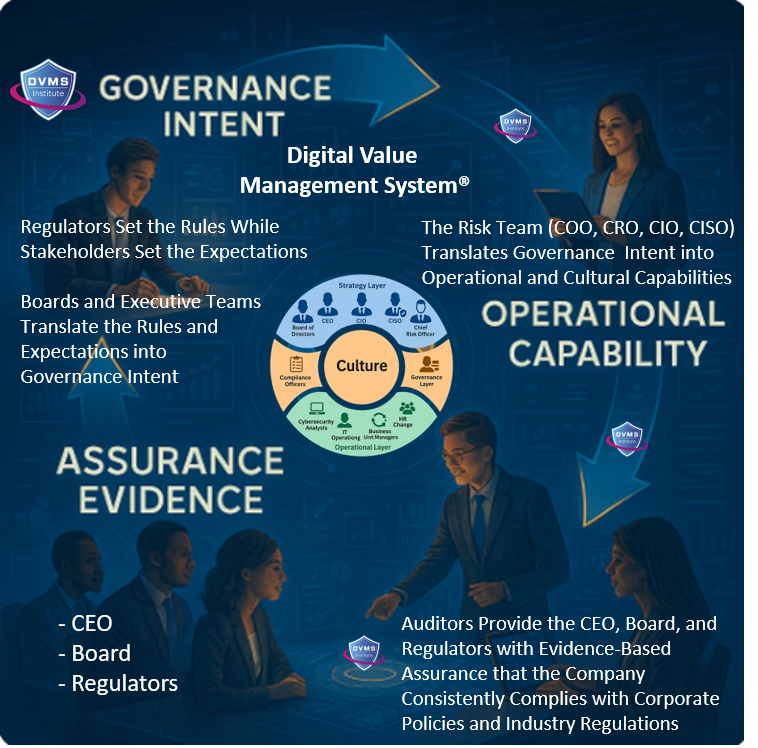
The Digital Value Management System (DVMS) directly addresses the shortcomings outlined in this paper by operationalizing Governance, Resilience, Assurance, and Accountability as a living, evidence-based system rather than a static collection of processes and documents. DVMS replaces paper and process based assumptions with continuously generated, traceable evidence that links business objectives to risks, controls, actions, and outcomes in real time. By embedding governance into digital workflows and operational processes, DVMS enables organizations to see how governance actually functions day to day, not just how it is documented. This provides continuous assurance to executives, boards, regulators, and stakeholders, while simultaneously strengthening operational resilience and clarifying accountability across the enterprise. In doing so, DVMS transforms governance from a retrospective compliance exercise into a proactive, value-enabling capability that supports strategic decision-making, builds trust, and sustains performance in complex, rapidly evolving digital ecosystems
Conclusion: GRAA as a Foundation for Trust and Sustainability
In an era defined by uncertainty, complexity, and digital dependence, organizations can no longer rely on static, paper-based governance systems that provide outdated and incomplete views of reality. The transition to a living, evidence-based system of Governance, Resilience, Assurance, and Accountability is not merely a technological upgrade; it is a fundamental shift in how organizations understand, manage, and prove their trustworthiness. By embedding governance into operations, leveraging real-time evidence, and aligning assurance with resilience and accountability, organizations can govern with confidence rather than assumption. Ultimately, GRAA provides the foundation for sustainable performance, stakeholder trust, and long-term organizational success in a continuously changing world.
About the Author

Rick Lemieux
Co-Founder and Chief Product Officer of the DVMS Institute
Rick has 40+ years of passion and experience creating solutions to give organizations a competitive edge in their service markets. In 2015, Rick was identified as one of the top five IT Entrepreneurs in the State of Rhode Island by the TECH 10 awards for developing innovative training and mentoring solutions for boards, senior executives, and operational stakeholders.
Digital Value Management System® is a registered trademark of the DVMS Institute LLC.
® DVMS Institute 2026 All Rights Reserved