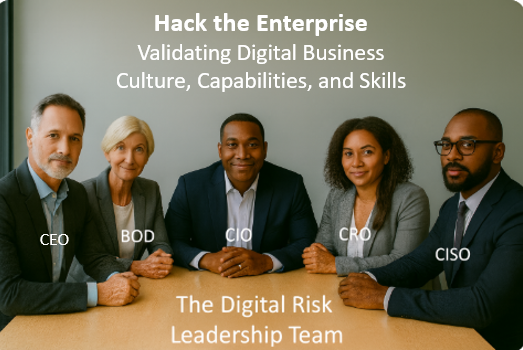
Leadership Mandate – Hack Your Enterprise Culture, Capabilities, and Skills Before It’s Too Late
Rick Lemieux – Co-Founder and Chief Product Officer of the DVMS Institute
Introduction:
In today’s volatile digital economy, organizations cannot rely solely on traditional management practices to ensure resilience, competitiveness, and accountability. Technologies evolve faster than governance structures, employee skill sets shift rapidly, and organizational cultures often operate in ways leadership does not fully understand. As a result, hidden vulnerabilities emerge not just in cybersecurity systems but across policies, workflows, relationships, and decision-making processes. These vulnerabilities become the cracks through which operational failures, compliance breakdowns, and even cyber threats can quietly enter.
To address this reality, leaders must learn to “ethically hack” their enterprise—not in the technical sense alone, but by probing their culture, examining capabilities, interrogating assumptions, and stress-testing the readiness of people and processes. Leadership’s ability to hack its own organization is now essential for building adaptive, learning-driven enterprises that can thrive in a world of continuous disruption.
Hacking Culture: Revealing the Mindsets and Behaviors that Drive Performance
Culture is often described as “the way things get done around here,” yet many leaders misunderstand how deeply culture shapes digital transformation and operational resilience. Traditional culture assessments—surveys, interviews, engagement scores—provide surface-level insights but rarely reveal how people behave when pressures mount, or systems break.
Ethical governance hacking requires leaders to go deeper. This involves examining the hidden, unspoken elements of culture, including the stories employees tell about the organization, the informal power structures that override policies, the workarounds people develop to compensate for broken processes, and the underlying beliefs that shape risk-taking or avoidance.
Leaders who hack their culture actively test the assumptions embedded in everyday behavior. They observe how teams respond when faced with ambiguous instructions, unexpected changes, or conflicting priorities. By adopting a hacker’s mindset—curious, skeptical, and evidence-driven—leaders uncover cultural weaknesses that traditional assessments miss. These include complacency, silos, mistrust, fear of speaking up, and misalignment between stated values and real behavior. Through hacking culture, leadership gains visibility into what truly drives performance, collaboration, and resilience.
Hacking Capabilities: Mapping What the Enterprise Can Really Do
Organizations routinely overestimate their capabilities. Strategies assume resources that do not exist, transformation programs rely on processes that are not actually followed, and leaders trust capabilities that look strong on paper but fail under stress.
Ethical hacking of enterprise capabilities means testing them—continuously and rigorously—much like a penetration tester evaluates system controls. Leaders must question whether the capabilities their teams claim to have correspond to reality. Do risk assessments influence decision-making, or are they created for compliance checkboxes? Do crisis-response plans work in practice, or do they collapse under pressure? Do service management processes strengthen resilience, or do they create bottlenecks?
Leaders who hack capabilities ask targeted, evidence-driven questions: What are we trying to achieve? How do we know this capability works? What proof do we have? Where are the gaps? This shifts the organization away from assumption-based governance toward outcome-based, validated performance.
Hacking capabilities also involve testing cross-functional linkages—how one capability interacts with another. For example, how does change management influence cybersecurity? How does employee skill development affect operational risk? By probing these systemic relationships, leaders identify misalignments and develop stronger, more integrated capabilities that can adapt to shifting strategic demands.
Hacking Technologies: Understanding the Real Behavior of Digital Systems
Most technology failures are not technical—they are organizational. Systems do not perform as expected because teams misunderstand how they work, rely on outdated processes, or integrate them poorly into daily operations.
Ethical leadership hacking applies the same logic used by cybersecurity professionals who test system weaknesses: continuously stress-test technology assumptions. Leaders must understand not just what technology does, but how it behaves in the real world. This includes uncovering inefficient workflows, misconfigurations, shadow IT, system dependencies, and unvalidated automations. Leaders should also examine how employees interact with technology: Do tools empower teams or restrict them? Are controls user-friendly or burdensome? Are data flows transparent or opaque?
Hacking technology means leaders observe how systems respond to variability, how data is generated and consumed, and how technologies align (or fail to align) with business outcomes. When leaders hack their technology landscape, they expose hidden weaknesses—security gaps, operational fragility, and mismatched expectations—before adversaries or crises exploit them.
Hacking Skill Sets: Closing the Gap Between Employee Capability and Organizational Need
People are the most critical variable in organizational resilience. Yet, leaders often assume that employees possess the necessary competencies simply because they occupy a role, have completed training, or have performed well in the past. Skill sets, however, must evolve continuously as threats, technologies, and business models change.
Ethical hacking of employee skills involves assessing real-world readiness—not through quizzes or annual training modules, but through scenario-based evaluation, live-fire exercises, cross-functional problem-solving, and performance evidence.
Leaders must identify skill gaps that are not visible on résumés or performance reviews—such as critical thinking, collaboration under stress, digital literacy, or the ability to adapt to rapidly evolving threats. Hacking skills involve understanding how employees respond to uncertainty, how they exercise judgment, and how well-equipped they are to execute the organization’s strategy under pressure. By enhancing workforce capabilities, leaders identify where targeted development, reskilling, or structural redesign is necessary to strengthen the enterprise.
The Hacker Mindset: Why Leadership Must Think Like Adversaries
Ethical hacking in leadership is not malicious—it is curious, evidence-driven, and proactive. Great leaders share the mindset of great hackers: they explore systems, look for inconsistencies, test limits, and seek to understand how things work rather than how they are supposed to work. In this sense, hacking becomes a leadership discipline. It helps leaders detect vulnerabilities early, enhance operational integrity, and build cultures committed to continuous improvement. It transforms governance from a static, rule-bound construct into a dynamic system of learning and adaptation. Most importantly, leadership hacking fosters psychological safety by encouraging employees to challenge assumptions, speak up about risks, and participate in collaborative problem-solving. Leaders who model ethical hacking empower their teams to do the same, turning the entire organization into a self-healing, self-improving system.
Conclusion: Hacking the Enterprise as a Path to Operational Resilience
As digital transformation accelerates, organizations face new challenges that demand deeper visibility into their culture, capabilities, technologies, and workforce. Leaders cannot afford to manage based on assumptions, outdated models, or surface-level insights.
Ethical hacking provides a robust methodology for uncovering hidden weaknesses and validating strengths across the entire enterprise. By hacking their own culture, leaders reveal the beliefs and behaviors that shape performance. By hacking capabilities, they separate real effectiveness from imagined competence. By hacking technologies, they expose system behavior and integration gaps. By honing their hacking skill sets, they ensure their people can meet the demands of a dynamic environment. When leaders adopt this mindset, they transform their organizations into adaptive, resilient, and learning-driven enterprises that can withstand disruption and sustain change. Ethical hacking thus becomes not just a technical discipline, but a leadership imperative for the modern age.
About the Author

Rick Lemieux
Co-Founder and Chief Product Officer of the DVMS Institute
Rick has 40+ years of passion and experience creating solutions to give organizations a competitive edge in their service markets. In 2015, Rick was identified as one of the top five IT Entrepreneurs in the State of Rhode Island by the TECH 10 awards for developing innovative training and mentoring solutions for boards, senior executives, and operational stakeholders.
Digital Value Management System® is a registered trademark of the DVMS Institute LLC.
® DVMS Institute 2026 All Rights Reserved