Why Our GRC Investments Aren’t Delivering Resilience …and Everyone Feels It – The GRAA Leadership Series Part 1
David Nichols – Co-Founder and Executive Director of the DVMS Institute
There’s a particular feeling many executives know well but rarely name out loud.
You leave a risk committee or board meeting with a thick stack of slides. The dashboards are mostly green, and the internal audit opinions are positive. You have NIST, ISO, ITIL, NIST Privacy Framework, and ESG obligations, all of which are mapped, tracked, and reported. The GRC platform runs smoothly. On paper, the organization appears mature.
And yet, as you close the door behind you, there’s that small knot in your stomach.
It doesn’t seem like resilience. It feels… fragile. One major incident, one supplier failure, one misjudged AI deployment, and the whole carefully crafted picture might fall apart.
This series is for the people who recognize that feeling.
You haven’t starved GRC of resources, nor have you ignored risk. In fact, you’ve invested heavily. Still, something fundamental isn’t right. This first article focuses on identifying what that “something” is, and why it can’t be fixed with just another framework, tool, or dashboard.
The Investment Side of the Ledger
If you list the actions your organization has taken over the past decade, it reads like a textbook example of “doing the right things.”
You’ve adopted comprehensive frameworks: NIST CSF, ISO standards, ITIL for service management, sector-specific regulations, and an expanding array of ESG and privacy requirements. You’ve deployed one or more GRC platforms to unify policies, risks, controls, and testing. You’ve increased staff in risk, compliance, cybersecurity, privacy, and internal audit. You’ve established board-level oversight structures, risk committees, and escalation pathways.
If someone measured you against a classic GRC maturity model, you wouldn’t fall to the bottom. In many organizations, these investments have closed obvious gaps. Basic hygiene has improved compared to ten years ago. That matters.
But it raises a tougher question: if the inputs are so strong, why doesn’t it still feel safe to take your hand off the wheel, even for a moment?
The Experience Side of the Ledger
Set the investments aside and look at the lived experience.
Incidents still occur unexpectedly, despite risk registers and audit findings warning about similar problems. Different risk and assurance teams sometimes give conflicting advice on priorities; each justified from their own point of view. Business units complain about “control fatigue” and “assessment fatigue,” not because they oppose accountability, but because they see the same questions asked in slightly different ways by different teams.
There are dashboards everywhere, but not enough insight. You can access more data than ever before, but the key question, “Are we behaving as a resilient organization?” remains unclear.
And beneath it all, there’s an unspoken gap between what the board states and what people actually do. The story in the room is that you’re mature and in control. The whisper in the hallways is that some of the most critical decisions about risk, ethics, and resilience are still being made on the fly, under pressure, with incomplete information and unclear accountability.
These aren’t random annoyances. They are symptoms of something structural.
The Old Mental Model of GRC
For years, GRC has been guided by a simple and reasonable mental model:
If we choose robust frameworks, write clear policies, implement appropriate controls, and demonstrate those controls to auditors and regulators, then risk will be “managed.”
In more stable, bounded environments, that model held real power. Regulatory change was slower. Supply chains were shorter and clearer. Digital products developed at a manageable pace. The gap between “policy” and “practice” was smaller because the system itself was less dynamic.
Today, the context is unrecognizable compared to that world.
Digital products, services, and data flows are constantly changing. Critical functions rely on complex supply chains and third parties that you neither control nor fully understand. AI and algorithmic decision-making are moving important decisions to the outer edges of the organization. Societal expectations regarding ethics, sustainability, privacy, and safety are evolving more rapidly than traditional governance cycles can keep pace.
In this environment, the old mental model isn’t wrong, but it’s incomplete. Frameworks, policies, and controls are essential. However, they are not sufficient. As a result, you can have everything “right” at the artifact level, good frameworks, documented controls, clean audits, and still lack a system that behaves resiliently when reality hits.
That’s the knot in your stomach trying to tell you something.
The Real Problem: A System-of-Systems Without a System Design
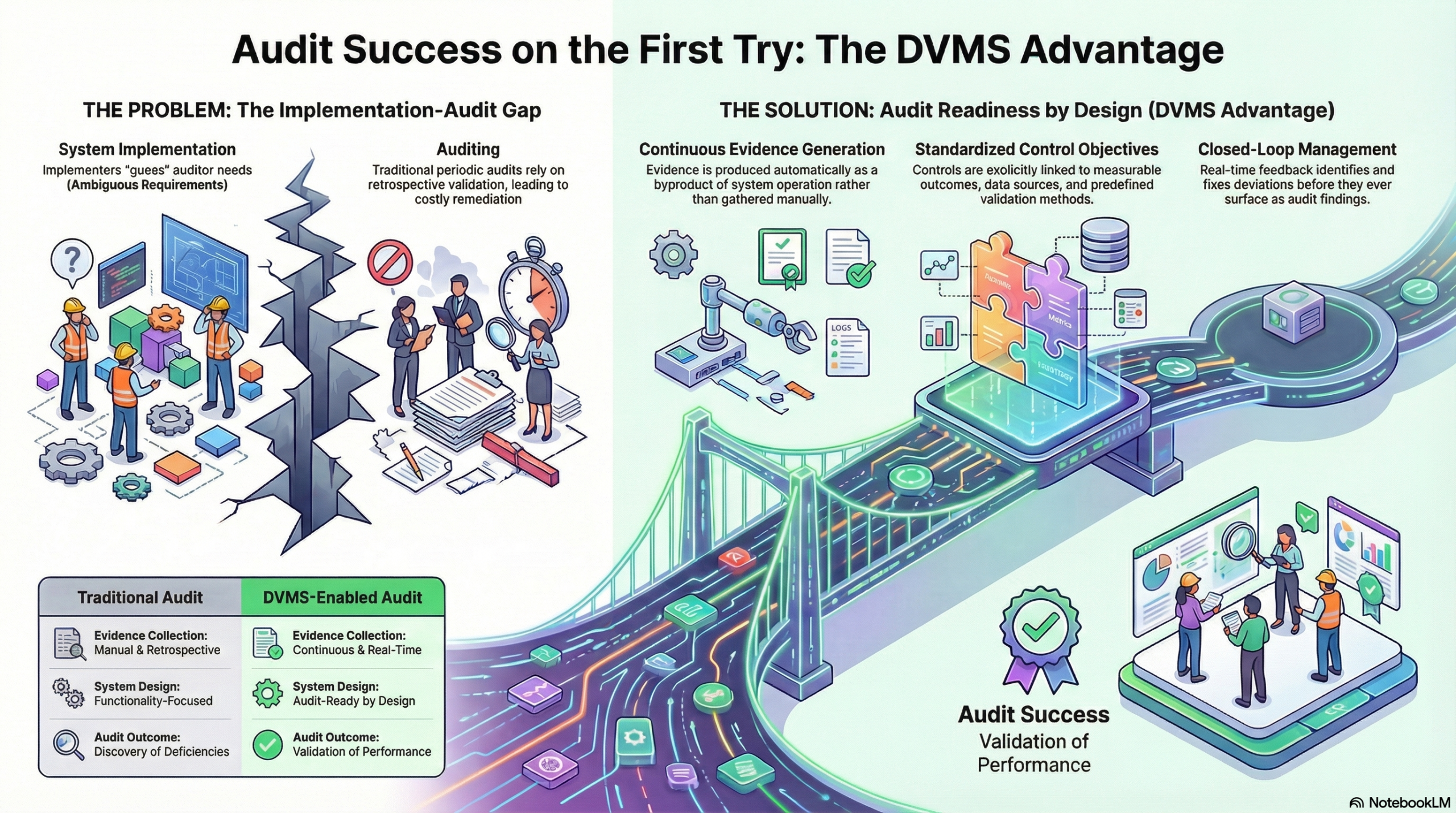
Most organizations do not lack frameworks. Instead, they face a more subtle issue: they have built up a system-of-systems without a clear system design.
Each framework, including NIST, ISO, ITIL, COBIT, and ESG standards, was entered into the organization for a good reason. Each tool was acquired to solve a real need. Each new risk, compliance, or assurance function was justified by genuine external pressure or internal events.
Over time, however, this layering forms a patchwork of overlapping control sets, inconsistent terminology, and unclear ownership. Cyber, IT operations, enterprise risk, compliance, audit, privacy, ESG, and legal each develop their own way of describing the world. Within each silo, the picture makes sense. Across the entire landscape, it becomes harder to answer basic questions:
Who is truly responsible for resilience in this value stream? Where do we observe the combined impact of technology risk, third-party risk, and conduct risk?
If we were to change this policy, would we understand how it would ripple through behavior, incentives, and delivery?
As an executive, you often have strong components that don’t come together to form a cohesive whole. Beneath that, there’s a deeper problem. The enterprise lacks a shared operating system, no simple, agreed-upon way to:
- organize all those frameworks and tools into a coherent capability model,
- connect that model to how the business actually creates value,
- and link governance decisions to real behavior in a transparent, repeatable way.
Without that operating system, GRC remains a collection of earnest and busy activities. It doesn’t yet function as a single, integrated, adaptive system. What is missing is not another framework. What is missing is a behavioral overlay: a way to see and manage the organization that unifies governance, risk, and compliance with culture, structure, and digital value.
The Goal Beyond GRC: Governance, Resilience, Assurance, and Accountability
When most executives approve investments in GRC, they are not thinking in terms of control libraries and maturity grids. They are aiming at something more ambitious, even if they don’t always give it a name.
At the top of the organization, the real goal looks more like this:
- Governance that is clear, coherent, and aligned with how the organization genuinely creates value.
- Resilience that is designed into products, services, and partnerships, not retrofitted after each incident.
- Assurance that is evidence-based, continuous, and sufficiently trusted that the board can make decisions with confidence.
- Accountability that is fair, transparent, and tied to fundamental decision rights, rather than scattered across charts and committees.
- Together, that is Governance, Resilience, Assurance, and Accountability—GRAA.
Many leaders assumed, quite reasonably, that investing in “modern GRC” would lead them to GRAA. What they have found is that while frameworks and platforms can support GRAA, they do not guarantee it. You can have perfect compliance and still be vulnerable. You can have excellent audit ratings and still be caught off guard.
GRAA is not a product. It is an outcome. Achieving it requires consistency in leadership signals, structures, and behavior across the entire digital value chain. That consistency is precisely what the current patchwork lacks.
A Different Way of Thinking: Enter the Digital Value Management System
This is where the Digital Value Management System, the DVMS, enters the conversation.
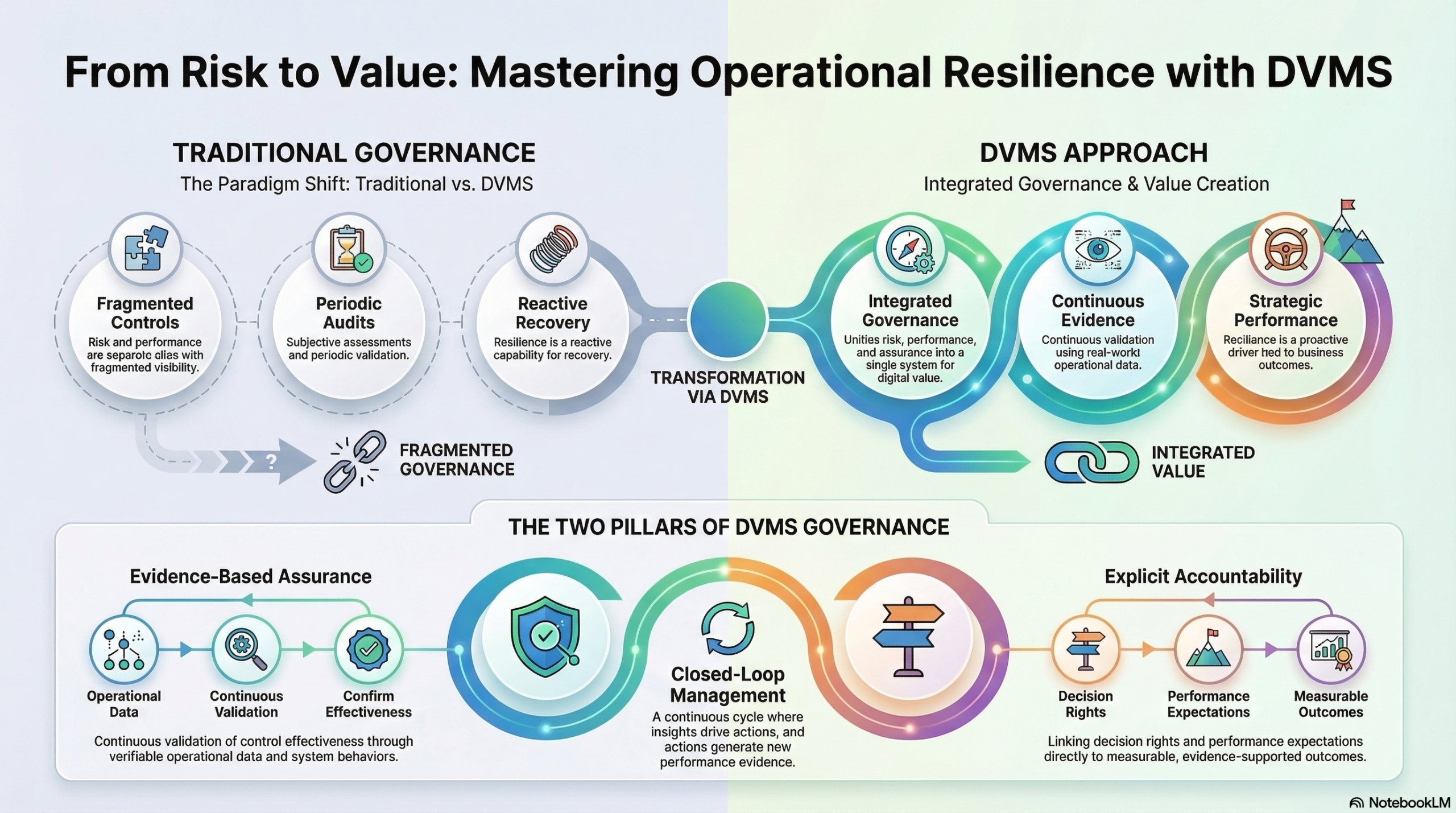
The DVMS isn’t a new framework to just add on. It’s an approach that views the organization as a complex adaptive system and offers an overlay, or operating model, for how all the existing pieces can work together.
At its core, the DVMS addresses three key areas that executives care deeply about.
First, it focuses attention on how the enterprise creates, protects, and delivers digital business value. Instead of viewing GRC as a separate domain, it integrates governance, risk, and assurance into the daily flow of value creation. GRC shifts from being about maintaining a distinct compliance sphere to about managing the digital business responsibly.
Second, it offers a simple, shared structure that allows you to map all existing frameworks and processes. Instead of existing in ten different dialects simultaneously, the organization gains a shared vocabulary for capabilities, roles, and responsibilities. Cyber, IT, operations, risk, and audit can still utilize their specialized tools and standards, but they interact through a unified overlay.
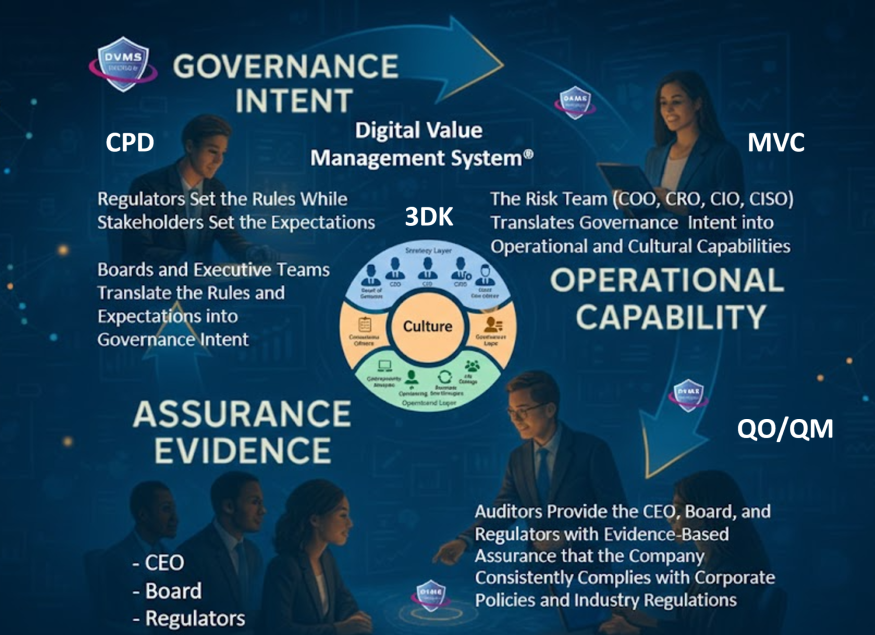
Third, it reveals the connections between leadership intent, organizational structure, and actual behavior. The DVMS does not view culture as a static entity on a wall. Instead, it considers culture as a pattern of behavior that emerges under stress and can be observed, understood, and managed. When leadership states one thing, structures reward another, and behavior follows a third logic, the DVMS provides a way to recognize and address that misalignment.
The key point is what DVMS does not require. It does not demand abandoning NIST, ISO, or ITIL. It does not force you to replace your GRC platforms. It does not expect executives to become experts in another specialized framework. Instead, it builds on what you already have and provides it with a solid foundation. Think of it as delivering your enterprise with the behavioral operating system that GRC 7.0 aspires to, but has not yet fully described.
From Problem Recognition to Practical Change
Executives are understandably cautious about grand transformation stories. Many have seen enough “next big thing” projects to be hesitant when someone proposes yet another reinvention. The move toward GRAA and an overlay like the DVMS isn’t about tearing everything down. It’s about rethinking and reconnecting with what you already have.
In practice, the journey often begins with a shift in perspective rather than a change in tools. Leaders start to ask different questions: not just “Do we have control here?” but “How does this control, or the lack of it, interact with the way this value stream is governed, structured, and actually behaves?” They assess risk and resilience based on how the organization creates, protects, and delivers value, rather than viewing these as separate categories.
From there, it becomes possible to align existing frameworks and processes into a simple, shared capability model, and to use that model for more explicit conversations about accountability, investment, and change. The upcoming articles in this series will delve more deeply into the overlay issue, examine culture as the most challenging control surface in your enterprise, and demonstrate how a minimal set of capabilities can provide the structure that has been missing.
For now, it is worth sitting with a simple, candid question: If your current GRC system were truly delivering the governance, resilience, assurance, and accountability you thought you were buying, would it still feel this fragile? If the answer is no, or even “I’m not sure,” then the issue is not your effort, your people, or your frameworks. It is the absence of a coherent operating model that allows all of that work to add up to more than the sum of its parts.
The DVMS was designed to be precisely that.
About the Author

Dave is the Executive Director of the DVMS Institute.
Dave spent his “formative years” on US Navy submarines. There, he learned complex systems, functioning in high-performance teams, and what it takes to be an exceptional leader. He took those skills into civilian life and built a successful career leading high-performance teams in software development and information service delivery.
Digital Value Management System® is a registered trademark of the DVMS Institute LLC.
® DVMS Institute 2026 All Rights Reserved