Beyond Compliance: Why UK Organizations Need More Than a Platform to Meet Provision 29
Rick Lemieux – Co-Founder and Chief Product Officer of the DVMS Institute
Introduction: From Compliance to Assurance
Provision 29 of the United Kingdom’s cyber and digital governance expectations represents a significant evolution in how organizations are expected to manage cybersecurity and resilience.
It is not simply a compliance obligation—it is a performance mandate. Provision 29 aligns closely with the six core functions of the NIST Cybersecurity Framework (CSF) 2.0—Govern, Identify, Protect, Detect, Respond, and Recover—each designed to ensure that organizations operate with governed, risk-informed, and continuously improving resilience postures.
While many organizations believe that implementing a digital platform or compliance tool will suffice to meet these requirements, this belief fundamentally misunderstands the intent of Provision 29. Compliance platforms can document controls, manage risk registers, or automate reporting, but they cannot build a culture of assurance, accountability, and continual improvement.
To truly fulfill Provision 29, UK organizations require an operational architecture—such as the Digital Value Management System (DVMS)—that integrates governance, assurance, and learning into a single, adaptive system.
Governance and Assurance: Leadership Beyond Tools
Provision 29 emphasizes that leadership must set clear risk management strategies, define accountability, and maintain oversight over cyber-risk activities. These expectations demand more than dashboards and compliance checklists; they require systems that make governance actionable and assurance measurable.
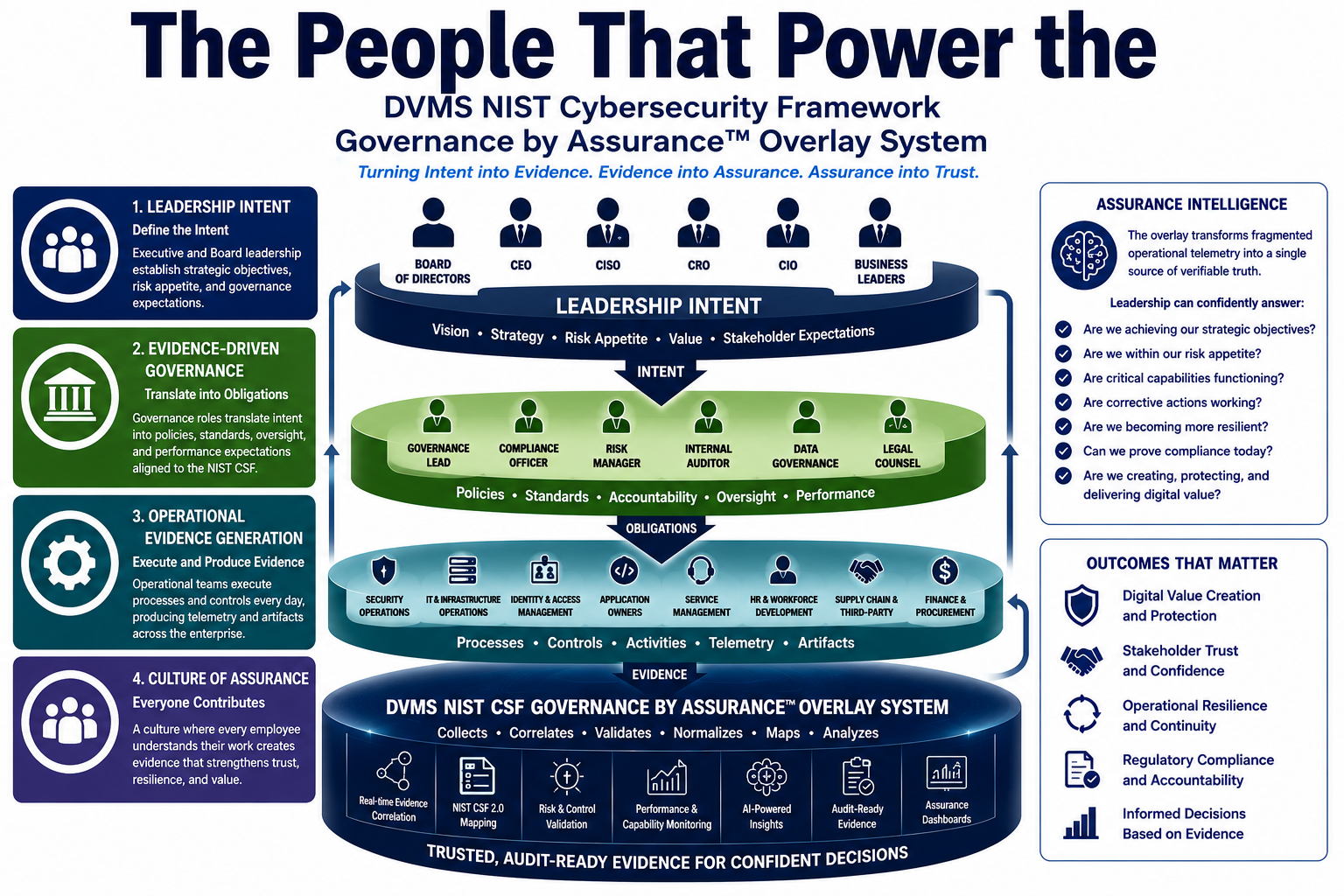
A platform may display compliance metrics, but governance is about intent—ensuring that policies and roles are translated into real-world behavior. The DVMS approach, with its “Govern” and “Assure” capabilities, operationalizes this intent by creating a closed feedback loop between policy and execution. Governance sets direction, while assurance verifies that the organization is “doing the right things the right way.”
This dual-loop model transforms oversight into a continuous, data-informed process. Rather than static compliance reports, leadership receives living assurance—evidence that strategy, risk, and operations remain aligned. This dynamic governance capability fulfills the core spirit of Provision 29 by demonstrating transparent accountability and evidence-based leadership rather than periodic conformity.
Strategy and Risk Integration: From Fragmentation to Alignment
Provision 29 calls for the integration of cybersecurity into enterprise risk management, treating it as a business enabler rather than a compliance burden. Traditional compliance platforms often treat cybersecurity as a separate function, managing threats and controls independently of strategic planning. This fragmentation undermines resilience because it disconnects risk from the value creation process.
The DVMS unites strategy and risk management into what it calls “strategy-risk”—a single decision system where business objectives, risk appetite, and constraints coexist. This integration ensures that every investment, process, and initiative aligns with both business value and acceptable risk tolerance.
Through its “Plan” and “Design” capabilities, the DVMS translates governance policies into measurable objectives and embeds them into the organizational architecture—its systems, workflows, and culture. This design-driven approach means security and resilience are built in, not bolted on. It enables organizations to demonstrate that cybersecurity governance is contextually grounded, strategically integrated, and continuously improved—precisely what Provision 29 expects.
Continuous Resilience: Operationalizing Change and Execution
Compliance platforms are static—they record the present state of controls but struggle to manage change dynamically. Provision 29, however, requires organizations to monitor, adapt, and improve their cyber resilience continuously. This expectation shifts the focus from compliance to evidence-based continuous assurance.
The DVMS addresses this through its “Change” and “Execute” capabilities, which together create a governance and execution loop. “Change” reflects an organization’s adaptive capability—the ability to evolve processes, behaviors, and controls in response to new threats or insights. “Execute” ensures that day-to-day operations deliver secure, resilient outcomes across people, processes, and technology.
This cycle of change and execution operationalizes the NIST CSF’s Identify–Protect–Detect–Respond–Recover functions in a coordinated, ongoing manner. Rather than achieving compliance once a year, organizations demonstrate continual improvement through measurable performance outcomes. In essence, DVMS enables UK organizations to replace episodic compliance audits with ongoing evidence of resilience—a direct embodiment of Provision 29’s intent.
Innovation as a Governance Capability
Provision 29 and NIST CSF 2.0 both recognize the necessity of learning and adaptation. In a rapidly evolving threat landscape, no compliance platform can anticipate every new risk. Therefore, organizations must embed innovation—not as a side function but as a core governance mechanism.
The DVMS’s “Innovate” capability provides a structured method for continuous learning and improvement. It identifies four levels of innovation—incremental, sustaining, adaptive, and disruptive—each contributing to growth in maturity. Using the Goal–Question–Metric (GQM) approach, DVMS transforms innovation from an abstract ideal into quantifiable behavior. Metrics track how governance evolves, how assurance processes adapt, and how organizational culture learns.
This capability ensures that learning is not reactive but anticipatory. It empowers organizations to proactively evolve their governance structures, transforming Provision 29’s call for continual improvement into a measurable, cultural norm.
Culture as a Measurable Asset
Perhaps the most overlooked aspect of Provision 29 is culture. The regulation implicitly requires that cybersecurity and governance be underpinned by human and organizational factors, including communication, collaboration, and learning. No technology platform can create these dynamics.
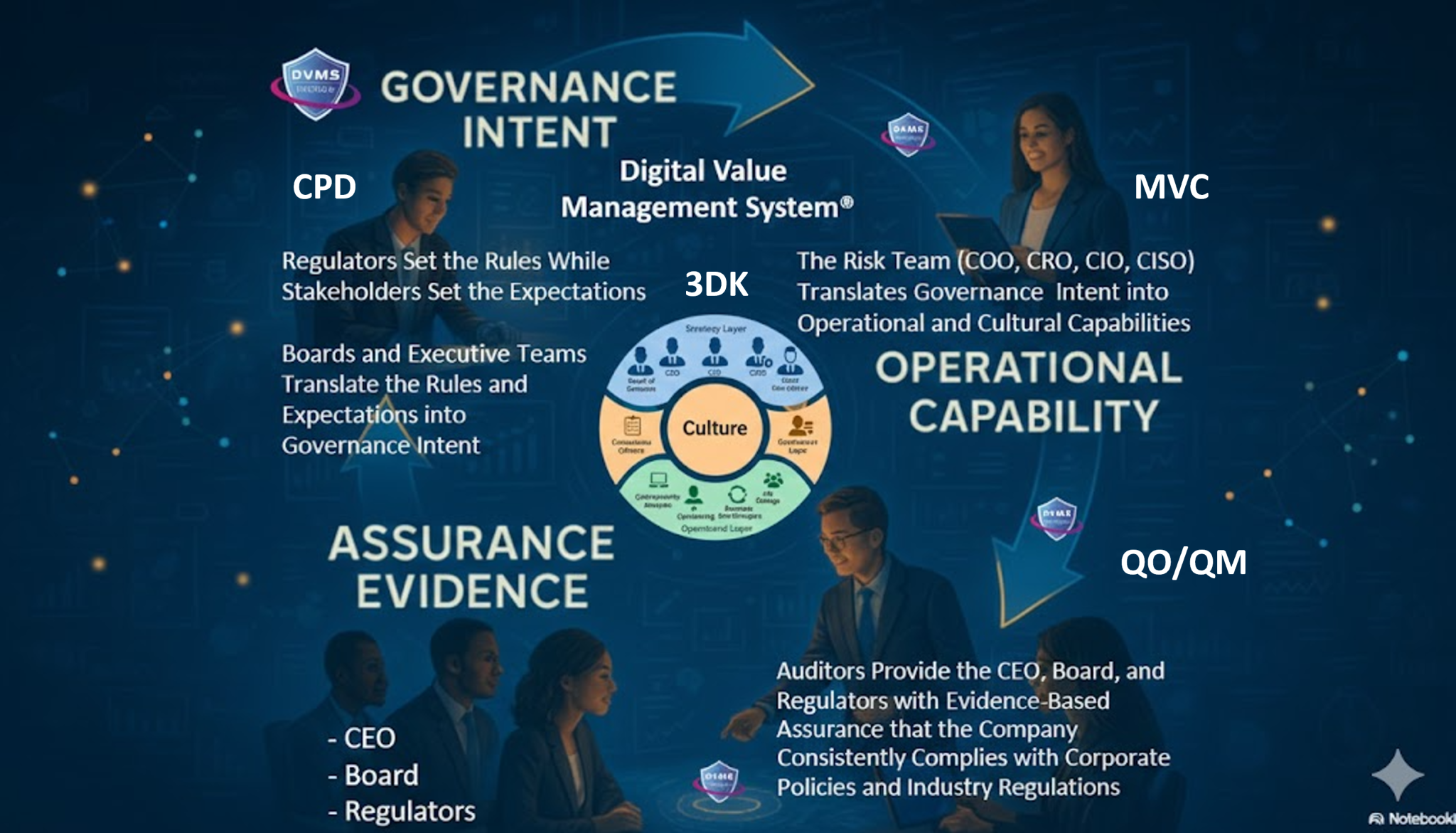
The DVMS addresses this through its 3D Knowledge Model, which makes culture observable and measurable. The model’s three axes—Knowledge Flow (past–present–future learning), Collaboration Flow (cross-functional cooperation), and Alignment Flow (strategic-operational coherence)—visualize how knowledge and decision-making flow through the enterprise.
By transforming cultural elements into measurable components of governance, the DVMS enables leadership to monitor how effectively teams learn from the past, collaborate in the present, and align for the future. This makes cultural assurance as tangible as operational assurance, fulfilling Provision 29’s expectation for accountability and continual learning.
The Create–Protect–Deliver Cycle: A Living System of Assurance
Underlying the DVMS architecture is the Create–Protect–Deliver (CPD) model—a behavioral engine that ensures all activities contribute to value creation and protection simultaneously. This cycle mirrors the concurrent nature of the NIST CSF functions and provides a practical mechanism for implementing Provision 29 outcomes.
In this model:
- Create represents innovation and the generation of digital value.
- Protect embeds assurance and resilience into every activity.
- Deliver ensures strategic outcomes translate into measurable stakeholder value.
Unlike the linear “plan-implement-comply” sequence typical of compliance tools, the DVMS CPD Model operates as a dynamic feedback loop. It ensures that governance, assurance, and learning remain in sync at all times. As a result, organizations demonstrate not just compliance but continual alignment between risk management, performance, and culture—a hallmark of Provision 29 maturity
Why Platforms Fall Short
Compliance platforms serve an essential but limited purpose. They help automate reporting, centralize evidence, and standardize workflows. Yet they cannot achieve the behavioral transformation that Provision 29 requires. Compliance can be automated, but assurance must be lived.
Platforms manage information; systems like DVMS manage relationships—between strategy and risk, policy and execution, leadership and culture. Provision 29 is not about having the right tool but about demonstrating that cybersecurity and resilience are governed, assured, and continually improved through a living system of feedback and accountability.
This is why UK organizations need more than platforms—they need systems that integrate human judgment, organizational learning, and dynamic governance. The DVMS achieves this by embedding assurance into the DNA of operations rather than layering it on top of them.
Conclusion: Assurance by Design
Provision 29 marks the UK government’s shift from compliance to assurance, from control-checking to outcome-measuring. While compliance platforms can help track activities, they cannot ensure that governance intent translates into resilient performance.
The Digital Value Management System bridges that gap. It unifies governance, assurance, and culture into one adaptive overlay system that operationalizes the outcomes of Provision 29 and the NIST CSF 2.0. It makes governance measurable, assurance continuous, and learning a cultural practice.
For UK organizations, the path to compliance with Provision 29 does not lie in acquiring another platform but in adopting an assurance system that evolves with their business. By doing so, they not only fulfill the letter of Provision 29 but also its spirit—to become trusted, resilient, and performance-assured digital enterprises capable of thriving in uncertainty.
About the Author

Rick Lemieux
Co-Founder and Chief Product Officer of the DVMS Institute
Rick has 40+ years of passion and experience creating solutions to give organizations a competitive edge in their service markets. In 2015, Rick was identified as one of the top five IT Entrepreneurs in the State of Rhode Island by the TECH 10 awards for developing innovative training and mentoring solutions for boards, senior executives, and operational stakeholders.
Digital Value Management System® is a registered trademark of the DVMS Institute LLC.
® DVMS Institute 2026 All Rights Reserved